
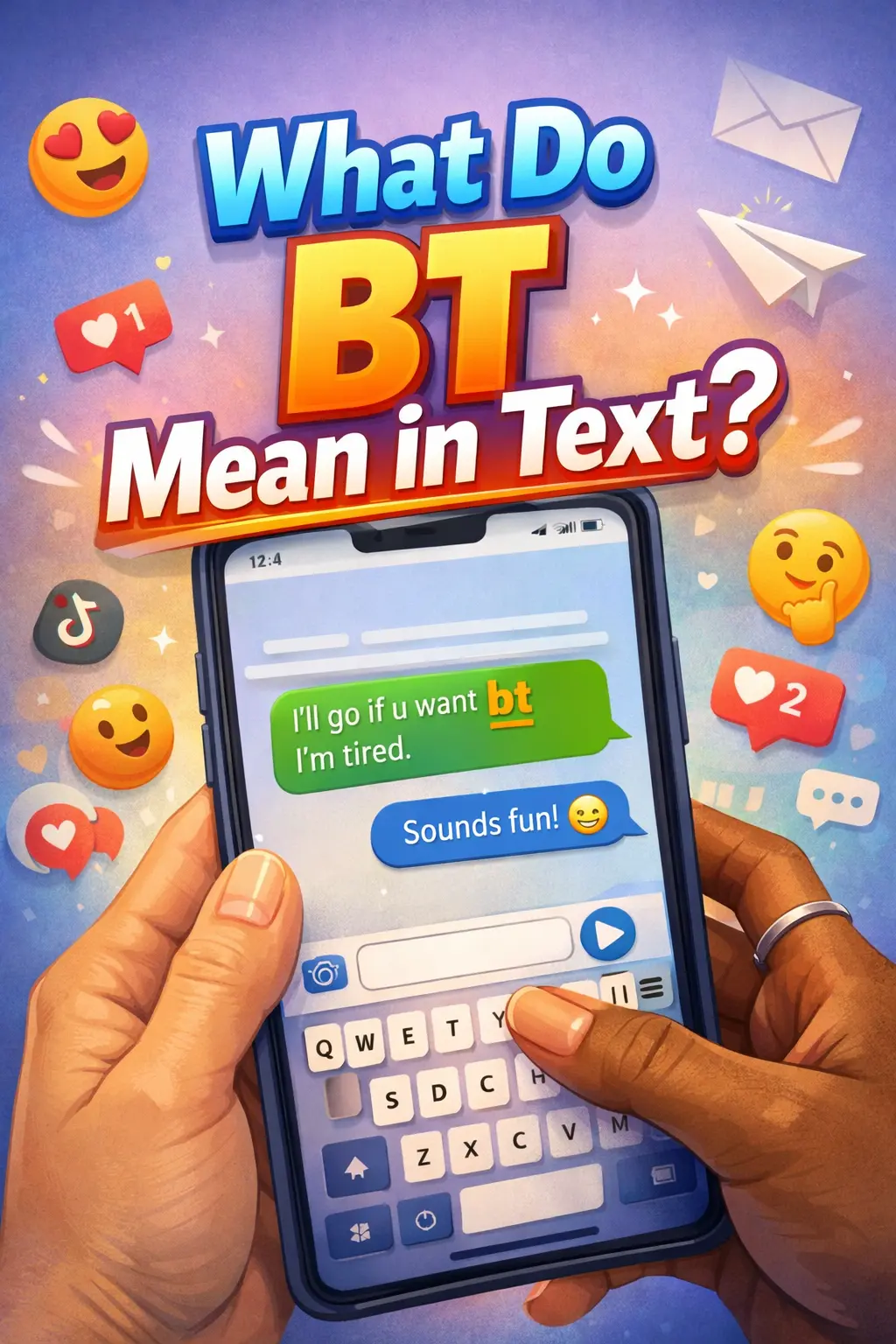
If you’ve ever received a message that simply said “bt” and paused for a second, you’re not alone.
Text slang moves fast. What feels obvious to one person can feel confusing to another. That’s exactly why so many people search for what do bt mean in text — because context changes everything.
Is it a typo?
Is it shorthand?
Is it emotional?
Is it rude?
In this guide, I’ll break it down clearly, naturally, and honestly — the way a communication expert would explain it to a friend.
By the end, you’ll understand:
- What “bt” actually means
- Where it came from
- How people use it in real conversations
- When you should (and shouldn’t) use it
- And how to respond confidently
Let’s clear it up.
What Do BT Mean in Text – Quick Meaning
In texting and online messaging, “bt” most commonly means:
- “But” (shortened for speed)
- Occasionally “back then”
- Rarely used as a typo for “bit”
Most of the time, it simply replaces “but” to save time while typing.
Quick Examples:
- “I wanted to come bt I was busy.”
- “It looks good bt idk.”
- “I like him bt…”
Notice how it acts as a connector — usually introducing contrast, hesitation, or emotional tension.
That small two-letter shortcut can completely shift the tone of a sentence.
Origin & Background
Unlike flashy slang terms, “bt” didn’t start as a trend. It evolved from speed and convenience.
Early Texting Culture
Back in early SMS days:
- Character limits mattered.
- Keypads were slower.
- Abbreviations became normal.
Words like:
- “u” for you
- “r” for are
- “bt” for but
became part of everyday digital speech.
Social Media Acceleration
As platforms like:
- TikTok
grew, shorter messaging styles spread quickly.
On fast-moving comment sections and DMs, speed often wins over grammar.
How Meaning Evolved
Originally just a typing shortcut, “bt” now sometimes carries tone:
- It can soften criticism.
- It can signal hesitation.
- It can hint at emotional conflict.
Example:
“I like you bt I’m not ready.”
That “bt” holds weight.
It’s small — but emotionally loaded.
Real-Life Conversations (How It Actually Appears)
Here’s how it looks in real conversations.
1. WhatsApp Conversation
Person A: Are you coming tonight?
Person B: I want to bt I have an exam tomorrow.
Notice how “bt” softens the disappointment.
2. Instagram DM
Person A: You looked amazing in that photo.
Person B: Aww thank you bt I felt awkward 😅
Here, “bt” introduces vulnerability.
3. TikTok Comments
Commenter 1: This song is perfect.
Commenter 2: It’s good bt the old version hits harder.
It shows disagreement — but casually.
4. Text Message Between Friends
Person A: So you’re officially done with him?
Person B: Yeah bt it still hurts.
Now the word carries emotion. It reveals unfinished feelings.
That’s the hidden power of “bt” — it often signals something unresolved.
Emotional & Psychological Meaning
“Bt” usually appears when someone feels tension.
It often introduces:
- Doubt
- Conflict
- Soft disagreement
- Emotional honesty
When someone types “bt,” they’re usually balancing two feelings.
Example:
“I’m happy bt scared.”
It shows emotional complexity.
Why People Use It
- Faster typing
- Casual tone
- Less confrontational than fully writing “but”
- Feels softer in informal chats
What It Reveals About Modern Communication
We communicate faster than we process.
Abbreviations like “bt” reflect:
- Quick emotional expression
- Low-pressure conversation style
- Digital intimacy
I once saw a student text:
“I trust you bt idk why I feel insecure.”
That small “bt” told me more than the rest of the sentence.
It was hesitation. Vulnerability. Real emotion.
In modern texting, small words carry big weight.
Usage in Different Contexts
1. Social Media
Common and acceptable.
Used in:
- Comments
- DMs
- Casual captions
Example:
“Love this trend bt it’s everywhere now.”
2. Friends & Relationships
Very common.
It introduces:
- Gentle disagreement
- Mixed feelings
- Emotional honesty
Example:
“I miss you bt I need space.”
3. Work / Professional Settings
Not recommended.
In professional emails or formal chats, write the full word “but.”
Example (correct):
“I understand your point, but we need more data.”
Avoid:
“I understand bt…”
It looks careless in professional settings.
4. Casual vs Serious Tone
Casual: Perfectly fine.
Serious discussions: Better to write the full word.
Tone matters.
When NOT to Use It
There are moments when “bt” can feel inappropriate.
Avoid Using It:
- In job applications
- In academic writing
- In formal presentations
- In sensitive emotional conversations
Example:
Wrong tone:
“I’m sorry bt it’s your fault.”
That feels dismissive.
In serious emotional situations, clarity matters more than speed.
Common Misunderstandings
1. Thinking It Means Something Deeper
Most of the time, it’s just “but.”
Don’t overanalyze unless context suggests emotion.
2. Confusing It with “Back Then”
Sometimes “bt” can mean “back then.”
Example:
“Bt we used to talk every day.”
Here, context clarifies meaning.
3. Tone Confusion
Without punctuation, it can feel blunt.
“I like it bt.”
That sounds unfinished.
Tone in text depends heavily on context and relationship.
Comparison Table
| Expression | Meaning | Tone | Usage Level |
|---|---|---|---|
| BT | Short for “but” | Casual | Informal |
| But | Standard connector | Neutral | All settings |
| Tho | Soft contrast | Light | Informal |
| However | Formal contrast | Professional | Formal |
| Although | Subtle contrast | Neutral | Semi-formal |
Key Insight
“Bt” isn’t different in meaning — it’s different in tone. It signals informality and speed, not a new definition.
Variations & Related Forms (10 Common Ones)
- Btw – By the way (adds extra info)
- Bc – Because (casual explanation)
- Idk – I don’t know (uncertainty)
- Ikr – I know right (agreement)
- Tho – Though (soft contrast)
- Tbh – To be honest (honesty signal)
- Nvm – Never mind (dismissal)
- Smh – Shaking my head (disapproval)
- Ong – On God (serious emphasis)
- Fr – For real (agreement or emphasis)
These often appear in the same conversational style as “bt.”
How to Respond When Someone Uses “BT”
Your response depends on tone.
Casual Replies
- “Haha I get that.”
- “Yeah bt what happened?”
Funny Replies
- “That ‘bt’ sounds serious 👀”
- “There’s always a bt 😂”
Mature Replies
- “It sounds like you’re feeling conflicted.”
- “Do you want to talk about it?”
Respectful Replies
- “I understand. Take your time.”
- “Thanks for being honest.”
Respond to the emotion, not just the word.
Regional & Cultural Usage
Western Culture
Very common in informal texting.
Especially among younger users.
Asian Culture
Used mostly in English-language chats.
Formal communication still prefers full words.
Middle Eastern Culture
Common in youth texting, especially bilingual speakers mixing Arabic and English.
Global Internet Usage
On global platforms like Reddit and Snapchat, abbreviations dominate casual exchanges.
Speed shapes language.
Generational Differences
Gen Z:
Comfortable with heavy abbreviation. “Bt” feels normal.
Millennials:
Understand it but may type the full word.
Older Generations:
Less likely to use it, may view it as informal or careless.
Language reflects identity.
Is It Safe for Kids?
Yes.
“Bt” is not offensive or harmful.
It’s simply a shortcut for “but.”
However, context still matters. Kids should understand when to switch to full words in academic or formal settings.
Teaching digital tone awareness is more important than banning abbreviations.
FAQs
1. What do bt mean in text from a girl?
Usually just “but.” It may introduce emotional contrast or hesitation.
2. Does bt mean back then?
Sometimes, yes. Context determines meaning.
3. Is bt rude?
No. It’s informal, not rude.
4. Should I use bt in professional emails?
No. Always write the full word “but.”
5. Why do people shorten but to bt?
Speed and casual texting culture.
6. Is bt a Gen Z slang?
It’s common among Gen Z but not exclusive to them.
Conclusion
So, what do bt mean in text?
Most of the time, it simply means “but.”
But — and this is important — it often carries emotional nuance.
It signals contrast.
It reveals hesitation.
It sometimes hints at deeper feelings.
In casual conversations, it’s perfectly normal.
In professional settings, write the full word.
Language is evolving.
Abbreviations aren’t ruining communication — they’re reshaping it.
Use “bt” confidently when the context is right.
And when you see it, pay attention to what comes after it.
That’s usually where the real meaning begins.