
If you have ever received a simple “copy” in a message, you probably paused for a second.
Was it serious?
Was it annoyed?
Was it just confirming something?
That tiny word carries more weight than it seems. Many people search for what does copy mean in text because it feels direct, almost military, and sometimes emotionally neutral. It can sound professional, distant, efficient, or even cold depending on the situation.
In this article, I will break it down in a clear and human way. You will understand exactly what it means, where it came from, how people use it today, and how to respond without overthinking it.
Let’s simplify it.
What Does Copy Mean in Text – Quick Meaning
In texting, “copy” means “I understand” or “message received.”
It is a confirmation word.
People use it to signal that they have read and acknowledged the information.
Simple definition:
- It means “I got it.”
- It confirms understanding.
- It often ends the conversation efficiently.
Example messages:
- “Meeting moved to 4 PM.”
“Copy.” - “Send the file before noon.”
“Copy.” - “Don’t forget to call mom.”
“Copy.”
Notice something? It does not express emotion. It expresses acknowledgment.
That is why tone matters.
Origin and Background of “Copy”
The word “copy” in this sense comes from radio communication.
In military and aviation settings, operators would say “copy that” to confirm they received a transmission clearly. It was fast, clear, and practical. No extra words. No confusion.
Over time, this phrase moved into everyday language through:
- Military movies
- Police dramas
- Aviation culture
- Action films
- Corporate communication
As texting became more common, people shortened “copy that” to just “copy.”
Social media accelerated this shift. Platforms like Instagram, TikTok, and WhatsApp made short replies normal. Quick confirmation became part of digital etiquette.
Today, “copy” is widely used in:
- Work chats
- Gaming communities
- Team coordination
- Casual conversations
Its meaning has stayed consistent, but its tone has evolved. Now it can feel efficient, cool, dry, or even slightly robotic depending on who says it.
Real-Life Conversations
Here are realistic examples from different platforms.
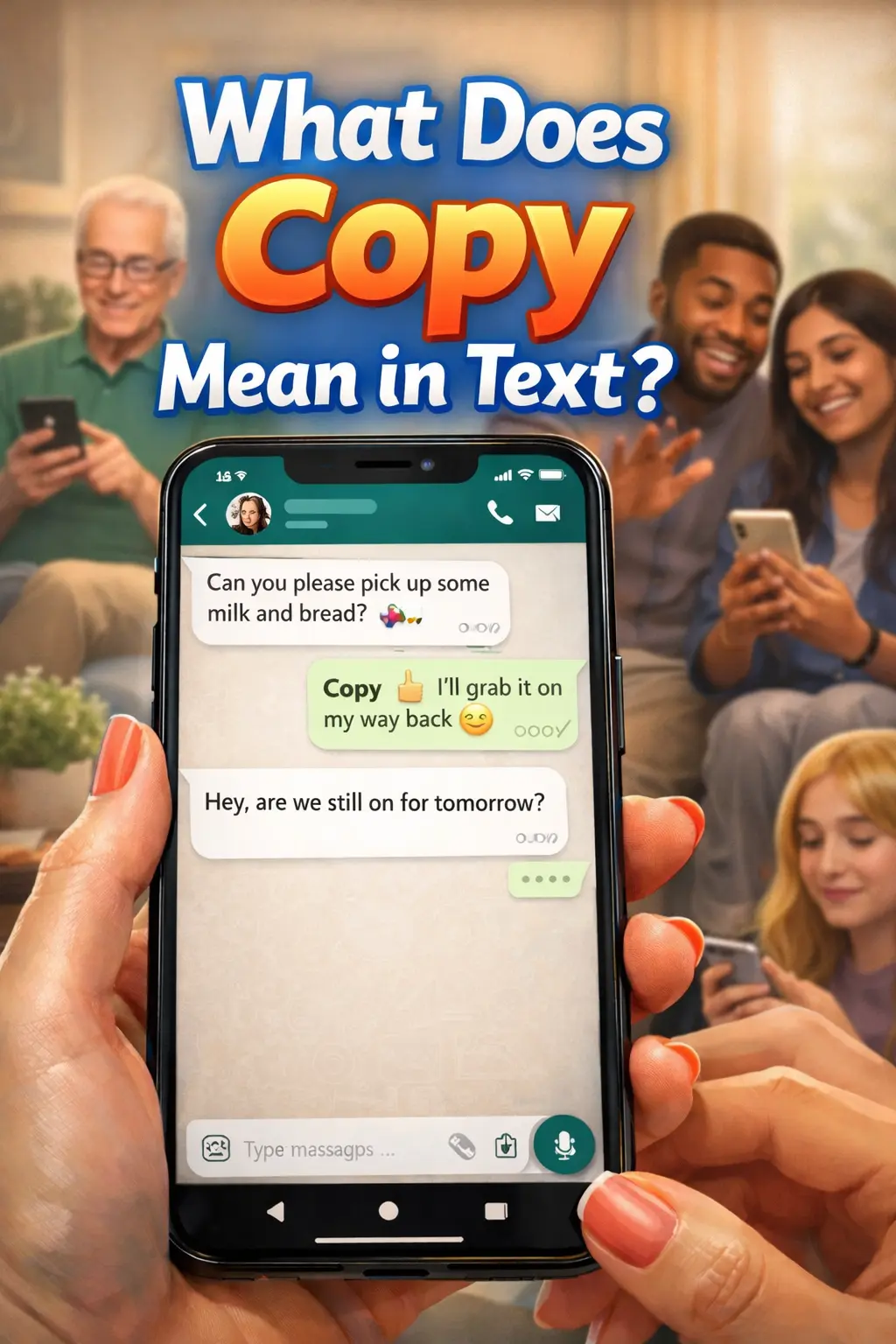
WhatsApp Conversation
Person A: “Can you grab milk on your way home?”
Person B: “Copy.”
This feels efficient. No extra emotion. Just confirmation.
Instagram DMs
Person A: “Let’s post the reel at 7 PM instead.”
Person B: “Copy. I’ll schedule it.”
Here it sounds organized and professional.
TikTok Comments
Creator: “Part 2 dropping tomorrow at 6.”
Follower: “Copy. I’m ready.”
In this case, it feels playful and engaged.
Text Message Between Friends
Person A: “Don’t tell Sarah about the surprise party.”
Person B: “Copy.”
This can feel serious. Almost secretive. That is where tone becomes interesting.
Emotional and Psychological Meaning
Even though “copy” looks neutral, it carries subtle psychological signals.
It can communicate:
- Efficiency
- Authority
- Emotional distance
- Professional focus
- Control
People who use “copy” often want clarity and minimal back and forth. It reflects a mindset that values directness.
In my experience as a communication educator, I have seen “copy” used heavily in high-pressure environments. One of my former students worked in event management. During live event coordination, her team used “copy” constantly. No emojis. No extra words. Just fast acknowledgment.
In stressful situations, simplicity reduces confusion.
But outside serious contexts, it can feel cold.
That is why context matters more than the word itself.
Usage in Different Contexts
1. Social Media
On social platforms, “copy” often feels playful or ironic.
It may mimic military style for humor.
It can signal excitement or readiness.
Example:
“New merch dropping Friday.”
“Copy. Wallet ready.”
2. Friends and Relationships
Among friends, it can feel cool and efficient.
But in emotional conversations, it may seem dismissive.
If someone says:
“I’m really stressed lately.”
Replying with “Copy.” would feel emotionally flat.
3. Work or Professional Settings
In workplace chats, “copy” works well.
It signals:
- You received instructions
- You understand the task
- You will act on it
It is clean and respectful when used properly.
4. Casual vs Serious Tone
Casual setting
It can be playful.
Serious setting
It can feel authoritative or official.
Tone depends on relationship and situation.
When NOT to Use It
There are situations where “copy” is inappropriate.
- During emotional conversations
- When someone is sharing vulnerable feelings
- In romantic or sensitive discussions
- In formal emails
- With someone unfamiliar who might misread tone
For example, if someone texts:
“My dog passed away today.”
Responding with “Copy.” would seem insensitive.
Language should match emotional weight.
Common Misunderstandings
Many people misinterpret “copy” as:
- Rudeness
- Sarcasm
- Annoyance
- Passive aggression
In reality, it usually just means acknowledgment.
The confusion happens because text lacks vocal tone and facial expression.
Another misunderstanding is thinking it means “I agree.”
It does not necessarily mean agreement. It only confirms receipt.
Literal meaning: message received.
Figurative interpretation: depends on context.
Comparison Table
| Expression | Meaning | Tone | Usage Context |
|---|---|---|---|
| Copy | I understand | Neutral, direct | Work, coordination |
| Got it | I understand | Friendly | Casual, everyday |
| Roger | Message received | Playful, military style | Humor, gaming |
| Noted | Acknowledged | Professional | Emails, work |
| Understood | Clear confirmation | Formal | Business settings |
| Ignored | No response | Negative | Conflict |
| Disagree | Opposite meaning | Direct | Debate |
Key Insight
“Copy” is about acknowledgment, not emotion. If you want warmth, choose a warmer alternative.
Variations and Types
Here are common variations you may see:
- Copy that
Stronger confirmation, more traditional. - Copy ✔️
Adds visual confirmation. - Copy loud and clear
Emphasizes clarity. - Roger that
Military-inspired alternative. - Copy boss
Respectful tone, often playful. - Copy chief
Casual and friendly. - Copy sir
Formal, sometimes humorous. - Copy mate
Informal, friendly. - Hard copy
Usually literal, referring to physical document. - Copy received
More formal workplace phrasing.
Each variation slightly shifts tone.
How to Respond When Someone Uses It
If someone texts “copy,” how should you respond?
Casual Replies
- “Cool.”
- “Thanks.”
- “Appreciate it.”
Funny Replies
- “Over and out.”
- “Mission accepted.”
- “Agent activated.”
Mature Replies
- “Let me know if you need clarification.”
- “Great, thank you.”
Respectful Replies
- “Thank you for confirming.”
- “Much appreciated.”
Match your response to context and relationship.
Regional and Cultural Usage
Western Culture
In the United States and Europe, “copy” often reflects military and corporate influence. It is common in startups and team environments.
Asian Culture
In many Asian workplaces, English business communication uses “noted” more than “copy.” However, younger generations online use “copy” casually.
Middle Eastern Culture
Direct English confirmations like “copy” are common in professional settings, especially in tech and logistics sectors.
Global Internet Usage
Gaming communities worldwide use “copy” and “roger” frequently during team play. It feels coordinated and efficient.
Generational Differences
Gen Z
Uses it playfully or ironically.
Millennials
Use it in work chats and practical communication.
Older generations
May find it too abrupt or unfamiliar.
Language evolves with culture.
Is It Safe for Kids?
Yes, “copy” is safe.
It contains no inappropriate meaning. It simply confirms understanding.
However, children should learn context awareness. Using “copy” with teachers or elders may feel too casual depending on cultural norms.
Teaching tone sensitivity is more important than banning words.
FAQs
1. Does copy mean yes?
Not exactly. It means “I received and understood.” It does not automatically mean agreement.
2. Is copy rude in text?
No, but it can feel cold if used during emotional conversations.
3. What is the difference between copy and got it?
“Got it” feels warmer and more conversational. “Copy” feels sharper and more direct.
4. Is copy formal?
It is semi-formal. It works best in professional chats or coordination settings.
5. Why do gamers say copy?
It comes from radio communication culture and signals clear team coordination.
6. Can copy be sarcastic?
Yes, if tone suggests it. Context determines interpretation.
Conclusion
So what does copy mean in text?
At its core, it means one simple thing: message received and understood.
But like many short digital expressions, its emotional tone depends entirely on context. It can feel efficient, playful, serious, or distant.
The key is awareness.
Before using “copy,” ask yourself:
Is this a moment for efficiency?
Or a moment for empathy?
When used thoughtfully, it becomes a powerful, clear communication tool. And when understood correctly, it stops feeling cold and starts feeling purposeful.
Language is not just about words. It is about intention.
Use it with confidence.