
In today’s fast-moving digital conversations, abbreviations pop up everywhere. Some are easy to guess, while others leave you staring at your screen wondering what you just read. One of those is “ITM.”
If you’ve come across this term in a message, comment, or DM, you’re not alone. Many people search for what it means because it can feel unclear depending on context. That confusion is exactly what we’re going to clear up here.
By the end of this guide, you’ll not only understand what “ITM” means, but also when to use it, how to respond to it, and what it reveals about modern communication.
ITM – Quick Meaning
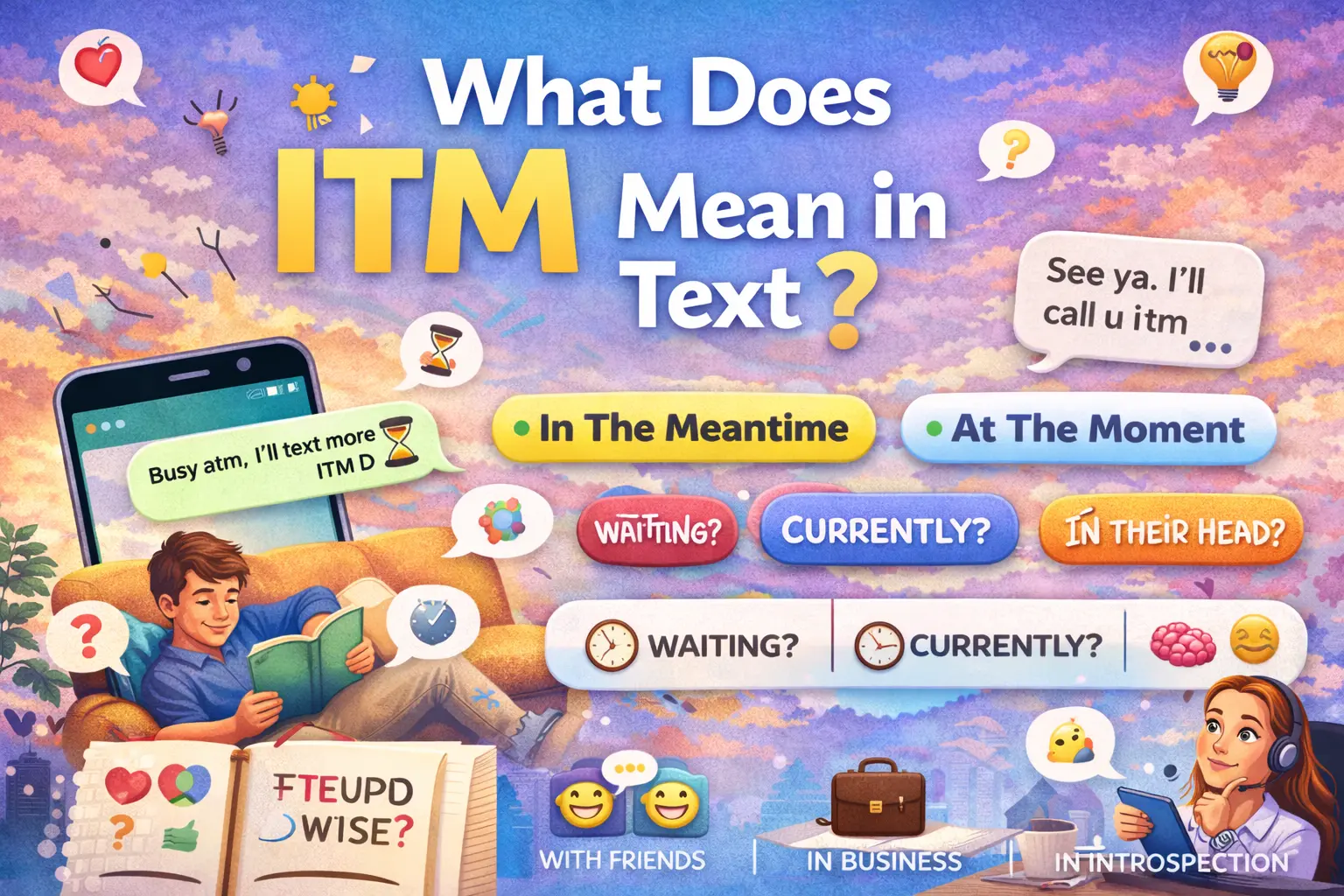
ITM most commonly means:
- “In The Moment”
- Sometimes used to describe being fully present or reacting instantly
Simple examples:
- “I didn’t think about it, I just said it ITM.”
- “That feeling was so real ITM.”
- “I was nervous ITM but it worked out.”
At its core, ITM is about immediacy. It captures thoughts, emotions, or actions that happen without overthinking.
Origin & Background
ITM doesn’t have a single clear origin like some older internet slang. Instead, it emerged naturally as texting became faster and more emotional.
As platforms like WhatsApp, Instagram, and TikTok encouraged quick reactions, people started shortening phrases that expressed real-time feelings. “In the moment” became “ITM” simply because it was quicker to type and matched the speed of conversation.
Its rise is closely tied to how people now communicate:
- Shorter attention spans
- Real-time emotional sharing
- Casual tone dominating digital spaces
Unlike older abbreviations that were purely functional, ITM carries emotional weight. It reflects how people want to capture raw, unfiltered experiences instantly.
Real-Life Conversations
To truly understand ITM, you need to see how it’s used in everyday chats.
WhatsApp Conversation
Person A: Why did you agree so fast?
Person B: I don’t know, it just felt right ITM.
Instagram DM
Person A: That caption was deep
Person B: Honestly, I wrote it ITM without thinking
TikTok Comments
User 1: This video hit different
User 2: Same, I almost cried ITM
Text Message
Person A: You seemed really confident today
Person B: I was actually scared ITM but didn’t show it
These examples show how ITM adds emotional honesty. It explains actions or feelings that weren’t planned.
Emotional & Psychological Meaning
ITM is more than just shorthand. It reveals something deeper about how people experience and express emotions today.
When someone uses ITM, they are often:
- Admitting vulnerability
- Explaining impulsive behavior
- Sharing authenticity
It signals that the moment took over logic.
In a world where people often curate their online presence, ITM creates a sense of realness. It says, “This wasn’t planned. This was me being human.”
A real-life style scenario
Imagine you send a risky message to someone you like. Later, you explain:
“I didn’t mean to say all that, I just felt it ITM.”
That one phrase softens everything. It shows honesty without fully committing to the emotion long-term.
Usage in Different Contexts
Social Media
ITM is widely used in captions and comments to describe emotional reactions.
Example: “I didn’t expect to feel this way ITM.”
Friends & Relationships
Among friends, it explains spontaneous decisions or feelings.
Example: “I said that ITM, don’t take it too seriously.”
Work / Professional Settings
ITM is rarely appropriate in formal communication. It can feel too casual or unclear.
Instead of: “I decided ITM”
Say: “I made a quick decision at the time.”
Casual vs Serious Tone
- Casual: Adds relatability and honesty
- Serious: Can sound like avoiding responsibility
Tone depends heavily on context and relationship.
When NOT to Use It
There are situations where ITM can backfire.
- Formal emails or meetings
- Serious arguments where clarity matters
- Cross-cultural conversations where slang may confuse
- Professional decisions requiring accountability
Using ITM in the wrong context can make you seem careless or vague.
Common Misunderstandings
Many people misinterpret ITM because it is context-driven.
1. Thinking it has one fixed meaning
It mainly means “in the moment,” but tone changes everything.
2. Assuming it removes responsibility
Some people use ITM to justify actions, which can sound dismissive.
3. Confusing tone
It can sound emotional, defensive, or honest depending on how it’s used.
4. Taking it too literally
It is not always about time. Sometimes it is about emotional state.
Comparison Table
| Expression | Meaning | Tone | Usage |
|---|---|---|---|
| ITM | In the moment | Emotional, spontaneous | Explaining actions or feelings |
| IMO | In my opinion | Neutral | Sharing thoughts |
| IDC | I don’t care | Dismissive | Showing indifference |
| YOLO | You only live once | Bold, risky | Justifying actions |
| BRB | Be right back | Functional | Temporary pause |
Key Insight
ITM stands out because it blends emotion with timing. It is not just about when something happened, but how deeply it was felt in that moment.
Variations / Types
Here are some related or slightly adapted forms you might see:
- ITM fr – In the moment, for real
- ITM rn – In the moment right now
- ITM vibes – Describing emotional energy
- ITM decision – A spontaneous choice
- ITM feeling – A raw emotional response
- ITM reaction – Immediate response without thinking
- ITM energy – Acting based on current mood
- ITM mood – Temporary emotional state
- ITM thoughts – Unfiltered thinking
- ITM moment – Highlighting a powerful experience
Each variation adds a slightly different emotional layer.
How to Respond When Someone Uses It
Casual Replies
- “I get that, happens sometimes”
- “Yeah, I’ve been there”
Funny Replies
- “ITM is dangerous sometimes 😂”
- “Your ITM self is wild”
Mature Replies
- “I understand, but let’s think it through now”
- “That makes sense, thanks for explaining”
Respectful Replies
- “I appreciate your honesty”
- “Thanks for being real about it”
Your response should match the emotional tone of the conversation.
Regional & Cultural Usage
Western Culture
Commonly used among Gen Z and Millennials. It reflects emotional openness and spontaneity.
Asian Culture
Less commonly used in everyday texting. People may prefer clearer or more structured expressions.
Middle Eastern Culture
Usage varies. Among younger users, it appears in English-based chats, but not in formal or family communication.
Global Internet Usage
ITM is part of a broader trend where English slang dominates online spaces, especially in social media comments.
Generational Differences
- Gen Z: Uses ITM naturally and frequently
- Millennials: Understand it but may use it less
- Older generations: Often unfamiliar with it
Is It Safe for Kids?
Yes, ITM is generally safe.
It does not contain offensive or inappropriate meaning. However, context still matters. Kids should understand when casual language is appropriate and when it is not.
FAQs
1. What does ITM stand for in texting?
It usually stands for “In The Moment,” referring to something done or felt spontaneously.
2. Is ITM a positive or negative term?
It can be either. It depends on the situation and tone.
3. Can ITM be used in professional messages?
It is not recommended. It may sound too casual or unclear.
4. Is ITM commonly used on social media?
Yes, especially in captions, comments, and DMs.
5. Does ITM excuse behavior?
Not necessarily. It explains actions but does not always justify them.
6. Are there other meanings of ITM?
In rare cases, ITM can mean other things, but “In The Moment” is the most common in texting.
7. Should I use ITM in serious conversations?
Be careful. It may come across as avoiding responsibility.
Conclusion
Understanding what ITM means in text is not just about decoding an abbreviation. It is about recognizing how people express emotion in real time.
This small phrase carries honesty, vulnerability, and spontaneity. It reflects a shift in communication where people value raw, unfiltered moments over perfectly planned responses.
When used thoughtfully, ITM can make your messages feel more human and relatable. Just remember that context matters. The same phrase that feels genuine in a chat with friends might feel inappropriate in a professional setting.
Once you understand its tone and purpose, you can use ITM with confidence and interpret it without confusion.