

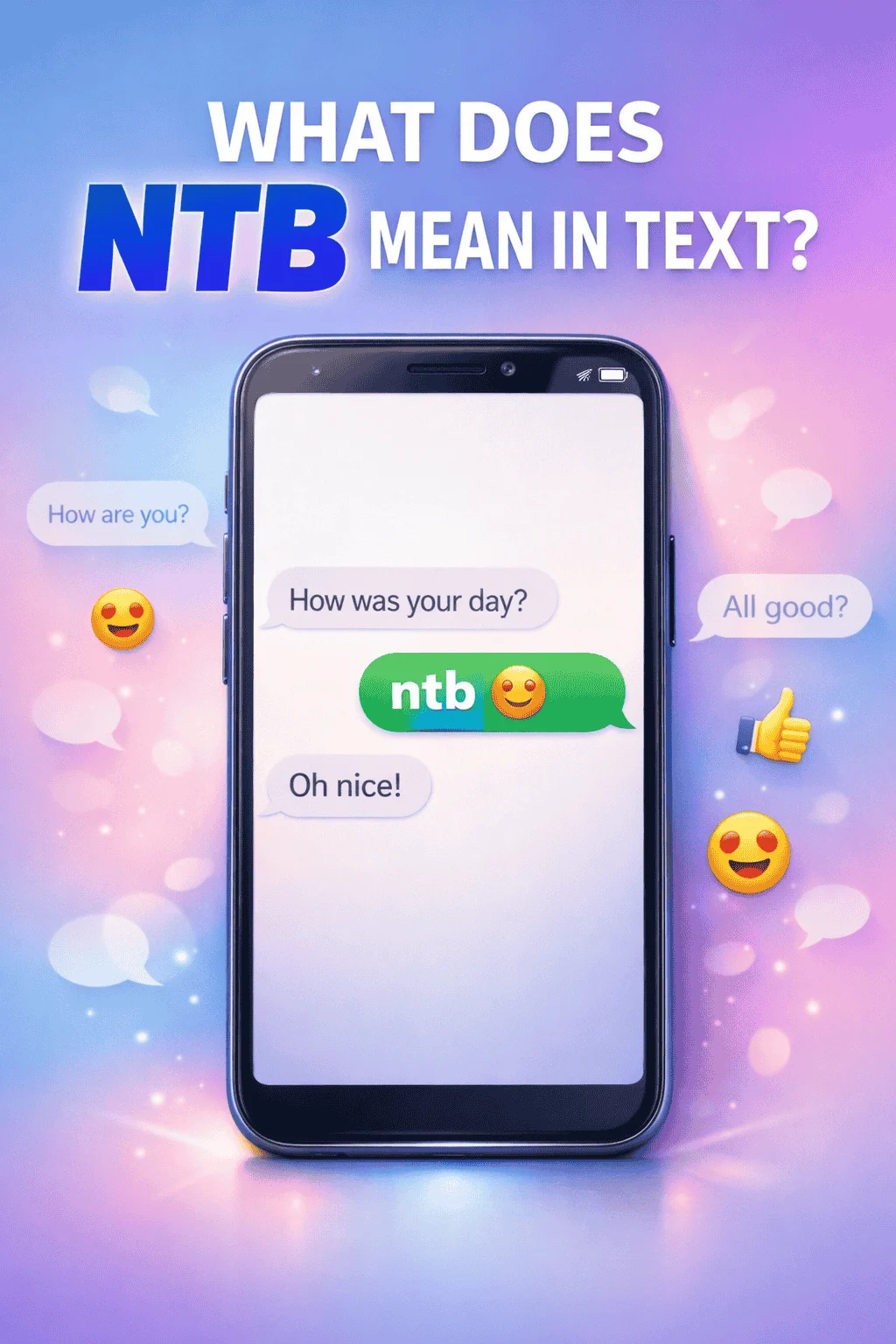
If you have ever received a message that simply said “ntb” and felt slightly confused, you are not alone.
Short forms dominate modern texting. We type fast. We skim faster. And sometimes, three small letters carry more tone than a full sentence. That is exactly why people search for what does ntb mean in text. They want clarity. They want context. And most importantly, they want to avoid misunderstanding someone’s tone.
Let’s break it down clearly and honestly, the way real communication works today.
What Does NTB Mean in Text? – Quick Meaning
In texting, NTB most commonly means “Not Too Bad.”
It is usually used as a casual response to a question like:
- “How are you?”
- “How’s your day going?”
- “How was the test?”
Instead of writing a full sentence, someone replies with “ntb.”
Simple Definition:
NTB = Not Too Bad
It means:
- Things are okay
- Could be better, but not terrible
- Neutral to mildly positive mood
Example Messages:
“How’s work?”
“ntb, just busy.”
“Did the presentation go well?”
“ntb actually.”
“How’s your mood today?”
“ntb. Surviving.”
It sits comfortably between “good” and “meh.”
Origin & Background
NTB did not appear overnight. It evolved from the long-standing spoken phrase “not too bad,” which has been common in English conversations for decades.
Long before texting, people casually answered:
“How are you?”
“Not too bad.”
When mobile texting became popular in the early 2000s, character limits influenced language. Platforms like SMS, then later messaging apps such as WhatsApp and social platforms like Instagram encouraged brevity.
People shortened:
- See you → CU
- Be right back → BRB
- Not too bad → NTB
Over time, the abbreviation became natural in online culture, especially among younger users who prefer speed over formality.
Its meaning has stayed mostly stable. However, tone has become more layered. Today, NTB can signal calmness, emotional neutrality, mild disappointment, or quiet resilience depending on context.
Real-Life Conversations
Let’s look at how NTB actually appears in everyday digital conversations.
1. WhatsApp Chat
Person A: How was your first day at the new job?
Person B: ntb honestly. Still learning everything.
Here, NTB shows cautious optimism.
2. Instagram DMs
Person A: You’ve been quiet lately. Everything okay?
Person B: ntb. Just needed some space.
In this case, NTB softens vulnerability. It avoids drama while hinting at emotion.
3. TikTok Comments
On a video about exam stress:
Person A: How did your finals go?
Person B: ntb. Thought I’d fail but survived.
Here, it expresses relief mixed with humor.
4. Simple Text Message
Person A: Are you feeling better now?
Person B: ntb. The headache’s mostly gone.
Neutral. Informative. Calm.
In all these examples, NTB feels emotionally controlled. Not overly excited. Not deeply negative.
Emotional & Psychological Meaning
On the surface, NTB means “not too bad.” But emotionally, it often reveals more.
It suggests moderation. Emotional balance. Sometimes even emotional restraint.
When someone says “great,” it feels enthusiastic.
When someone says “fine,” it can sound defensive.
When someone says “ntb,” it feels measured.
Psychologically, people use NTB when they:
- Do not want to overshare
- Want to stay neutral
- Feel cautiously okay
- Are protecting their emotions
I once asked a friend how she was doing during a stressful period. She replied, “ntb.” Later, she admitted things were overwhelming, but she did not want to burden anyone. That short reply carried quiet strength.
NTB often hides emotional nuance behind simplicity.
Usage in Different Contexts
1. Social Media
On platforms like TikTok or Instagram, NTB appears in comments and captions.
Example:
“Day 3 of the challenge. ntb so far.”
It signals casual progress.
2. Friends & Relationships
Among close friends, NTB feels safe and informal.
“Date night?”
“ntb actually. He was sweet.”
In relationships, tone matters. NTB can sound positive or slightly underwhelming depending on context.
3. Work / Professional Settings
This is where caution is needed.
In professional emails, NTB may feel too casual. Writing “ntb” in a workplace message can appear lazy or unprofessional.
Better alternative:
“Not too bad, thank you.”
Abbreviations work best in informal chats, not formal communication.
4. Casual vs Serious Tone
Casual setting:
“How’s life?”
“ntb.”
Serious setting:
“How are you handling the situation?”
“ntb” might feel emotionally distant.
Tone always depends on relationship and environment.
When NOT to Use It
There are moments where NTB may cause confusion.
Avoid using it:
- In formal emails
- During serious emotional conversations
- When someone expects a detailed response
- In cross-cultural conversations where slang may not translate well
For example, if someone asks about a serious health issue, replying “ntb” can seem dismissive.
Context is everything.
Common Misunderstandings
- Some think NTB means “Nothing To Be.”
- Others confuse it with “Not Too Busy.”
- Tone confusion is common. It can sound indifferent if misread.
- Some interpret it as mild disappointment rather than positivity.
Literal meaning is mild positivity. Figurative tone depends on delivery.
Comparison Table
| Expression | Meaning | Tone |
|---|---|---|
| NTB | Not Too Bad | Neutral to mildly positive |
| Fine | Okay | Can sound defensive |
| Good | Positive | Clearly upbeat |
| Meh | Indifferent | Slightly negative |
| Great | Very positive | Enthusiastic |
Key Insight
NTB occupies the emotional middle ground. It avoids extremes. That balance is why it feels safe in everyday texting.
Variations & Related Forms
Here are common variations you might see:
- NTB tbh – Not too bad, to be honest
- ntb lol – Mild positivity with humor
- NTB I guess – Uncertain approval
- ntb so far – Ongoing situation
- NTB actually – Slight pleasant surprise
- NTB today – Mood-specific
- ntb anymore – Improvement from worse
- NTB rn – Not too bad right now
- ntb thanks – Polite response
- NTB at all – Emphasized neutrality
Each variation subtly shifts emotional weight.
How to Respond When Someone Uses NTB
Casual Replies
- “Glad to hear that!”
- “Nice, that’s good.”
- “Better than bad.”
Funny Replies
- “We love surviving.”
- “NTB is a win these days.”
- “Neutral vibes only.”
Mature Replies
- “That sounds steady.”
- “Hope it keeps improving.”
- “Let me know if you need anything.”
Respectful Replies
- “I’m glad things aren’t too heavy.”
- “Thanks for sharing.”
- “Take care of yourself.”
Matching tone shows emotional intelligence.
Regional & Cultural Usage
Western Culture
In the US and UK, “not too bad” is a common everyday phrase. NTB naturally fits informal texting culture.
Asian Culture
In many Asian contexts, direct emotional expression is sometimes softened. NTB aligns well with polite understatement.
Middle Eastern Culture
In some Middle Eastern conversations, emotional tone is often more expressive. NTB might feel reserved compared to enthusiastic replies.
Global Internet Usage
Online culture favors brevity. NTB works because it is quick, neutral, and safe.
Generational Differences
Gen Z uses NTB casually in chats and comments.
Millennials understand it but may prefer full phrases.
Older generations might not recognize the abbreviation at all.
Is It Safe for Kids?
Yes, NTB is safe.
It contains no harmful or inappropriate meaning. However, parents should ensure children understand tone and context. Overusing abbreviations can sometimes reduce emotional clarity in communication.
Balance matters.
FAQs
1. What does NTB stand for in text?
It stands for “Not Too Bad.”
2. Is NTB positive or negative?
It is mildly positive or neutral.
3. Can NTB be sarcastic?
Yes, depending on tone and context.
4. Is NTB rude?
No, but it may sound distant in serious conversations.
5. Should I use NTB at work?
Avoid it in formal professional communication.
6. Is NTB common on social media?
Yes, especially in casual chats and comments.
Conclusion
So, what does ntb mean in text?
It means “Not Too Bad.” But more than that, it represents emotional balance in modern communication.
It is calm. Measured. Slightly optimistic without exaggeration.
In a world where people often feel pressure to say they are either “amazing” or “terrible,” NTB gives us space to simply exist somewhere in the middle.
Use it confidently in casual conversations. Be mindful in serious settings. And always remember that behind three small letters, there is usually a real human emotion waiting to be understood.