
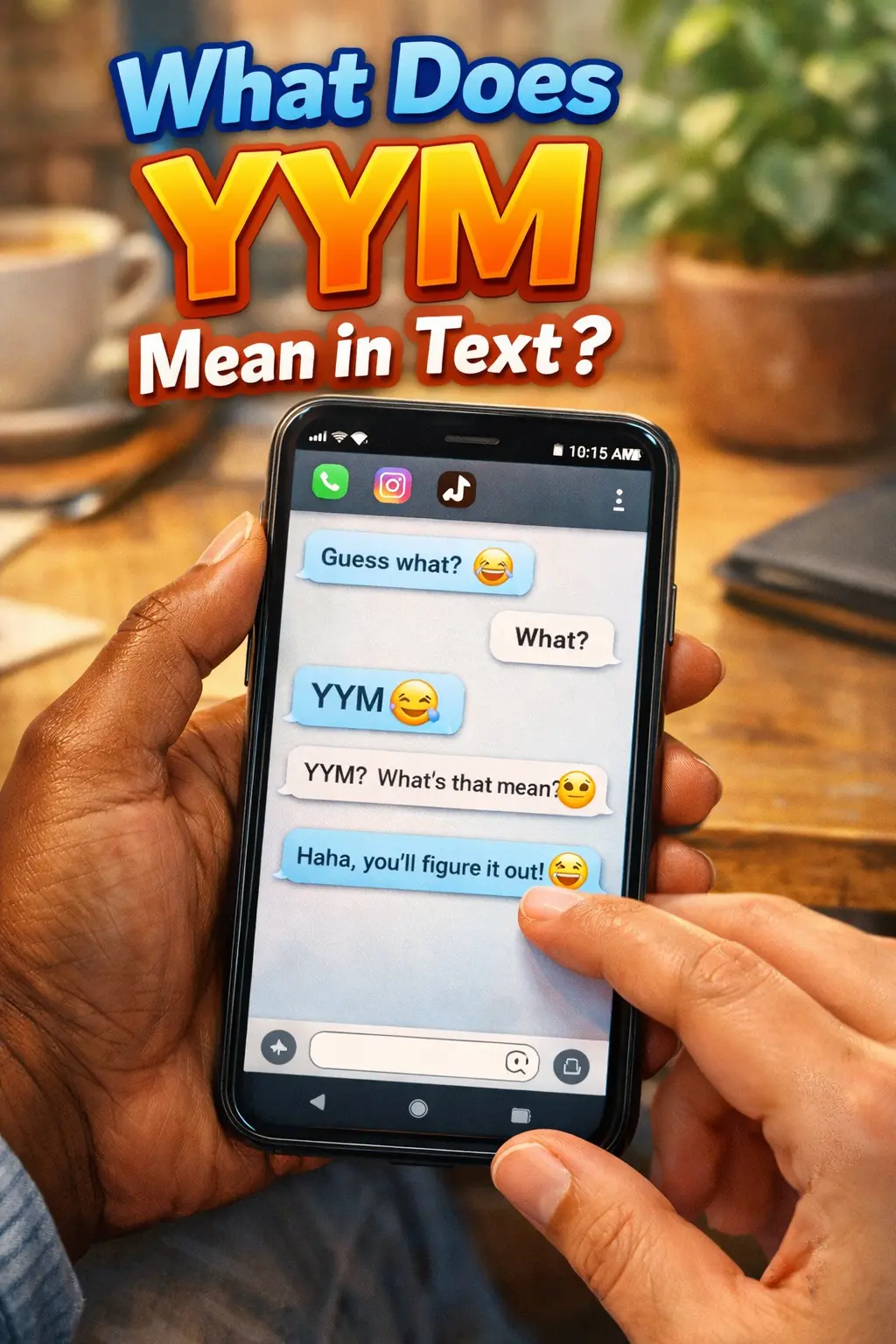
If you’ve ever received a message that simply says “yym” and paused for a second, you’re not alone.
Short text slang can feel like a secret code. One person sends three letters. The other person tries to decode tone, emotion, and intention in seconds.
So, what does yym mean in text?
People search this phrase because they want clarity. Is it friendly? Flirty? Dismissive? Is it positive or sarcastic? The confusion comes from the fact that “yym” is not as widely standardized as older abbreviations like “lol” or “brb.”
Let’s break it down in a simple, real-world way.
YYM – Quick Meaning
In texting, YYM most commonly means “Yeah, You Mad?”
It’s usually:
- Playful teasing
- Slightly sarcastic
- Used in casual conversations
- Often meant as light humor
You might see it used like this:
- “You lost again 😂 yym?”
- “I didn’t reply for 2 hours… yym?”
- “Bro I took the last slice. yym?”
The tone depends heavily on the relationship between the people talking.
In most cases, it’s playful, not aggressive.
Origin & Background
YYM emerged from the fast-paced culture of short-form messaging. As texting evolved from full sentences to abbreviations, users began shortening common playful phrases.
“You mad?” was already popular online. It became a meme phrase in gaming communities and internet debates during the early 2010s. Over time, adding “yeah” in front created a more teasing rhythm.
Gaming culture played a big role. Competitive banter often included phrases like:
- “You mad?”
- “Stay mad.”
- “Cry more.”
On platforms like TikTok, Instagram, and online multiplayer chats, these phrases became part of digital humor.
YYM is essentially a compressed version of that playful challenge.
It reflects how online communication favors speed, irony, and emotional shorthand.
Real-Life Conversations
Here’s how YYM actually appears in everyday chats.
WhatsApp Chat
Person A: I finished the whole series without you 😌
Person B: Wow really?
Person A: yym? 😂
In this case, it’s teasing, not hostile.
Instagram DMs
Person A: I look better in that pic than you
Person B: Please
Person A: yym?
Here, it’s competitive but playful.
TikTok Comments
User 1: That outfit is mid
User 2: You couldn’t pull it off
User 1: yym?
On TikTok, it can carry a sharper edge depending on tone.
Text Message Between Friends
Person A: I ate your snacks
Person B: I was saving those
Person A: yym?
Among close friends, it’s harmless teasing.
Emotional & Psychological Meaning
At its core, YYM expresses playful provocation.
It tests emotional reaction.
It says, “Are you actually upset, or are we joking?”
Psychologically, it reflects modern digital humor. Instead of openly saying, “Are you mad at me?” which feels vulnerable, people flip it into a playful challenge.
It creates distance from seriousness.
I’ve seen this often among younger communicators. A student once told me they use phrases like YYM to avoid appearing too emotional. It gives them a shield. They can tease without fully exposing their own feelings.
YYM often hides subtle curiosity behind humor.
Usage in Different Contexts
Social Media
On platforms like Instagram and TikTok, YYM is often used in comments after playful disagreements.
Tone can range from friendly to sarcastic.
Context matters.
Friends & Relationships
Among close friends, it usually signals:
- Light teasing
- Inside jokes
- Competitive banter
In romantic relationships, it can feel flirty or slightly provocative.
Work / Professional Settings
Avoid it.
YYM is informal and slang-heavy. It can sound immature or confrontational in professional communication.
Casual vs Serious Tone
In casual chats, it’s harmless.
In serious conversations, especially during conflict, it can escalate tension. It may seem dismissive of genuine feelings.
When NOT to Use It
There are moments where YYM can backfire.
Avoid using it:
- During real emotional conflicts
- When someone is genuinely hurt
- In professional environments
- With people who don’t understand slang
It can seem mocking if used at the wrong time.
Tone sensitivity is key.
Common Misunderstandings
Some people assume YYM means:
- “You’re mad” as a statement
- “Why you mad?”
- Something aggressive
The biggest misunderstanding is tone.
Without emojis or context, YYM can look confrontational.
Literal interpretation makes it seem like an accusation.
Figuratively, it’s often just playful.
Comparison Table
| Expression | Meaning | Tone | Usage Level |
|---|---|---|---|
| YYM | Yeah, you mad? | Playful / teasing | Informal |
| You mad? | Are you upset? | Direct / confrontational | Informal |
| Stay mad | Keep being upset | Taunting | Informal |
| LOL | Laughing out loud | Friendly | Universal |
| Calm down | Relax | Can be dismissive | Risky |
Key Insight: YYM is lighter than “Stay mad” but sharper than “LOL.” It sits in that teasing middle ground.
Variations & Related Forms
Here are common variations or related expressions:
- YM – Short for “You mad?”
- YMM – “You mad, man?” casual extension
- YMB – “You mad bro?” meme version
- Stay Mad – Encourages continued frustration
- Cry More – Stronger, more mocking
- Mad or Nah? – Playful curiosity
- U Mad? – Direct shorthand
- Big Mad – Strongly upset
- Lowkey Mad – Slightly upset
- Salty? – Feeling annoyed or bitter
Each one varies in intensity.
YYM stays relatively moderate compared to harsher taunts.
How to Respond When Someone Uses It
Casual Replies
- “Maybe a little 😂”
- “Not even close”
- “You wish”
Funny Replies
- “Yeah I’m writing a whole speech about it”
- “Shaking crying throwing up”
- “Calling the police rn”
Mature Replies
- “No, just surprised.”
- “Not mad, just clarifying.”
- “We’re good.”
Respectful Replies
- “All good here.”
- “No hard feelings.”
- “Just joking too.”
Your response sets the tone.
Regional & Cultural Usage
Western Culture
In the US and UK, teasing banter is common in friendships. YYM fits into that playful sarcasm culture.
Asian Culture
In some Asian contexts, direct teasing can feel uncomfortable unless between close friends. Tone sensitivity is higher.
Middle Eastern Culture
Humor is valued, but respect is deeply emphasized. YYM works better among peers, not elders.
Global Internet Usage
Online gaming and meme culture have normalized phrases like YYM worldwide. Context often comes from shared digital culture rather than geography.
Generational Differences
Gen Z embraces ironic humor. YYM feels natural to them.
Millennials may understand it but use it less frequently.
Older generations might misread it entirely.
Is It Safe for Kids?
YYM is not inherently inappropriate.
However, children may not fully understand tone nuance.
It’s safe in playful settings but should not be used to dismiss real feelings.
Teaching context awareness matters more than banning slang.
FAQs
What does yym stand for in texting?
It usually stands for “Yeah, you mad?” and is used playfully.
Is yym rude?
It can be if used during serious arguments. Tone determines impact.
Is yym the same as “you mad”?
It’s similar but slightly softer due to the casual phrasing.
Can yym be flirty?
Yes. In some contexts, it carries playful flirtation.
Should I use yym at work?
No. It’s too informal and may seem unprofessional.
Why do people use yym instead of full sentences?
Speed, humor, and modern texting culture favor short forms.
Conclusion
YYM may be just three letters, but like most digital slang, its meaning lives in tone and relationship.
Used correctly, it’s playful and harmless.
Used carelessly, it can feel dismissive.
Modern communication moves fast. We compress emotions into abbreviations. The key is awareness. Know your audience. Read the room. Add an emoji if needed.
When you understand the emotional layer behind slang like YYM, you gain more than vocabulary. You gain social intelligence.
And that always translates well, online and offline.