
If you’ve recently seen someone write “GMT” in a message and paused for a second, you’re not alone.
Most people recognize GMT from time zones, but in texting, the meaning can feel confusing. Is it about time? Is it slang? Is it something sarcastic?
People search for what GMT mean in text because the abbreviation shifts depending on context. Sometimes it refers to time. Sometimes it carries subtle social meaning. And sometimes it is simply misunderstood.
Let’s break it down clearly, naturally, and in a way that makes sense in real conversations.
What GMT Mean in Text – Quick Meaning
In most text conversations, GMT stands for:
- Greenwich Mean Time
- A global time standard used to coordinate schedules
- A reference point for different time zones
In texting, it’s commonly used when:
- Scheduling online meetings
- Talking about international time differences
- Clarifying livestream or event times
Simple Text Examples:
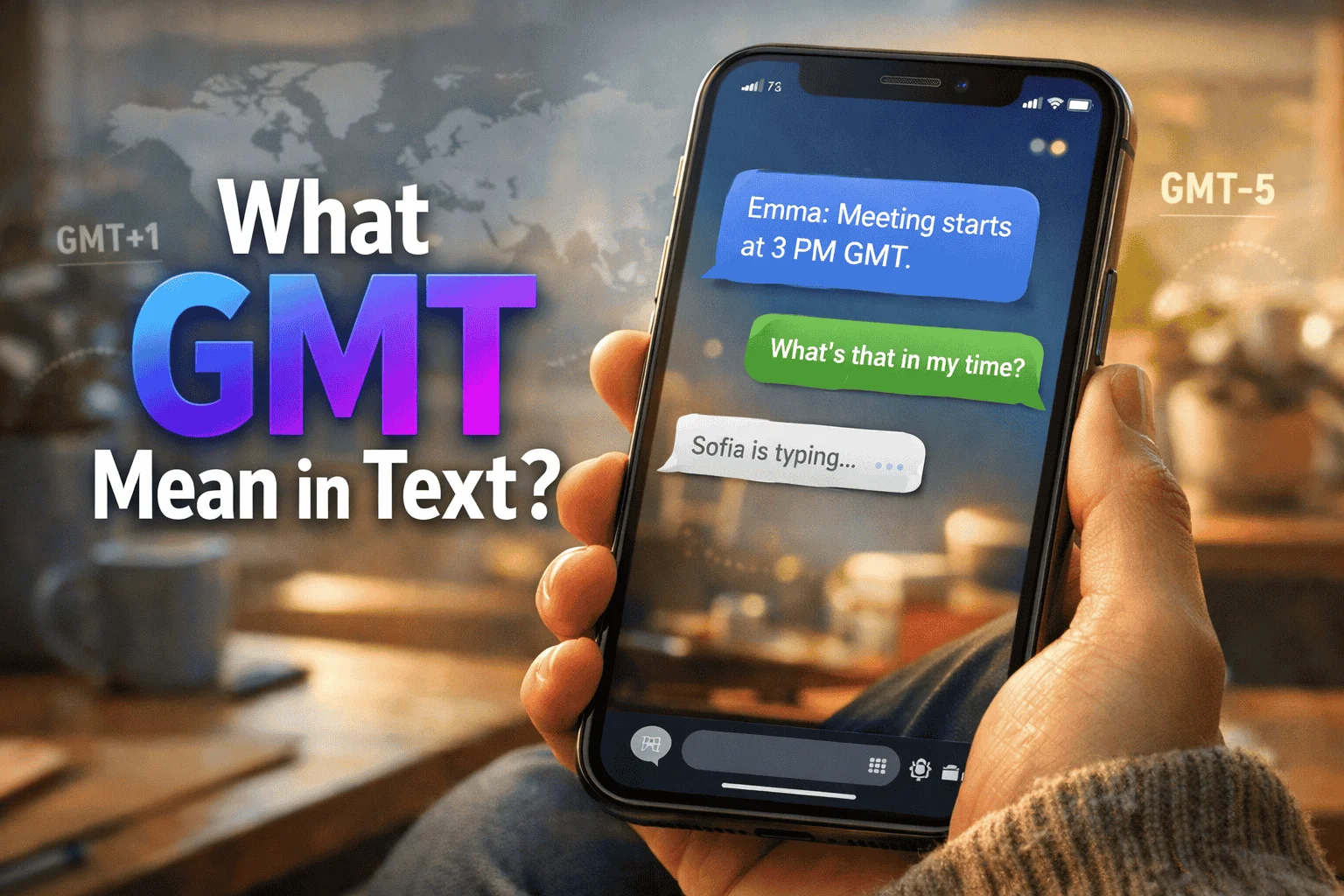
- “The meeting starts at 3 PM GMT.”
- “What’s that in my time? I’m GMT+2.”
- “Let’s go live at 8 GMT.”
In everyday slang conversations, GMT rarely means anything else. If someone uses it casually without time context, it usually still refers to time zones.
Origin & Background
GMT stands for Greenwich Mean Time, which originated in the 19th century at the Royal Observatory in Greenwich, London.
The term became globally important when the world needed a standardized way to track time, especially for shipping, railways, and international trade. Before that, cities followed their own local solar time, which created chaos for coordination.
Later, GMT became the global reference time, even though it has largely been replaced by Coordinated Universal Time in scientific use. Still, GMT remains widely used in everyday language.
Cultural Influence
As the internet connected people globally, time zone coordination became part of daily life. Online gaming, remote work, livestreams, and international friendships made GMT a practical shorthand.
Social media platforms, especially those with global audiences, helped normalize it. You’ll often see content creators post things like:
“New video drops at 6 PM GMT.”
Over time, GMT became part of digital culture rather than just a scientific term.
Real-Life Conversations
Here’s how GMT actually shows up in real conversations.
1. WhatsApp Group Chat
Person A:
Guys, meeting tomorrow at 10 AM GMT.
Person B:
Wait, I’m in Dubai. What’s that for me?
Person C:
That’s 2 PM your time.
You can feel the practical tone here. It’s about clarity.
2. Instagram DM
Person A:
When are you going live?
Person B:
Probably 7 PM GMT. I’ll post a reminder.
Person A:
Cool, I’ll set an alarm.
This shows how influencers use GMT to address global followers.
3. TikTok Comments
Creator:
Next stream 9 GMT!
Commenter 1:
Is that UK time?
Commenter 2:
Yeah, convert it if you’re outside Europe.
Here, GMT becomes part of international digital interaction.
4. Casual Text Between Friends
Person A:
Let’s watch it together when it drops.
Person B:
It releases at midnight GMT.
Person A:
So that’s 7 PM for me. Perfect.
It’s not slang here. It’s coordination.
Emotional & Psychological Meaning
GMT itself is not emotional. But how it’s used can carry subtle social meaning.
When someone uses GMT, it often signals:
- They are addressing a global audience
- They want clarity
- They are used to international communication
Psychologically, using GMT can also imply professionalism or organization. It shows awareness of time zones and respect for others’ schedules.
I once worked with a remote team spread across three continents. We stopped saying “my time” and switched to GMT references. The communication instantly became smoother. No confusion. No missed calls. It built trust.
That’s the hidden emotional layer. GMT represents structure and consideration.
Usage in Different Contexts
Social Media
Content creators use GMT to:
- Announce livestreams
- Schedule drops
- Coordinate events
It helps avoid confusion for global followers.
Friends & Relationships
In international relationships or long-distance friendships, GMT becomes practical.
“Call me at 6 GMT” is clearer than saying “6 PM my time.”
It prevents accidental misunderstandings.
Work / Professional Settings
In remote jobs, GMT is common in:
- Corporate emails
- Meeting invites
- Freelance contracts
It sounds professional and neutral.
Casual vs Serious Tone
Casual:
“Stream at 8 GMT, don’t be late!”
Serious:
“Please attend the meeting at 14:00 GMT.”
The tone depends on context, not the abbreviation itself.
When NOT to Use It
Even though GMT is neutral, there are situations where it may not be appropriate.
- When speaking to someone unfamiliar with time zones
- With young children who may not understand global time standards
- In local-only conversations where local time is clearer
- In highly formal legal documents that require precise UTC references
Also, avoid assuming everyone knows how to convert time zones. That can create unnecessary stress.
Common Misunderstandings
Here are common mistakes people make:
- Thinking GMT is slang
- Confusing it with “good morning text”
- Assuming it applies to every country equally year-round
- Mixing it up with BST or local daylight saving times
Tone confusion rarely happens with GMT, but practical confusion does.
Literal meaning matters here.
Comparison Table
| Term | Meaning | Context | Tone |
|---|---|---|---|
| GMT | Greenwich Mean Time | Global scheduling | Neutral |
| UTC | Coordinated Universal Time | Scientific, official | Formal |
| Local Time | Your region’s time | Casual conversations | Informal |
| EST / PST | Specific US time zones | Regional planning | Neutral |
| ASAP | As soon as possible | Urgency | Emotional |
Key Insight
GMT is not emotional slang. It is a coordination tool. Its power lies in clarity, not expression.
Variations / Types
Here are common GMT-related forms:
- GMT+1 – One hour ahead of Greenwich
- GMT-5 – Five hours behind Greenwich
- GMT Time – Casual shorthand for the standard
- Midnight GMT – Exact global release reference
- 8 PM GMT – Scheduled event time
- GMT Zone – Referring to countries using GMT
- Convert from GMT – Asking for time adjustment
- Current GMT – Checking the live global time
- GMT Standard – Used in official scheduling
- GMT Clock – Online time tracking reference
Each variation still centers around global time coordination.
How to Respond When Someone Uses It
Casual Replies
- “Got it!”
- “I’ll convert that now.”
- “Perfect, see you then.”
Funny Replies
- “My brain needs a time zone calculator.”
- “GMT and I are not friends.”
Mature Replies
- “Thanks for clarifying the time zone.”
- “That works perfectly for me.”
Respectful Replies
- “I appreciate you specifying GMT.”
- “Confirmed. I’ll join at the scheduled time.”
Responding correctly shows awareness and professionalism.
Regional & Cultural Usage
Western Culture
In Europe and the UK, GMT is widely recognized. It feels normal and standard.
In North America, people are more used to EST, CST, PST, but GMT is still understood in international settings.
Asian Culture
In countries like India, Pakistan, Japan, and Singapore, people often reference their own time zones first. GMT is mostly used in global business or online events.
Middle Eastern Culture
GMT is commonly used in aviation, business, and international trade. In casual settings, local time is more common.
Global Internet Usage
Online communities, gaming platforms, and crypto markets frequently use GMT as a neutral reference point.
It prevents confusion when participants are scattered worldwide.
Generational Differences
Gen Z tends to be comfortable converting time zones because they grow up online.
Millennials use GMT often in professional remote settings.
Older generations may prefer local time unless working internationally.
Is It Safe for Kids?
Yes.
GMT is completely neutral and safe. It has no hidden slang meaning. However, children may need help understanding time zone differences.
Context awareness matters more than the abbreviation itself.
FAQs
1. What does GMT stand for in text?
It stands for Greenwich Mean Time, a global time standard.
2. Is GMT slang?
No. It is a formal time reference, not slang.
3. Why do influencers use GMT?
To coordinate with international audiences.
4. Is GMT the same as UTC?
They are closely related, but UTC is the modern scientific standard.
5. Does GMT change with daylight saving time?
GMT itself does not change, but some regions shift to other time standards seasonally.
6. Can GMT mean something else in texting?
Rarely. In almost all cases, it refers to time.
Conclusion
Understanding what GMT mean in text is simpler than it first appears.
It is not hidden slang. It is not secret internet code. It is a global time reference that helps people connect across borders.
In a world where friendships, work, and entertainment are no longer limited by geography, GMT represents clarity. It shows consideration. It prevents confusion.
Use it confidently when coordinating internationally. And when someone else uses it, you now understand exactly what they mean.
Clear communication builds trust. GMT is one small but powerful example of that.