
If you spend any time chatting online, playing games, or scrolling through social media, you have probably seen the term AFK appear in conversations.
Someone might suddenly type “AFK for a minute,” or reply to a message hours later saying, “Sorry, I was AFK.”
For people who are new to internet slang, this small three letter abbreviation can feel confusing. Is it a joke? A code? Or does it mean something serious?
The truth is simple but interesting. AFK is one of the earliest pieces of internet slang, and it still plays an important role in how people communicate online today.
Understanding what AFK means in text helps you interpret conversations correctly and respond naturally in chats, games, and social media discussions.
In this guide, we will explore the real meaning of AFK, where it came from, how people actually use it in conversations, and why it has remained popular for decades.
AFK – Quick Meaning
AFK stands for:
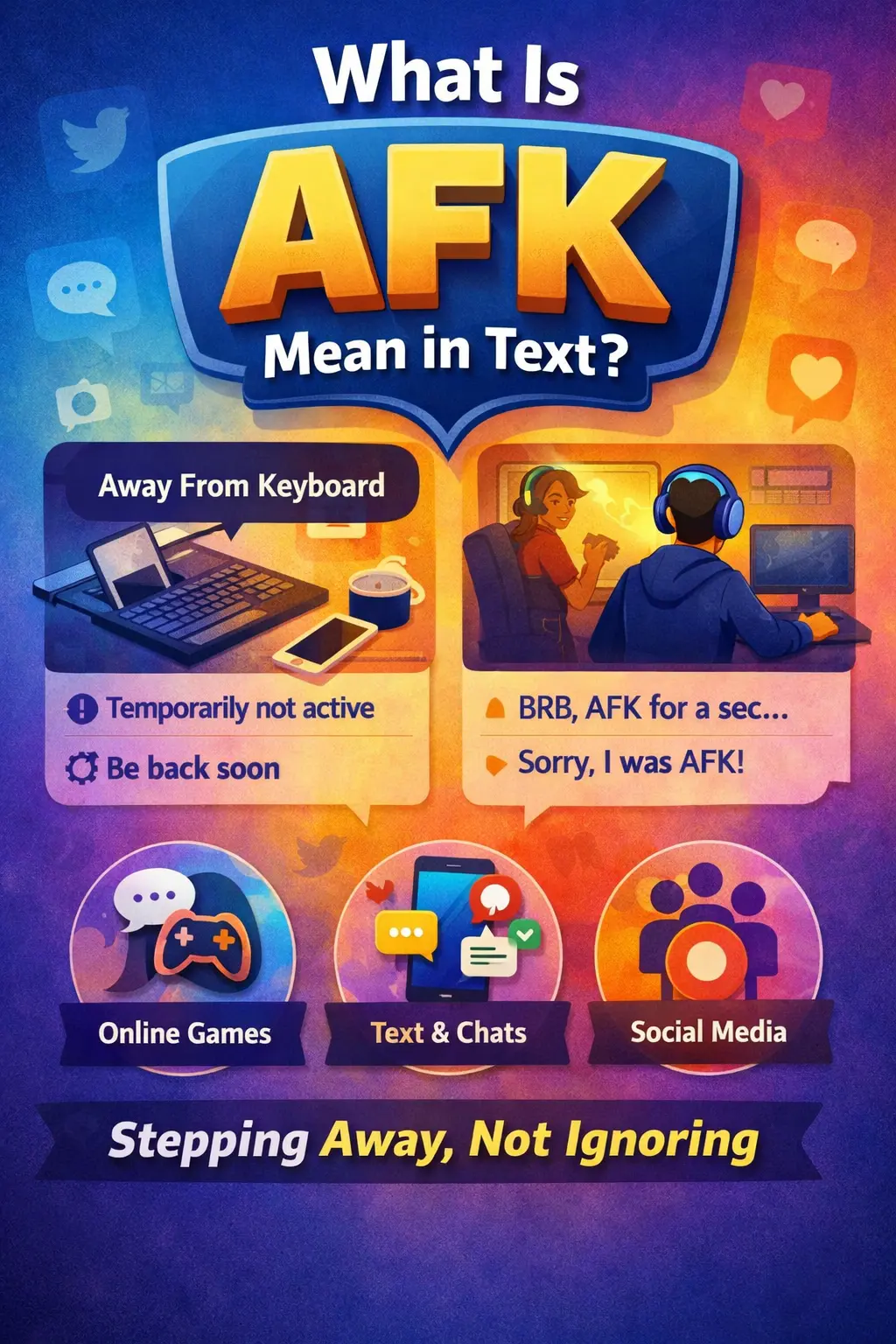
Away From Keyboard
It simply means the person is temporarily not present or not actively using their device.
People use AFK when they need to step away during an online conversation or activity.
Quick definition
AFK means:
- The person is temporarily unavailable
- They stepped away from their phone or computer
- They may respond later
- They are not ignoring the conversation
Example messages
“Hold on guys, AFK for 5 minutes.”
“Sorry I didn’t reply earlier, I was AFK.”
“AFK dinner time, be back later.”
The message signals temporary absence, not disinterest.
Origin & Background
The term AFK comes from the early days of the internet when people primarily communicated through desktop computers.
In the 1990s and early 2000s, online communities formed around:
- Internet Relay Chat (IRC)
- Early forums
- Multiplayer computer games
Since most people were sitting at physical keyboards, the phrase “Away From Keyboard” became a quick way to explain that someone had stepped away.
Instead of writing a full sentence like:
“I’m going to step away from the computer for a moment.”
Users simply typed:
“AFK.”
The gaming influence
Online gaming communities played a huge role in popularizing AFK.
In multiplayer games, players needed to tell teammates when they were temporarily unavailable. Saying AFK helped avoid confusion during important moments.
For example:
“AFK one minute, doorbell.”
Over time, the slang moved beyond gaming.
Today you will see AFK used on:
- messaging apps
- social media platforms
- live streams
- online work chats
Interestingly, the phrase still says “keyboard” even though many people now use phones.
The meaning evolved to include any device, not just computers.
Real-Life Conversations
Here are some realistic examples of how AFK appears in everyday conversations.
WhatsApp Chat
Person A:
Are you still joining the call?
Person B:
Yeah give me 2 mins, AFK grabbing coffee.
Person A:
No problem.
Instagram DMs
Person A:
Why did you disappear mid conversation 😭
Person B:
My bad I went AFK. Mom called me.
Person A:
Okay that makes sense lol.
TikTok Comments
Person A:
Bro stopped replying halfway through the debate.
Person B:
Probably went AFK 😂
Person C:
Or rage quit.
Text Messages
Person A:
You there?
Person B:
Sorry just saw this. I was AFK cooking dinner.
Person A:
No worries!
These examples show something important. AFK is rarely dramatic. It simply keeps communication clear.
Emotional & Psychological Meaning
Even though AFK is practical, it also carries subtle emotional meaning.
When someone says AFK, they are doing something thoughtful.
They are acknowledging the conversation instead of silently disappearing.
This small act helps maintain trust in digital communication.
Without AFK, a sudden silence could feel like:
- being ignored
- losing interest
- passive rejection
But when someone says AFK, it signals respect for the conversation.
Why people use AFK
People use it to:
- set expectations
- avoid misunderstandings
- stay polite in digital spaces
- maintain group coordination in games or work chats
A small real-life scenario
Imagine you are having a deep conversation with a friend online. Suddenly your phone rings.
Instead of disappearing, you quickly type:
“AFK for a few minutes.”
That simple message reassures the other person that the conversation still matters.
It is a small digital courtesy that keeps relationships smooth.
Usage in Different Contexts
AFK can appear in many types of conversations.
Social Media
On platforms like Instagram, Discord, or Reddit, AFK signals temporary inactivity.
Example:
“Going AFK for a bit, be right back.”
It is common during live chats and community discussions.
Friends and Relationships
Friends use AFK casually when they step away from texting.
Example:
“AFK dinner time.”
In close friendships, it often carries a relaxed tone.
Work or Professional Settings
AFK sometimes appears in remote work chats, especially among tech teams or gamers who moved into professional environments.
Example:
“AFK for a quick meeting.”
However, formal workplaces usually prefer clearer phrases like:
“Stepping away for a meeting.”
Casual vs Serious Tone
AFK is generally casual.
It works well in:
- gaming chats
- friend groups
- online communities
But in formal emails or serious professional messages, writing a full sentence feels more appropriate.
When NOT to Use It
Even though AFK is common, there are situations where it may not be appropriate.
Formal communication
Avoid AFK in:
- business emails
- academic communication
- professional client conversations
Example to avoid:
“AFK for lunch.”
Instead write:
“I’ll be away from my desk during lunch.”
Important discussions
During serious conversations, simply saying AFK might feel abrupt.
Example:
A deep emotional conversation may require more explanation.
With people unfamiliar with internet slang
Older audiences or less tech focused individuals might not understand AFK.
Using clear language prevents confusion.
Common Misunderstandings
AFK is simple, but people sometimes misunderstand it.
Mistake 1: Thinking it means ignoring
AFK actually means the opposite. It explains why someone is not responding.
Mistake 2: Assuming long absence
AFK usually implies temporary absence, not hours of silence.
Mistake 3: Confusing it with offline
Someone can be AFK while still technically online.
They might have the chat open but stepped away.
Comparison Table
| Expression | Meaning | Tone |
|---|---|---|
| AFK | Away from keyboard temporarily | Neutral |
| BRB | Be right back | Very casual |
| Offline | Not connected to the internet | Technical |
| Busy | Currently occupied | Slightly formal |
| Active | Available and responding | Opposite meaning |
Key Insight
AFK is unique because it sits between casual slang and practical communication. It quickly explains temporary absence without sounding overly formal.
Variations / Types
Internet culture often creates variations around popular slang.
Here are some related expressions.
BRB
Be right back. A quick return is expected.
BBL
Be back later. Indicates a longer absence.
GTG
Got to go. The person is leaving entirely.
Idle
User is online but inactive.
Offline
Not connected to the internet.
Lurking
Reading messages without actively participating.
Do Not Disturb (DND)
User prefers not to receive messages temporarily.
Stepping Out
A more professional alternative.
Taking a Break
Common in gaming or long conversations.
Back Soon
Simple phrase similar to BRB.
How to Respond When Someone Uses It
When someone says AFK, your reply depends on the tone of the conversation.
Casual replies
“No problem.”
“Okay, talk later.”
“Sure!”
Funny replies
“Don’t get lost.”
“Bring snacks back.”
“AFK but thinking about pizza?”
Mature replies
“Take your time.”
“Message when you’re back.”
Respectful replies
“Thanks for letting me know.”
“I’ll be here when you return.”
These responses keep the conversation friendly and smooth.
Regional & Cultural Usage
AFK is used worldwide, but cultural context changes how frequently people use it.
Western culture
In North America and Europe, AFK is widely understood due to gaming culture and early internet forums.
It appears often in Discord, Twitch, and gaming chats.
Asian culture
Many Asian online communities also use AFK, especially in gaming environments.
However, some messaging apps use native language equivalents instead.
Middle Eastern culture
Internet slang like AFK is common among younger users who engage with global digital culture.
Older generations may prefer full sentences instead.
Global internet usage
Today AFK is almost universal in online spaces.
Even people who do not speak English fluently often recognize it because of gaming and social media.
Generational differences
Gen Z tends to use AFK casually in chats and gaming.
Millennials grew up with the term and understand it well.
Older generations may still prefer full phrases such as “I’ll be away for a moment.”
Is It Safe for Kids?
Yes, AFK is completely safe for kids.
It does not contain offensive or inappropriate meaning.
It simply communicates temporary absence.
However, parents should still teach children to understand context and online etiquette.
Knowing when to step away politely is an important digital skill.
FAQs
What does AFK mean in texting?
AFK means Away From Keyboard. It tells others that the person temporarily stepped away from their device.
Is AFK still used today?
Yes. AFK remains widely used in gaming, social media, messaging apps, and online communities.
Does AFK mean someone is ignoring you?
No. It usually means the person stepped away briefly and plans to return.
Can AFK be used on a phone?
Yes. Even though the phrase says “keyboard,” it applies to phones and tablets as well.
What is the opposite of AFK?
The opposite would be active, meaning the person is present and responding in real time.
Is AFK only used in gaming?
No. While it became popular in gaming, people now use AFK in everyday texting and social media conversations.
Conclusion
AFK may be a small abbreviation, but it represents an important part of modern online communication.
It helps people stay polite and transparent when conversations pause. Instead of disappearing without explanation, users simply signal that they are temporarily away.
This tiny piece of internet slang has survived decades of technological change. From early chat rooms to modern social media and mobile messaging, AFK still serves the same purpose.
Understanding what AFK means in text makes digital conversations easier to navigate. It removes confusion and keeps communication respectful.
So the next time someone types “AFK,” you will know exactly what they mean.
They are not ignoring you.
They are simply stepping away for a moment.