
If you have ever received a message saying “Why were you MIA?” or seen someone comment “She’s been MIA lately,” you probably paused for a second.
Does it mean someone is mad? Ignoring you? Disappeared?
The phrase looks simple, yet it carries emotional weight depending on the situation. That is exactly why so many people search for what MIA mean in text. They want clarity. They want to understand tone. And sometimes, they want reassurance.
Let’s break it down in a way that feels real, relatable, and easy to understand.
What MIA Mean in Text – Quick Meaning
MIA stands for “Missing In Action.”
In texting and online conversations, it usually means:
- Someone has been absent
- Someone has not replied in a while
- Someone disappeared from social media or a conversation
- Someone is not responding like they normally would
It can be playful, concerned, or slightly confrontational depending on tone.
Here are a few simple examples:
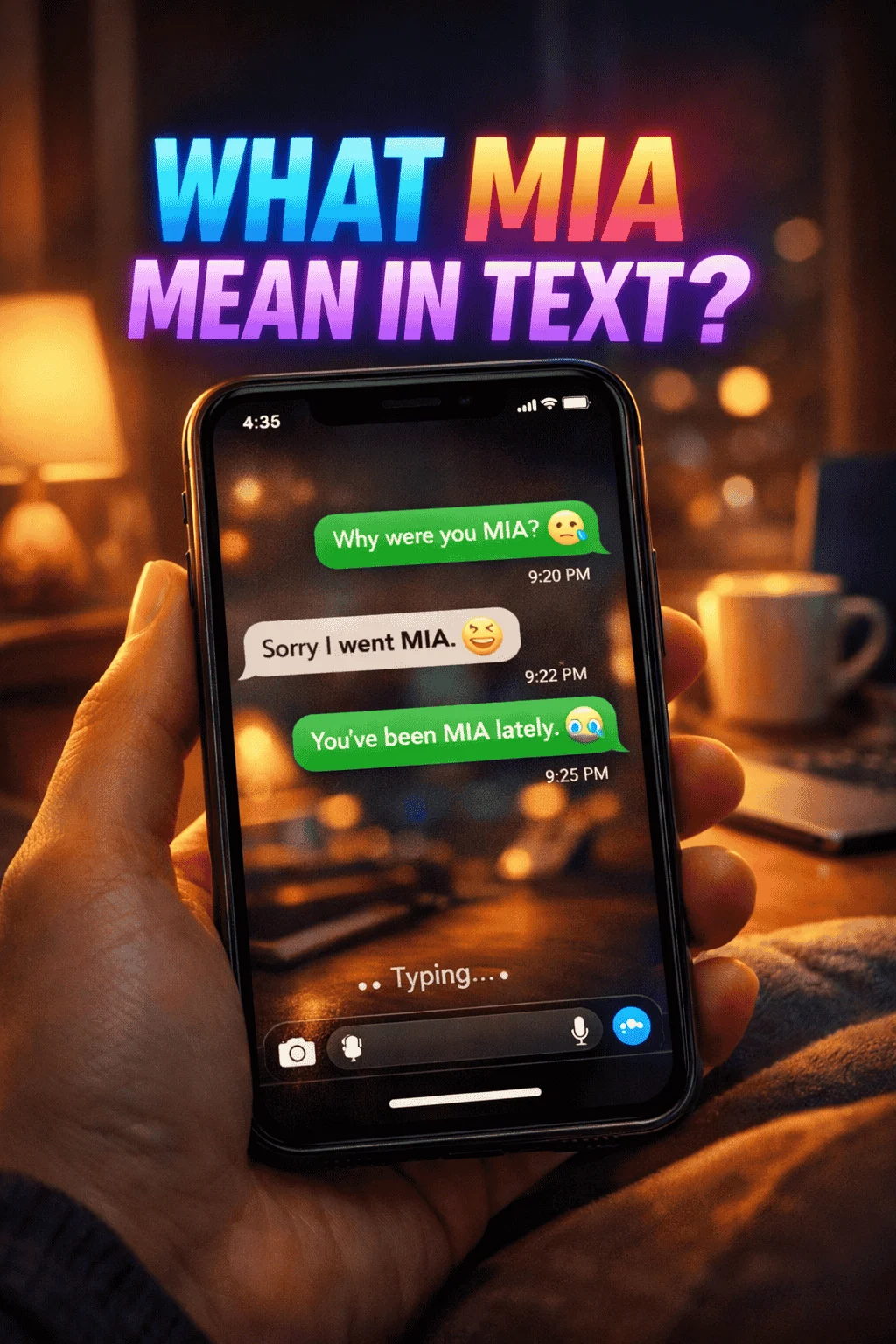
- “You’ve been MIA all weekend.”
- “Sorry I went MIA. Work was mistaken .”
- “Why are you MIA in the group chat?”
At its core, it simply means someone has not been around.
But the emotional layer depends on context.
Origin and Background
The term MIA originally comes from the military. It was widely used during wars, especially the Vietnam War, to describe soldiers listed as “Missing In Action.” It carried serious emotional weight, often referring to someone whose whereabouts were unknown.
Over time, language evolves. Military terms often cross into everyday speech. Just like “on the radar” or “under fire,” MIA slowly moved into casual conversation.
By the early 2000s, texting culture adopted it. As instant messaging grew and platforms like WhatsApp, Instagram, and TikTok became central to communication, people needed short ways to describe digital absence.
“MIA” was perfect. It was short. It was expressive. And it captured the feeling of someone disappearing from your digital world.
Today, it no longer carries military seriousness in casual chats. Instead, it signals absence in social interaction.
Real-Life Conversations
To understand what MIA mean in text, you need to see it in action.
1. WhatsApp Chat
Person A: You’ve been MIA since Friday. Everything okay?
Person B: Yeah, sorry. Family stuff. I just needed a break.
Here, MIA shows concern, not anger.
2. Instagram DMs
Person A: Wow, you finally posted. Thought you went MIA.
Person B: Haha, just needed a social detox.
In this case, it feels playful and light.
3. TikTok Comments
Person A: Girl, you went MIA on us!
Person B: I know! I’ve been working nonstop.
This usage is friendly and dramatic.
4. Text Messages Between Friends
Person A: Why are you MIA lately?
Person B: I’ve just been overwhelmed. Didn’t mean to disappear.
Here, it carries emotional weight. It hints at distance in the relationship.
Emotional and Psychological Meaning
When someone says you’re MIA, it often means one of three things:
- They missed you.
- They felt ignored.
- They noticed your absence.
In modern communication, presence equals connection. When someone goes silent, it can trigger uncertainty. Are they upset? Busy? Losing interest?
Using MIA softens the confrontation. Instead of saying “Why are you ignoring me?” someone says “Why are you MIA?” It sounds lighter, even if the emotion underneath is serious.
I once had a friend message me, “You’ve been MIA lately.” At first, I felt defensive. Then I realized they just missed our regular chats. That single word carried care, not accusation.
This is the psychology of modern texting. Words are short, but feelings are layered.
Usage in Different Contexts
Social Media
Influencers and creators often say they went MIA during a break. It signals temporary absence, not permanent disappearance.
Example: “Sorry I’ve been MIA. Needed a mental reset.”
Friends and Relationships
Among friends, it is casual but meaningful.
In romantic relationships, it can feel heavier. If your partner says you’ve been MIA, it may reflect emotional distance.
Work or Professional Settings
MIA is rarely appropriate in formal emails. It can feel unprofessional.
However, in casual team chats, someone might say:
“Hey, you were MIA in yesterday’s meeting.”
Tone matters.
Casual vs Serious Tone
- Casual: “Bro went MIA after one workout.”
- Serious: “You’ve been MIA emotionally.”
Same acronym. Different depth.
When Not to Use It
Even though MIA is common, it is not always appropriate.
Avoid using it:
- In formal business communication
- When discussing real emergencies
- In sensitive conversations about grief or loss
- With people unfamiliar with slang
Also remember that in military families, the original meaning may still feel sensitive.
Context shows respect.
Common Misunderstandings
Some people think MIA means:
- Mad In Action
- Missing In America
- Made In Asia
None of these are correct in texting slang.
Another confusion is tone. Some read MIA as accusation, others as concern.
Literal meaning: Absent.
Figurative meaning: Emotionally distant or socially inactive.
If tone is unclear, ask for clarification instead of assuming.
Comparison Table
| Expression | Meaning | Tone | Usage Context |
|---|---|---|---|
| MIA | Missing in action, absent | Concerned or playful | Text, social media |
| Ghosted | Suddenly cut off contact | Negative | Dating |
| AFK | Away from keyboard | Neutral | Gaming |
| Silent | Not responding | Serious | Relationships |
| Off the grid | Completely disconnected | Dramatic | Social media |
Key Insight:
MIA suggests temporary absence. Ghosted suggests intentional disappearance. That difference matters emotionally.
Variations and Types
Here are common variations you may see:
- Went MIA
Means someone disappeared for a period. - Been MIA
Ongoing absence. - Low-key MIA
Slightly absent but still around. - MIA again
Repeated pattern of disappearing. - Social media MIA
Offline from platforms. - Emotionally MIA
Present physically but distant emotionally. - MIA mode
Intentionally taking a break. - Pulling an MIA
Choosing to disappear. - Briefly MIA
Short absence. - Going MIA for a bit
Planned digital detox.
Each variation adds nuance.
How to Respond When Someone Uses It
Casual Replies
- “Haha, I know. I’ve been busy.”
- “My bad. Life happened.”
Funny Replies
- “I was on a secret mission.”
- “Undercover operations. Classified.”
Mature Replies
- “I needed space, but I appreciate you checking in.”
- “Sorry for the silence. I should have communicated better.”
Respectful Replies
- “Thank you for noticing. I’ve had a lot going on.”
- “I’m here now. Let’s catch up.”
Your reply sets the emotional tone going forward.
Regional and Cultural Usage
Western Culture
In the United States and Europe, MIA is widely understood and casually used in everyday texting.
Asian Culture
In many Asian countries, English slang is common among younger generations. However, older generations may not understand the term immediately.
Middle Eastern Culture
Urban youth frequently use English acronyms in chats. Still, in more formal or traditional settings, MIA may sound too informal.
Global Internet Usage
Across global platforms like TikTok and Instagram, MIA is recognized as digital absence.
Online culture has standardized it.
Generational Differences
Gen Z uses MIA casually and humorously.
Millennials often use it with mild concern.
Older generations may prefer direct language like “You haven’t replied.”
Generational tone shapes interpretation.
Is It Safe for Kids?
Yes, MIA is generally safe.
It is not offensive or explicit. However, children should understand context. If they use it respectfully, there is no issue.
Parents may want to explain its original meaning so kids understand its history.
FAQs
What does MIA mean in text from a girl?
It usually means you have been absent or not replying. Tone determines whether it is playful or serious.
Is MIA negative?
Not necessarily. It can express concern, humor, or mild frustration.
Does MIA mean someone is ignoring you?
Not automatically. It simply means they have been absent.
Can MIA be used in professional emails?
It is better avoided in formal communication.
What is the difference between MIA and ghosted?
MIA implies temporary absence. Ghosted implies cutting contact intentionally.
Is MIA rude?
Only if used aggressively. Tone and context matter.
Conclusion
Understanding what MIA mean in text is about more than decoding three letters.
It is about understanding absence in a digital world where constant connection feels normal. When someone says you have been MIA, they are acknowledging your silence.
Sometimes it means they missed you.
Sometimes it means they felt distance.
Sometimes it is just playful exaggeration.
Language evolves, and so do emotions behind it.
Now that you know its meaning, tone, and cultural depth, you can use MIA confidently and respond with clarity instead of confusion.
Communication is not just about words. It is about presence.
And sometimes, even absence speaks.