
If you spend time on social media, texting apps, or online gaming chats, you’ve probably seen “OMFG” pop up everywhere. It appears in excited reactions, dramatic conversations, funny memes, and emotional moments online.
But many people still wonder what it actually means, whether it’s rude, and when it’s okay to use it.
The truth is that OMFG is more than just internet slang. It reflects emotion, shock, humor, and the fast-paced style of modern digital communication. Depending on the context, it can sound hilarious, aggressive, excited, or deeply emotional.
This guide explains the real meaning of OMFG in text, where it came from, how people use it today, and when you should avoid it altogether.
OMFG Mean in Text – Quick Meaning
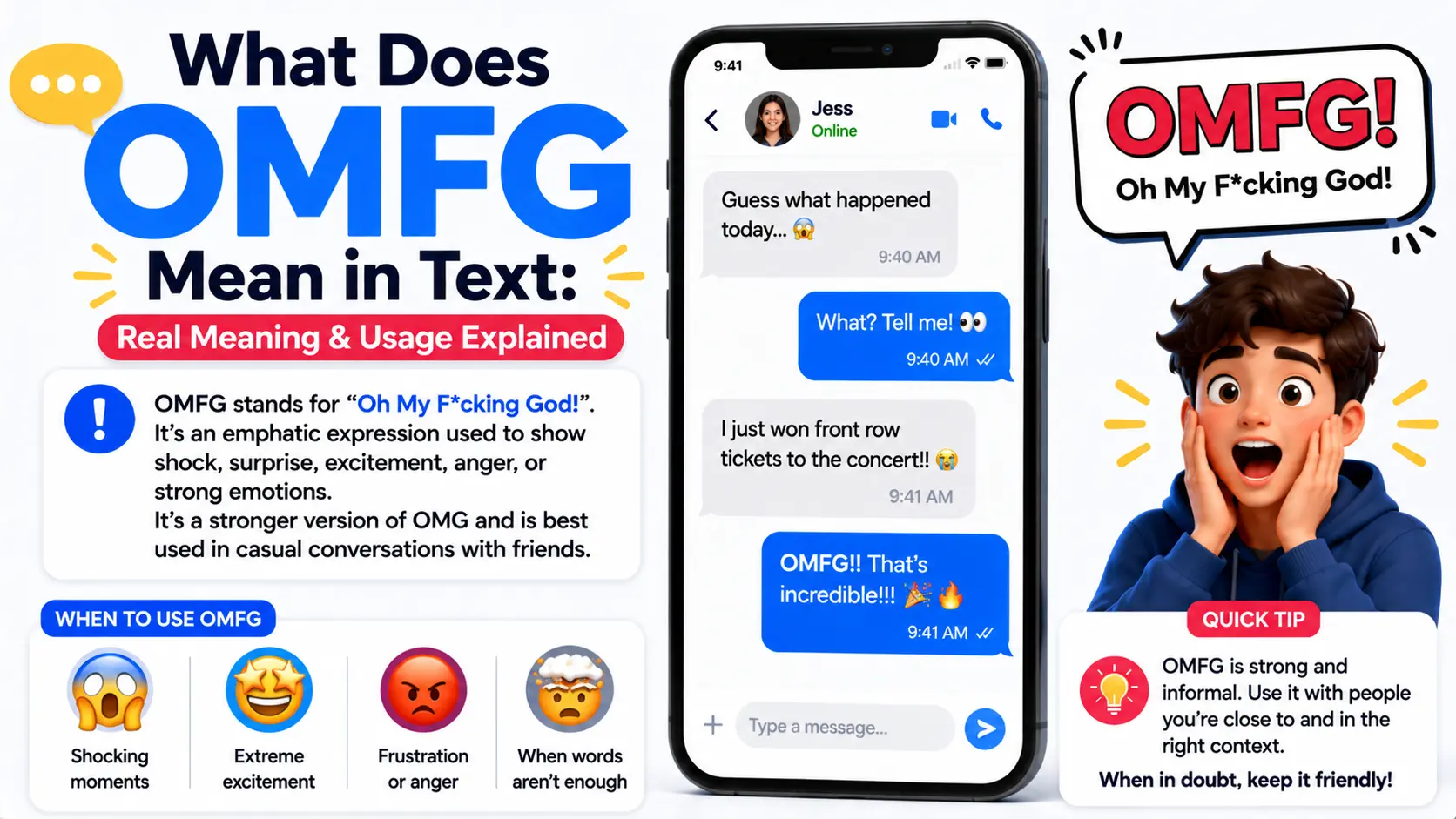
OMFG stands for:
“Oh My F*ing God”**
It’s an intensified version of “OMG” and is usually used to express:
- Extreme surprise
- Shock
- Excitement
- Disbelief
- Frustration
- Emotional overload
People use it when a normal “OMG” does not feel strong enough.
Quick Examples
“OMFG I can’t believe you actually did that!”
“OMFG this movie ending destroyed me.”
“OMFG my exam got canceled!”
The tone completely depends on the situation. Sometimes it’s playful and funny. Other times it can sound angry or dramatic.
Origin & Background
OMFG grew naturally from the older abbreviation “OMG,” which became popular in online chats during the early internet era.
“OMG” itself dates back much further than most people realize. Historians have even found examples of it being used in letters from the early 1900s. But the internet transformed it into a global expression.
As online communication became faster and more emotional, users began adding stronger words for emphasis. That’s how OMFG emerged.
Gaming communities, internet forums, and early social platforms helped spread it rapidly. Later, platforms like Instagram, TikTok, Snapchat, Reddit, and X made it part of everyday digital language.
Today, OMFG is often used to react instantly to:
- Viral videos
- Celebrity drama
- Relationship gossip
- Gaming wins
- Unexpected news
- Emotional content
The phrase reflects how internet culture rewards quick emotional reactions.
Real-Life Conversations
Here’s how people naturally use OMFG in modern conversations.
WhatsApp Conversation
Person A:
I just got the visa approval email.
Person B:
OMFG ARE YOU SERIOUS???
Person A:
YES. I’m shaking right now.
Instagram DM
Person A:
Did you see her engagement photos?
Person B:
OMFG she looks unreal.
Person A:
I know. Literally movie-level beautiful.
TikTok Comments
Person A:
OMFG this song unlocked memories I forgot existed.
Person B:
Same. I instantly thought about 2019.
Text Message
Person A:
I accidentally sent the screenshot to the person we were talking about.
Person B:
OMFG NOOOOOOO
Person A:
I want to disappear.
These examples show how emotional and reactive the phrase feels in real conversations.
Emotional & Psychological Meaning
OMFG is emotionally charged language.
People usually type it when their feelings become too intense for calmer words. It creates a sense of immediacy and emotional honesty.
In digital communication, short expressions often replace facial expressions and body language. OMFG acts almost like an emotional shortcut.
It can express:
- Sudden excitement
- Panic
- Awe
- Chaos
- Joy
- Embarrassment
- Emotional bonding
Sometimes people use it dramatically even when the situation is small. That exaggeration has become part of internet humor.
For example, someone might say:
“OMFG my fries fell on the floor.”
They are not truly devastated. They’re performing emotion in a playful way.
A Realistic Everyday Scenario
Imagine a college student waiting for scholarship results.
After refreshing the email inbox all day, the acceptance finally appears.
The first message sent to friends might simply be:
“OMFG I GOT IT.”
That tiny phrase carries relief, stress, excitement, and disbelief all at once.
That’s why slang like OMFG survives. It communicates emotion quickly and efficiently.
Usage in Different Contexts
Social Media
OMFG is extremely common on:
- TikTok
- Snapchat
- X
- YouTube comments
People use it for dramatic reactions and emotional engagement.
Example:
“OMFG this plot twist broke my brain.”
Friends & Relationships
Among close friends, OMFG often feels casual and expressive.
It can strengthen emotional connection because it sounds raw and genuine.
Example:
“OMFG I miss you already.”
In relationships, tone matters. It can sound affectionate or aggressive depending on the wording.
Work & Professional Settings
Using OMFG professionally is risky.
Because it contains profanity, many workplaces consider it inappropriate.
Even if coworkers are casual, it can appear immature or disrespectful in:
- Emails
- Client messages
- Office group chats
- Formal discussions
Safer alternatives include:
- OMG
- Wow
- That’s unbelievable
- I’m shocked
Casual vs Serious Tone
OMFG is usually informal.
In funny conversations, it sounds lighthearted.
In serious arguments, however, it can sound emotionally intense or even hostile.
Compare these:
“OMFG that puppy is adorable.”
vs.
“OMFG what is wrong with you?”
The second example carries much stronger emotional weight.
When NOT to Use It
There are situations where OMFG may create problems or misunderstandings.
Professional Communication
Avoid using it in:
- Job interviews
- Work emails
- Academic writing
- Business meetings
It may damage credibility.
Religious or Conservative Environments
Some people consider phrases involving “God” offensive, especially when combined with profanity.
In religious families or cultures, OMFG may feel disrespectful.
Sensitive Emotional Situations
If someone is discussing grief, trauma, illness, or serious problems, OMFG can sound insensitive or emotionally careless.
Talking to Older Generations
Not everyone understands internet slang tone.
Some older adults interpret OMFG literally and may view it as rude or vulgar.
Common Misunderstandings
People Think It Always Means Anger
Not true.
OMFG often expresses excitement or amazement rather than rage.
Some Think It’s Always Offensive
Context matters.
Among friends, many people see it as harmless internet slang.
In formal settings, though, it may absolutely offend people.
Tone Gets Misread Easily
Text removes vocal tone and facial expression.
A playful “OMFG stopppp 😂” feels very different from:
“OMFG stop.”
Small differences completely change the emotional meaning.
Comparison Table
| Expression | Meaning | Tone | Intensity |
|---|---|---|---|
| OMG | Oh My God | Casual surprise | Medium |
| OMFG | Oh My F***ing God | Strong emotional reaction | Very High |
| WTF | What The F*** | Confusion or anger | High |
| NO WAY | Disbelief | Friendly | Medium |
| BRUH | Frustration or humor | Casual | Low to Medium |
| WOW | Surprise or admiration | Neutral | Low |
| SHEESH | Amazement | Trendy/playful | Medium |
| HOLY CRAP | Shock | Informal | Medium |
Key Insight
OMFG stands out because it combines emotional intensity with internet-style exaggeration. It feels more dramatic than OMG but more emotional than many other slang reactions.
Variations / Types
Here are common variations people use online.
1. OMG
A softer and more socially acceptable version.
2. OML
Means “Oh My Lord.” Often used as a cleaner alternative.
3. OMGGG
Extra letters increase emotional intensity or excitement.
4. OMFGGG
An exaggerated version used for dramatic reactions.
5. WTF
Expresses confusion, anger, or disbelief.
6. ISTG
Means “I Swear To God.” Used for frustration or emphasis.
7. HOLY MOLY
A playful and child-friendly expression of surprise.
8. BRUH
Often used for disappointment, disbelief, or humor.
9. SHEESH
Expresses amazement or reaction to something impressive.
10. NO FREAKING WAY
A toned-down alternative that avoids profanity.
How to Respond When Someone Uses It
Your response should match the emotional tone.
Casual Replies
- “I KNOW RIGHT”
- “That’s ridiculous.”
- “Same honestly.”
Funny Replies
- “Please calm down before your phone explodes.”
- “Your keyboard survived that message somehow.”
- “The drama level is unmatched.”
Mature Replies
- “That sounds overwhelming.”
- “I can understand why you reacted that way.”
- “That’s actually huge news.”
Respectful Replies
- “I’m really happy for you.”
- “I hope everything turns out okay.”
- “That must feel emotional.”
Tone awareness is one of the most important communication skills online.
Regional & Cultural Usage
Western Culture
In many Western countries, OMFG is widely normalized among younger internet users.
People often treat it casually in memes, gaming, and entertainment spaces.
Asian Culture
Usage varies significantly.
In some Asian cultures, direct profanity is less socially accepted, especially publicly. Younger users may still use OMFG online because of global internet influence.
Middle Eastern Culture
People may avoid OMFG because religious language carries stronger cultural sensitivity.
Using it casually around conservative audiences can be viewed negatively.
Global Internet Usage
Internet culture has made OMFG recognizable almost everywhere.
Even non-native English speakers frequently understand and use it in online spaces.
Gen Z vs Millennials
Gen Z
- Uses OMFG more casually
- Often exaggerated for humor
- Common in memes and reaction culture
Millennials
- Usually use it more literally
- More connected to emotional emphasis than irony
Generational tone differences matter more than many people realize.
Is It Safe for Kids?
OMFG contains profanity, so parents may prefer children not to use it regularly.
That said, many teenagers encounter it online very early through:
- TikTok
- Gaming chats
- Social media comments
- Group texting
The key issue is context awareness.
Kids should understand:
- It’s informal
- Some people find it offensive
- It’s not appropriate everywhere
Teaching communication boundaries is usually more effective than simply banning slang.
FAQs
What does OMFG mean in texting?
OMFG means “Oh My F***ing God.” It expresses strong surprise, excitement, or shock.
Is OMFG rude?
It can be. Because it includes profanity, some people find it offensive, especially in formal or religious settings.
Is OMFG stronger than OMG?
Yes. OMFG adds emotional intensity and stronger emphasis compared to OMG.
Can I use OMFG at work?
Usually no. It’s best avoided in professional communication because it may appear unprofessional.
Why do people use OMFG so much online?
It communicates emotion quickly and dramatically, which fits fast-paced internet culture.
Is OMFG only negative?
No. It can express happiness, excitement, admiration, panic, or frustration depending on context.
What’s a cleaner alternative to OMFG?
Safer alternatives include:
- OMG
- OML
- Wow
- No way
- Seriously?!
Conclusion
OMFG has become one of the internet’s most emotionally expressive slang terms. It reflects how modern communication values speed, emotion, humor, and dramatic reactions.
For some people, it’s just a funny exaggeration. For others, it genuinely captures moments of shock, excitement, or emotional overload.
The important thing is understanding context.
Used with close friends, it can feel relatable and natural. Used in the wrong setting, it may sound offensive or immature.
Digital communication is not only about words anymore. It’s about tone, timing, emotion, and cultural awareness. Knowing when and how to use expressions like OMFG helps you communicate more confidently online without being misunderstood.