
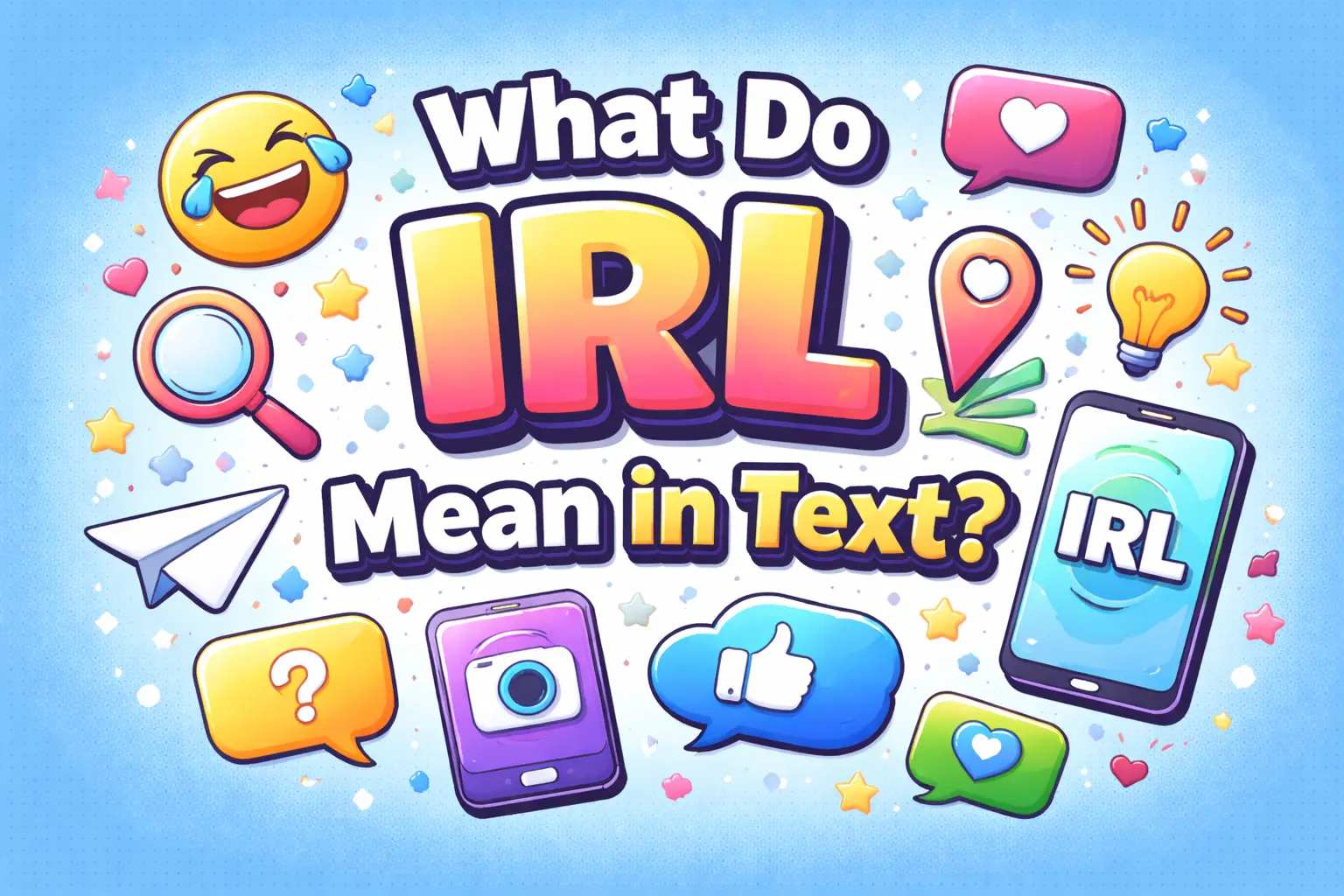
If you’ve ever seen someone write “let’s meet IRL” or “I’m totally different IRL,” you might have paused for a second. What exactly does that mean?
The phrase “what do irl mean in text” is one of the most searched questions today, especially as online conversations continue to blend with real-life interactions. People want to understand not just the definition, but also how it fits into modern communication.
At first glance, IRL seems simple. But in real conversations, it carries emotional tone, social meaning, and even subtle context that many people miss.
This guide clears that confusion. You’ll learn what IRL means, where it came from, how people actually use it, and when it might not be the best choice.
What Do IRL Mean in Text – Quick Meaning
IRL stands for “In Real Life.”
It is used to distinguish between:
- Online experiences vs real-world experiences
- Digital identity vs actual personality
- Virtual interaction vs physical presence
Simple Definition:
IRL = In the real, offline world
Examples:
- “You’re funny IRL too?”
- “We should hang out IRL sometime.”
- “She seems quiet online but she’s loud IRL.”
It’s short, casual, and widely used across platforms.
Origin & Background
IRL has been around longer than many people think. It started gaining popularity in the early days of internet forums and chatrooms in the late 1990s and early 2000s.
Back then, people were just beginning to form online identities. There was a clear separation between “online life” and “real life.” IRL became a quick way to mark that difference.
As platforms like messaging apps and social media grew, the meaning evolved. It no longer just separated worlds. It started connecting them.
Today, IRL is used:
- To suggest meeting offline
- To compare personalities
- To highlight authenticity
Social media platforms like Instagram and TikTok played a big role in making IRL more common. People began sharing “online vs IRL” content, showing how different or similar they are in reality.
Over time, IRL became less technical and more emotional.
Real-Life Conversations
Here’s how IRL naturally appears in everyday conversations.
WhatsApp Chat
Person A: You’re always online but never reply 😒
Person B: I’m busy IRL, not ignoring you
Instagram DMs
Person A: You look different in your stories
Person B: Haha yeah, filters vs IRL me
TikTok Comments
Person A: Is she really like this?
Person B: Nah, she’s chill IRL
Text Messages
Person A: We’ve been talking for months
Person B: I know, we should meet IRL now
These examples show that IRL is not just informational. It often carries emotion, honesty, or even vulnerability.
Emotional & Psychological Meaning
IRL might look like a simple abbreviation, but it reflects something deeper about how we communicate today.
At its core, IRL expresses authenticity.
When someone says “I’m different IRL,” they’re hinting at a gap between their online persona and their true self. It can reveal:
- A desire to be understood
- A fear of being judged
- A need for real connection
People use IRL because online communication can feel incomplete. It lacks tone, body language, and presence.
A relatable scenario:
You’ve been chatting with someone for weeks. Everything feels easy and fun. Then one of you says, “We should talk IRL.”
That moment shifts things. It moves from casual interaction to something more real and meaningful.
IRL becomes a bridge between digital comfort and real-world vulnerability.
Usage in Different Contexts
Social Media
IRL is often used to compare:
- Online image vs real personality
- Edited content vs reality
Example: “This is me IRL vs on Instagram.”
Friends & Relationships
Used to suggest meeting or deepen connection:
- “Let’s hang out IRL.”
- “You’re nicer IRL than I expected.”
Work / Professional Settings
Rarely used in formal communication. However, it may appear in casual workplace chats:
- “We’ll discuss this IRL in the meeting.”
Casual vs Serious Tone
- Casual: Friendly, relaxed, informal
- Serious: Can signal a desire for genuine connection
Tone depends heavily on context.
When NOT to Use It
Even though IRL is common, there are situations where it may feel out of place.
Avoid using IRL:
- In formal emails or academic writing
- With people unfamiliar with internet slang
- In sensitive conversations where clarity matters
Why?
Not everyone understands abbreviations. Using IRL in the wrong context can:
- Confuse the reader
- Make your message seem unprofessional
- Reduce emotional clarity
Common Misunderstandings
1. Thinking IRL Always Means Meeting
Not always. Sometimes it just describes real-life personality.
2. Assuming It’s Always Casual
In some cases, it carries emotional weight, especially in relationships.
3. Confusing It With “Reality”
IRL is not philosophical. It simply refers to offline life, not deep existential meaning.
4. Tone Confusion
“I’m different IRL” can sound:
- Honest
- Defensive
- Insecure
It depends on the situation.
Comparison Table
| Expression | Meaning | Usage |
|---|---|---|
| IRL | In real life | Distinguish offline vs online |
| Online | Digital interaction | Opposite context |
| AFK | Away from keyboard | Temporary absence |
| Offline | Not connected | Similar but more technical |
| Real world | Physical reality | More formal version |
| Virtual | Digital environment | Opposite of IRL |
| OOO | Out of office | Work-related absence |
Key Insight
IRL stands out because it is both casual and emotionally expressive. Unlike technical terms like “offline,” it carries a human element.
Variations / Types
Here are common variations and related expressions:
- IRL friend
A friend you know in real life - IRL vs Online
Comparison between real and digital self - Meet IRL
Suggestion to meet physically - IRL me
Your true personality - IRL stuff
Real-world responsibilities - IRL problems
Offline life issues - IRL job
Actual profession outside the internet - IRL relationship
Physical, real-world connection - IRL moment
Something happening in real life - IRL version
Authentic or unfiltered version of something
How to Respond When Someone Uses It
Casual Replies
- “Yeah, that’s me IRL too 😄”
- “Let’s do it IRL soon!”
Funny Replies
- “IRL me is way cooler, trust me”
- “Wait till you see my IRL upgrade 😂”
Mature Replies
- “I’d like that. It would be nice to connect IRL.”
- “That sounds more meaningful than texting.”
Respectful Replies
- “Sure, whenever you’re comfortable meeting IRL.”
- “I understand, real-life things come first.”
Regional & Cultural Usage
Western Culture
IRL is very common. Often used casually in daily communication.
Asian Culture
Used mostly by younger generations. Slightly less common in formal contexts.
Middle Eastern Culture
Growing usage among youth, especially in social media conversations.
Global Internet Usage
IRL is widely understood across platforms. It’s part of global internet language.
Generational Differences
- Gen Z: Uses IRL naturally and frequently
- Millennials: Understand and use it, but slightly less often
Older generations may not be as familiar with it.
Is It Safe for Kids?
Yes, IRL is generally safe.
However, context matters. When kids use phrases like “meet IRL,” it’s important for parents to ensure:
- They understand online safety
- They avoid meeting strangers alone
The term itself is harmless, but how it’s used should be guided.
FAQs
1. What do IRL mean in text?
It means “in real life,” referring to offline or physical-world situations.
2. Is IRL formal or informal?
It is informal and best used in casual conversations.
3. Can IRL mean meeting someone?
Yes, often it suggests meeting in person.
4. Do people still use IRL?
Yes, it remains widely used across social media and messaging apps.
5. Is IRL only for young people?
Mostly used by younger users, but understood by many.
6. What is the opposite of IRL?
“Online,” “virtual,” or “digital” are common opposites.
7. Can IRL be used in professional settings?
Only in very casual workplace communication, not in formal writing.
Conclusion
IRL may look like just another internet abbreviation, but it reflects something real about how people connect today.
It reminds us that behind every message, profile, or post, there is a person living a full life beyond the screen.
Understanding what IRL means in text is not just about language. It’s about recognizing the balance between digital interaction and genuine human connection.
Use it naturally. Use it confidently. And most importantly, remember that sometimes the most meaningful conversations happen IRL.