
If you’ve recently received a message containing “DD” and found yourself wondering what it means, you’re not alone. Text messaging and social media are filled with abbreviations that can have multiple meanings depending on the context, and DD is one of those terms that often causes confusion.
In some conversations, DD refers to a daughter. In others, it can stand for “dear daughter,” “designated driver,” or even have entirely different meanings in online communities. Because the abbreviation is used across texting, social media, parenting forums, and casual conversations, understanding the context is essential.
This guide explains exactly what DD means in text, where it came from, how people use it today, and how to respond when someone sends it to you.
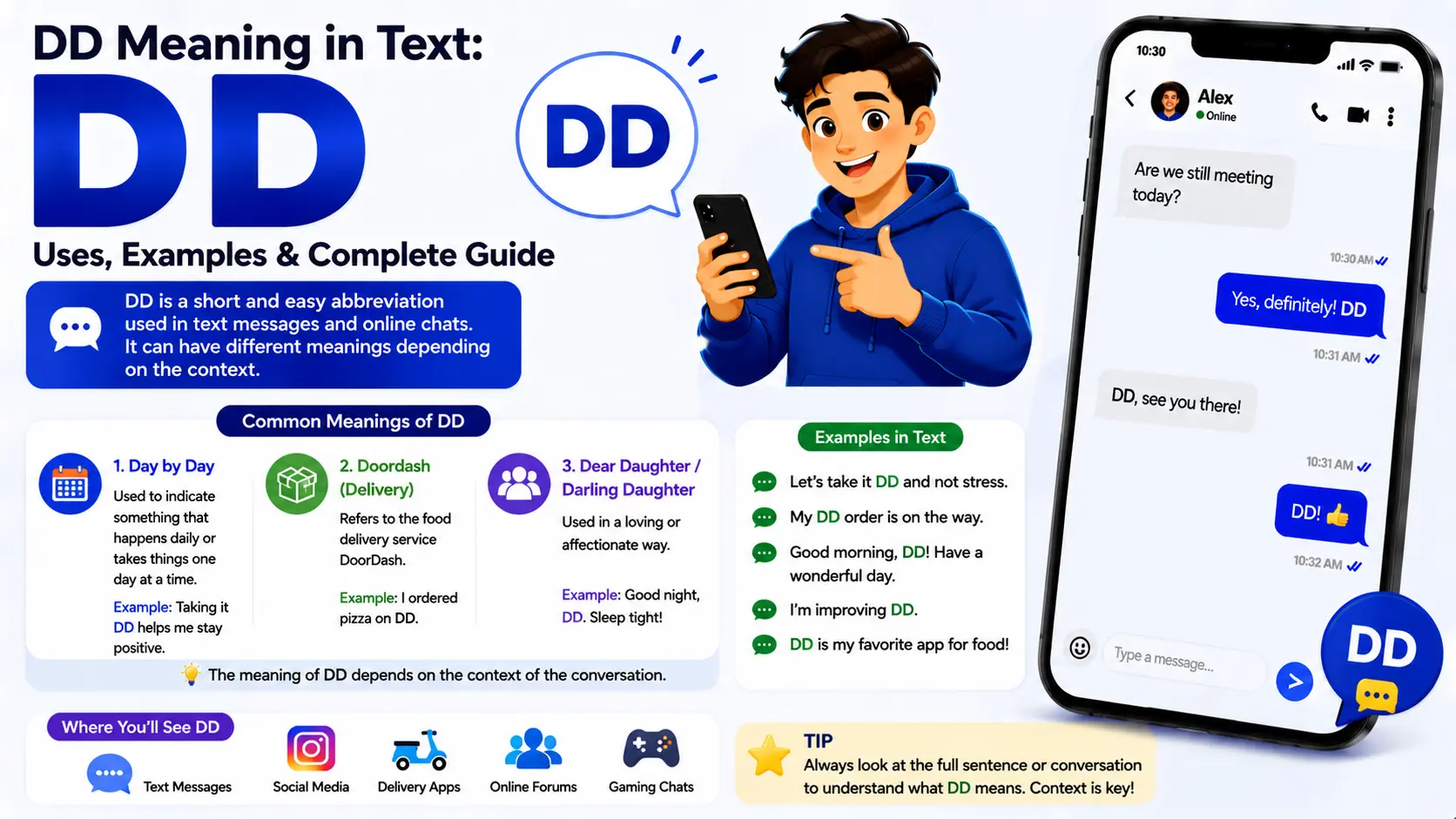
DD Meaning in Text – Quick Meaning
The most common meaning of DD in text messaging is:
DD = Dear Daughter
It is often used by parents, family members, and people participating in parenting forums or online communities.
Other common meanings include:
- Dear Daughter
- Daughter
- Designated Driver
- Due Diligence (in business or finance discussions)
Examples
“My DD starts school next week.”
“I’m so proud of my DD today.”
“Who’s the DD tonight?”
The correct interpretation depends entirely on the conversation.
Origin & Background
The abbreviation DD became popular long before modern social media exploded.
In parenting forums during the early internet era, members frequently used family-related shorthand. Instead of repeatedly typing “my daughter” or “dear daughter,” users began writing DD. Similar abbreviations appeared as well:
- DS = Dear Son
- DH = Dear Husband
- DW = Dear Wife
These shortcuts saved time and helped create a sense of community among parents sharing stories online.
As texting became more common, DD spread beyond forums into text messages, Facebook groups, and messaging apps. Later, younger internet users encountered the abbreviation and sometimes interpreted it differently depending on the platform.
Today, DD remains especially common in parenting communities, family discussions, and casual text conversations.
Real-Life Conversations
WhatsApp Conversation
Person A: How was your weekend?
Person B: Pretty busy. My DD had a dance competition.
Person A: Did she enjoy it?
Person B: She loved every minute of it.
Instagram DM
Person A: That birthday cake looked amazing!
Person B: Thanks! My DD helped decorate it.
Person A: She did a great job.
TikTok Comments
Person A: Your daughter is adorable!
Person B: Thank you! My DD is always making us laugh.
Person A: She definitely has a big personality.
Text Message
Person A: Are you coming to the party tonight?
Person B: Yes, but I’m the DD.
Person A: Good choice. We’ll see you there.
These examples show how the same abbreviation can have different meanings depending on context.
Emotional & Psychological Meaning
Language is about more than efficiency. The words people choose often reveal emotional connections.
When parents use DD to mean “Dear Daughter,” the abbreviation carries affection and warmth. It is not merely a shortcut. It reflects a close family relationship and a sense of pride.
Many parents naturally adopt terms like DD because they become part of their daily communication style. In online parenting groups, these abbreviations create a feeling of belonging and shared experience.
Imagine a mother posting online:
“My DD just graduated today, and I couldn’t be prouder.”
The abbreviation may be short, but the emotion behind it is significant. Readers immediately understand the loving relationship being described.
This demonstrates how modern digital communication combines convenience with emotional expression.
Usage in Different Contexts
Social Media
On Facebook groups, parenting communities, Instagram captions, and family discussions, DD usually means “Dear Daughter.”
Example:
“My DD won her first soccer match today.”
Friends & Relationships
Among friends, DD may occasionally refer to someone’s daughter.
Example:
“Can’t make it tonight. My DD isn’t feeling well.”
Work and Professional Settings
In business environments, DD often means Due Diligence rather than Dear Daughter.
Example:
“We need to complete DD before finalizing the acquisition.”
Professional audiences generally assume a business-related meaning.
Casual vs Serious Tone
Casual:
“My DD keeps stealing my snacks.”
Serious:
“My DD is recovering well after surgery.”
The abbreviation itself remains the same, but the emotional tone changes according to the topic.
When NOT to Use It
Although DD is widely understood in certain groups, there are situations where it may create confusion.
Professional Documents
Avoid using DD in formal reports unless everyone understands the abbreviation.
International Communication
Not all cultures or regions recognize parenting abbreviations.
Academic Writing
Write “daughter” instead of DD to maintain clarity.
Sensitive Discussions
In emotional or important conversations, full words often feel more personal and respectful.
For example:
“My daughter passed her exam.”
This may feel warmer and clearer than using an abbreviation.
Common Misunderstandings
Several misunderstandings surround DD.
Assuming Only One Meaning
Many people think DD always means Dear Daughter, but it can have multiple interpretations.
Confusing It with Designated Driver
In social settings, DD often refers to the person responsible for driving others safely.
Misreading the Tone
Some readers interpret DD as purely functional, while others see it as affectionate.
Missing Context
Without surrounding information, the abbreviation can easily be misunderstood.
For example:
“My DD was amazing tonight.”
This likely means daughter.
But:
“Need a DD for the party.”
This almost certainly means designated driver.
Comparison Table
| Expression | Meaning | Usage |
|---|---|---|
| DD | Dear Daughter | Parenting and family conversations |
| DS | Dear Son | Parenting discussions |
| DH | Dear Husband | Family and relationship forums |
| DW | Dear Wife | Family-related conversations |
| Daughter | Literal full word | Formal and informal communication |
| DD (Designated Driver) | Responsible driver | Social events |
| Son | Opposite family role | Family conversations |
| Child | Gender-neutral term | General discussions |
Key Insight
The meaning of DD depends far more on context than the letters themselves. Understanding who is speaking and what they are discussing usually reveals the intended interpretation immediately.
Variations and Types of DD
1. Dear Daughter (DD)
The most common parenting-related meaning.
2. Daughter (DD)
A simple shorthand reference to a daughter.
3. Designated Driver (DD)
The person who stays sober and drives others safely.
4. Due Diligence (DD)
Business investigation before a major decision.
5. Digital Download (DD)
Used in gaming and software communities.
6. Daily Discussion (DD)
Common in online forums and community groups.
7. Double Date (DD)
Occasionally used in social conversations.
8. Development Diary (DD)
Popular in gaming and software development communities.
9. Data Dictionary (DD)
Technical and database-related usage.
10. Direct Deposit (DD)
Used in banking and payroll discussions.
How to Respond When Someone Uses DD
Casual Replies
- “How’s your DD doing?”
- “That’s great to hear about your DD!”
- “She sounds wonderful.”
Funny Replies
- “Your DD sounds more organized than most adults.”
- “I think your DD deserves a trophy.”
Mature Replies
- “You must be very proud of her.”
- “Congratulations to your DD on that achievement.”
Respectful Replies
- “Please send my best wishes to your DD.”
- “I hope your DD is doing well.”
The best response depends on the tone and context of the conversation.
Regional & Cultural Usage
Western Culture
DD is frequently recognized as Dear Daughter within parenting groups and online forums.
Asian Culture
The abbreviation is less universally understood. Many people prefer writing the full word “daughter.”
Middle Eastern Culture
Usage varies significantly. English-speaking online communities may recognize DD, while others may not.
Global Internet Usage
Online parenting spaces around the world commonly use DD as shorthand for Dear Daughter.
Generational Differences
Gen Z
Gen Z tends to use newer abbreviations and may be less familiar with parenting-focused shorthand unless encountered online.
Millennials
Millennials are more likely to recognize DD because many participated in forums, blogs, and parenting communities where the abbreviation became popular.
Is It Safe for Kids?
Yes. DD is generally considered a safe and family-friendly abbreviation.
When used to mean Dear Daughter or Daughter, it contains no inappropriate content. However, children should still learn that abbreviations can have multiple meanings depending on context.
Teaching context awareness helps young users communicate more effectively online.
FAQs
What does DD stand for in texting?
Most commonly, DD means “Dear Daughter” or simply “Daughter.”
Does DD always mean daughter?
No. It can also mean Designated Driver, Due Diligence, Digital Download, and several other terms.
What does DD mean in parenting forums?
In parenting communities, DD almost always means Dear Daughter.
What does DD mean at a party?
At social events, DD usually means Designated Driver.
Is DD a compliment?
Not exactly. However, when used as Dear Daughter, it often reflects affection and warmth.
Can DD be used professionally?
Yes, but in professional settings it usually refers to Due Diligence rather than Dear Daughter.
Why do people use DD instead of daughter?
Many people use it as a convenient shorthand and because it became a long-standing tradition in online parenting communities.
Conclusion
DD is a simple abbreviation with surprisingly diverse meanings. In most family and parenting conversations, it stands for Dear Daughter and conveys affection, pride, and connection. In social settings, it may refer to a Designated Driver, while business professionals often use it to mean Due Diligence.
The key to understanding DD is paying attention to context. The surrounding conversation almost always reveals the intended meaning.
As digital communication continues to evolve, abbreviations like DD remain useful because they save time while still carrying emotional meaning. Once you understand the context behind the letters, you’ll be able to use and interpret DD confidently in texts, social media posts, and everyday conversations.