
If you’ve recently received a message containing just the letter “E”, you’re not alone in wondering what it means. Many people encounter this single-letter response in text messages, social media comments, gaming chats, and online conversations and immediately feel confused.
Unlike traditional abbreviations that stand for a specific phrase, “E” can carry different meanings depending on the platform, context, and the relationship between the people communicating. Sometimes it is used humorously, sometimes as a random response, and other times as an inside joke shared among internet users.
The reason so many people search for “what does e mean in text” is because the letter often appears without explanation. It can seem meaningless at first glance, yet it continues to show up across digital conversations.
This guide explains exactly what “E” means, where it came from, how people use it today, and how to respond when someone sends it to you.
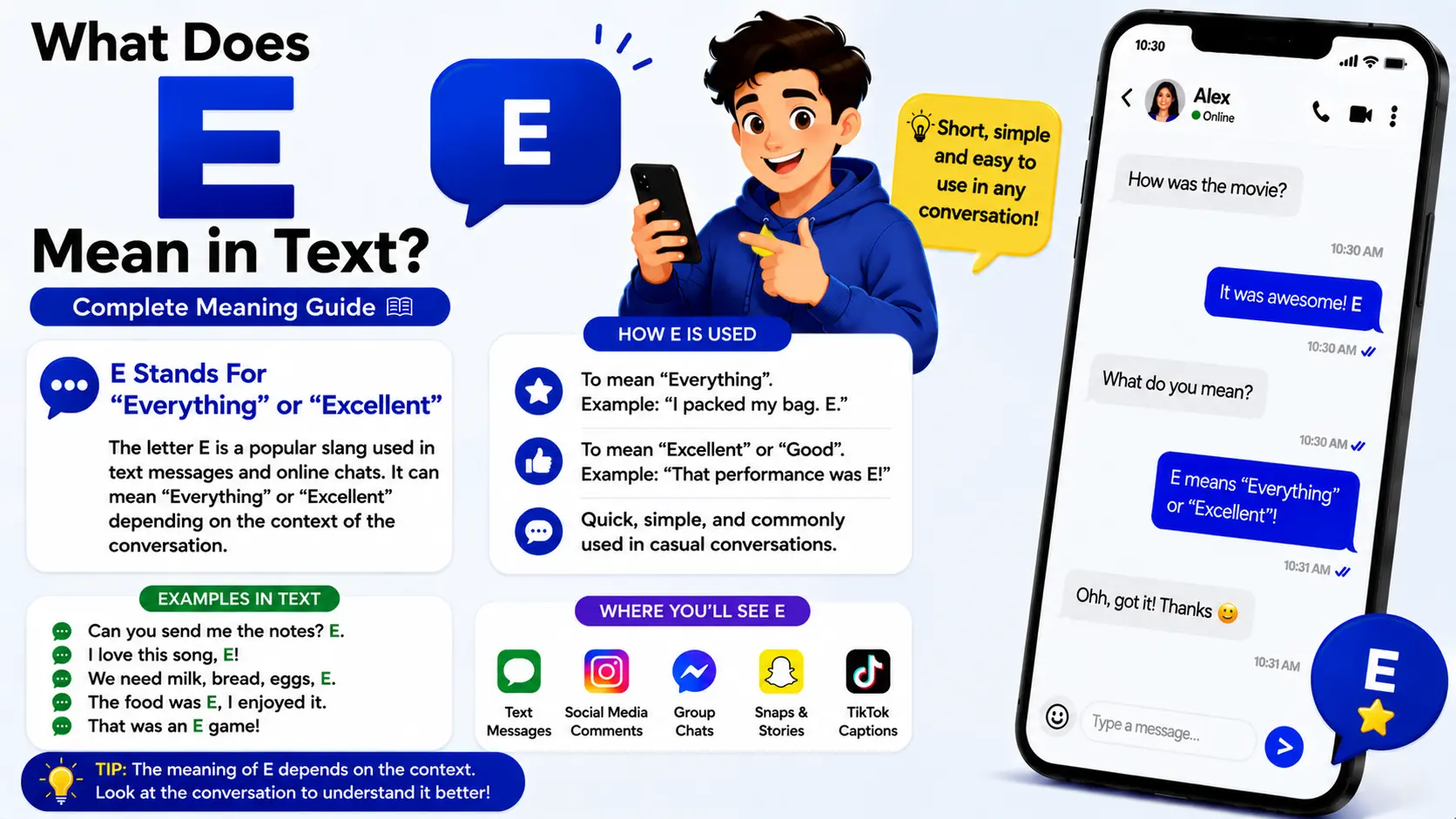
What Does E Mean in Text? Quick Meaning
In modern texting and internet culture, “E” is often used as a humorous, random, or intentionally simple response.
Common meanings include:
- A joke response with no deep meaning
- A way to acknowledge a message casually
- A meme-based reaction
- A random expression used for humor
- A minimalist reply when someone doesn’t know what else to say
Examples
“How was your day?”
“E”
“What are you doing?”
“E”
“Why did you comment only E?”
“Because E.”
In many cases, the humor comes from the fact that the response appears completely unexpected.
Origin & Background
The popularity of “E” can be traced back to internet meme culture.
One major influence came from gaming communities where random letters, sounds, and absurd humor became popular. Online forums, video comments, and multiplayer games helped spread the trend.
Over time, “E” became associated with ironic humor. Instead of giving a meaningful response, people would simply type the letter and allow the randomness itself to become the joke.
Social media accelerated this trend. Platforms like Instagram, TikTok, YouTube, Discord, and Reddit encouraged short, attention-grabbing interactions. A single letter could generate curiosity and engagement.
As internet culture evolved, “E” transformed from a random character into a recognizable meme understood by many younger users.
Today, it often represents:
- Internet humor
- Absurdity
- Casual participation
- Minimal effort communication
- Shared meme culture
Its meaning is usually understood through context rather than dictionary definitions.
Real-Life Conversations
WhatsApp Conversation
Person A: Did you finish the assignment?
Person B: E
Person A: That’s not an answer.
Person B: Exactly.
Instagram DM
Person A: Why are you awake at 3 AM?
Person B: E
Person A: Fair enough.
TikTok Comments
Person A: Can someone explain this video?
Person B: E
Person C: The explanation somehow makes sense.
Text Message
Person A: Are you excited for tomorrow?
Person B: E
Person A: Nervous?
Person B: A little.
In this example, “E” acts as an emotional placeholder when someone struggles to express their feelings directly.
Emotional & Psychological Meaning
Although “E” often appears meaningless, it can communicate subtle emotions.
Sometimes people use it when they feel:
- Awkward
- Unsure what to say
- Playful
- Bored
- Overwhelmed
- Amused
Modern communication increasingly favors quick responses over lengthy explanations. A single letter can signal presence without requiring a detailed reply.
Psychologically, it reflects a trend toward minimalist communication. People often want to stay connected while investing very little effort into the interaction.
A Real-Life Style Scenario
Imagine texting a friend after a stressful exam.
You ask:
“How did it go?”
Instead of writing a paragraph, they reply:
“E.”
You immediately sense that they are emotionally exhausted and not ready to discuss it. The letter becomes a shorthand for feelings that are difficult to explain.
This is why context matters more than the actual character itself.
Usage in Different Contexts
Social Media
On social media, “E” is frequently used as a joke.
People may comment it under videos, photos, or memes simply to participate in the conversation or continue an ongoing joke.
Friends & Relationships
Among friends, “E” usually signals humor or casual communication.
It may indicate:
- Shared internet culture
- Playfulness
- Light sarcasm
- Friendly teasing
Work and Professional Settings
Using “E” in professional communication is generally not recommended.
Coworkers or clients may not understand the reference and could interpret it as careless or unprofessional.
Casual vs Serious Tone
In casual conversations, “E” can be funny.
In serious discussions involving emotions, conflict, or important information, it may appear dismissive or insensitive.
Understanding the tone of the conversation is essential.
When NOT to Use It
There are situations where using “E” may create confusion or frustration.
Avoid using it when:
- Someone is sharing bad news
- A professional response is expected
- Giving instructions
- Discussing important decisions
- Communicating with people unfamiliar with internet slang
For example, if someone says:
“My grandfather is in the hospital.”
Responding with “E” could appear disrespectful even if no harm was intended.
Context determines appropriateness.
Common Misunderstandings
Many people misunderstand the meaning of “E.”
Mistake 1: Thinking It Has One Fixed Definition
Unlike abbreviations such as LOL or BRB, “E” does not always mean the same thing.
Mistake 2: Assuming It Is a Typing Error
Sometimes people intentionally send “E” as a joke.
Mistake 3: Interpreting It as Rudeness
While it can seem dismissive, many users intend it humorously.
Mistake 4: Believing Everyone Understands It
Internet culture varies by age, region, and social group. Not everyone recognizes the meme.
Mistake 5: Taking It Literally
The letter itself is less important than the context surrounding it.
Comparison Table
| Expression | Meaning | Tone | Usage |
|---|---|---|---|
| E | Random meme response | Playful | Casual internet culture |
| LOL | Laughing | Friendly | Texting and social media |
| Meh | Indifference | Neutral | Casual conversations |
| K | Okay | Brief | Text messages |
| Hmm | Thinking | Reflective | Conversations |
| BRB | Be right back | Practical | Online chats |
| Seriously | Opposite of E’s randomness | Direct | Important discussions |
| Detailed Reply | Opposite communication style | Thoughtful | Professional and serious contexts |
Key Insight
What makes “E” unique is that it often communicates through shared understanding rather than literal meaning. The humor comes from its simplicity and unpredictability.
Variations and Types
1. E
The basic version used as a standalone response.
2. e
A lowercase variation that feels even more casual.
3. EEE
Used for exaggerated humor or emphasis.
4. E?
Shows confusion or questioning.
5. E!
Expresses excitement or playful energy.
6. Eeeee
A stretched version used for dramatic effect.
7. Big E
Sometimes used jokingly to make the meme feel more important.
8. The E
Treats the letter as a legendary or iconic object.
9. E Moment
Describes a funny or absurd situation.
10. E Energy
Refers to chaotic, random, internet-style behavior.
How to Respond When Someone Uses It
Casual Replies
- Same.
- Fair enough.
- Mood.
- I understand.
Funny Replies
- The wisdom is unmatched.
- Deep words.
- Inspirational.
- Truly life-changing.
Mature Replies
- Want to talk about it?
- Sounds like you’re tired.
- I’m listening if you need anything.
Respectful Replies
- Got it.
- Thanks for responding.
- Let me know if you’d like to discuss further.
Your response should match the tone of the conversation.
Regional & Cultural Usage
Western Culture
In North America and Europe, “E” is largely associated with meme culture and online humor.
Users often recognize it as intentionally random.
Asian Culture
Younger internet users may understand the joke through gaming, anime, and social media communities.
However, interpretation varies widely between countries.
Middle Eastern Culture
Many younger users encounter “E” through global platforms like TikTok, Instagram, and gaming networks.
Older generations may find it confusing.
Global Internet Usage
The internet has created a shared culture where memes spread rapidly across borders.
As a result, “E” can often be recognized regardless of language.
Generational Differences
Gen Z
Generally understands “E” as meme humor.
Many use it naturally in online conversations.
Millennials
Some recognize the trend, especially those active on social media.
Others may need context.
Older generations often interpret it literally and may not understand the joke immediately.
Is It Safe for Kids?
Yes, “E” is generally safe for kids.
The letter itself is not offensive and does not contain inappropriate content.
However, parents should remember that internet slang constantly evolves. Understanding the context in which children use online expressions is always helpful.
In most situations, “E” is simply a harmless joke or meme.
Frequently Asked Questions
What does E mean in a text message?
It usually acts as a humorous, random, or minimalist response rather than a formal abbreviation.
Is E considered slang?
Yes. It functions as internet slang and meme culture communication.
Does E stand for a specific phrase?
Usually no. Its meaning depends on context rather than a fixed definition.
Why do people comment E online?
Many users do it for humor, irony, or participation in internet memes.
Is E rude?
Not necessarily. However, it can seem dismissive in serious conversations.
What should I reply when someone texts E?
You can respond casually, humorously, or ask for clarification depending on the situation.
Do all generations understand E?
No. Younger internet users are generally more familiar with its meme-related meaning.
Conclusion
The meaning of “E” in text may seem confusing at first, but its popularity reveals something interesting about modern communication. Not every message is meant to deliver information. Sometimes people communicate through humor, shared cultural references, or simple acknowledgment.
In most cases, “E” is a playful expression rooted in internet culture. It can signal amusement, randomness, emotional exhaustion, or simply a desire to participate without saying much.
The key to understanding it is context. Pay attention to the conversation, the platform, and the relationship between the people involved.
Once you recognize the cultural background behind it, that mysterious single letter becomes much easier to understand. And the next time someone sends you “E,” you’ll know exactly why.