
If you’ve spent any time on TikTok, Instagram, Snapchat, or group chats, you’ve probably come across someone saying they’re “fried.” At first glance, the word might sound confusing. Are they talking about food, feeling exhausted, or something else entirely?
The truth is that “fried” has several meanings in digital communication, and the intended meaning depends on the conversation and the people involved. Sometimes it describes someone who is mentally drained after a long day. Other times, it refers to someone laughing so hard they can barely think straight. In certain social circles, it can also describe someone who is under the influence of drugs or alcohol.
Because the slang has evolved through internet culture, many people search for what does fried mean in text to avoid misunderstandings. Whether you’re reading a friend’s message, scrolling through social media comments, or chatting online, understanding this expression helps you interpret conversations more naturally.
In this guide, you’ll learn where the term came from, how its meaning has changed over time, and when it’s appropriate to use it. You’ll also see realistic conversation examples that show how people actually use “fried” in everyday texting.
What Does Fried Mean in Text? Quick Meaning
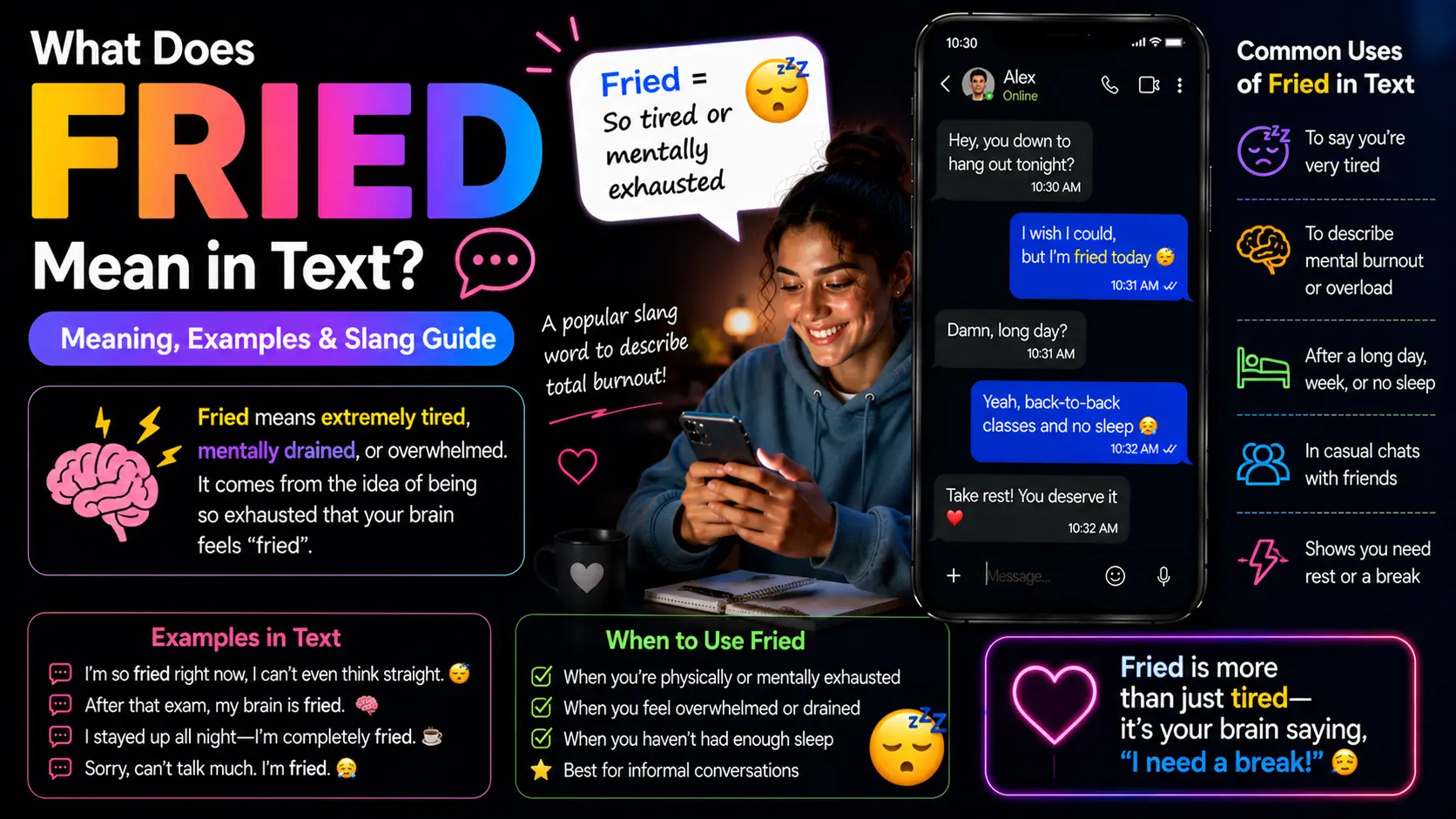
In texting and online conversations, fried usually means that someone is mentally, emotionally, or physically worn out. Depending on the situation, it may also describe someone who is extremely amused, overwhelmed, or intoxicated.
Common meanings include:
- Feeling mentally exhausted after studying or working.
- Being emotionally drained from a stressful experience.
- Laughing so hard that you can barely think.
- Being under the influence of alcohol or recreational drugs in informal conversations.
The surrounding conversation almost always reveals which meaning is intended.
Example messages
“I studied for six hours straight. My brain is completely fried.”
“That video was so funny. I’m absolutely fried.”
“After that double shift, I’m fried. I’m going straight to bed.”
In most everyday conversations, the first meaning, being mentally exhausted, is by far the most common.
Origin and Background of “Fried”
The slang use of fried has existed for decades, long before smartphones and social media became part of daily life.
Originally, the word simply referred to cooking food in hot oil. Over time, English speakers began using it metaphorically to describe something that had been overworked or damaged. Just as excessive heat can affect food, a person’s brain or energy can feel “overcooked” after too much stress or activity.
By the 1960s and 1970s, the expression became closely associated with counterculture communities. During this period, people often used “fried” to describe someone who appeared heavily intoxicated or mentally overwhelmed after using drugs. This meaning spread through music, movies, and youth culture.
As internet communication grew, the expression became much broader. Social media users began using fried in a less serious and more humorous way. Instead of referring only to intoxication, it often described everyday situations like:
- Staying awake all night finishing assignments.
- Working long hours without a break.
- Watching countless funny videos until your brain feels overloaded.
- Feeling emotionally exhausted after a difficult conversation.
Platforms like TikTok, Instagram, X, Snapchat, and Discord helped popularize this lighter interpretation. Today, millions of users casually write things like:
“I’m fried after finals.”
“That meme fried my brain.”
“Today’s meeting completely fried me.”
The phrase has become part of internet humor because it exaggerates everyday exhaustion in a relatable way.
Another reason for its popularity is its flexibility. One short word can communicate fatigue, stress, confusion, amusement, or even disbelief without requiring a lengthy explanation.
Real-Life Conversations
The best way to understand what fried means in text is to see how real people naturally use it. Below are realistic examples from different messaging platforms.
1. WhatsApp Conversation
Person A: How did your chemistry exam go?
Person B: Honestly, I’m fried. I don’t even remember half the questions anymore.
Person A: Sounds rough. Get some sleep and don’t think about it tonight.
In this conversation, fried means mentally exhausted after an intense exam.
2. Instagram DM
Person A: Did you watch that prank reel I sent?
Person B: Yes! I laughed so hard. I’m fried.
Person A: Same. I replayed it five times.
Here, fried expresses being overwhelmed with laughter and amusement.
3. TikTok Comments
Person A: This edit is absolutely ridiculous.
Person B: My brain is fried after watching this.
Person C: I had to replay it because I missed half the details.
In TikTok culture, brain fried often means feeling mentally overloaded because something is funny, chaotic, fast-paced, or visually intense.
4. Text Message Between Friends
Person A: Want to hang out tonight?
Person B: I’d love to, but I’m completely fried after work.
Person A: No worries. Let’s do tomorrow instead.
This example shows one of the most common everyday uses of the slang. It politely explains that someone is simply too tired to socialize.
These conversations highlight why context matters. The word itself stays the same, but its meaning shifts depending on the situation. Most of the time, people use fried to describe feeling mentally drained or emotionally overwhelmed rather than anything literal.
Emotional & Psychological Meaning
At first glance, fried seems like a casual slang word. However, it often communicates much more than simple tiredness. In many conversations, it reflects a person’s emotional state, mental capacity, and even their need for a break.
When someone texts, “I’m fried,” they’re usually saying that they’ve reached their limit. Their mind feels overloaded, their attention is fading, and they may not have the energy to continue a conversation or complete another task.
Psychologically, the word is appealing because it quickly paints a vivid picture. Instead of writing a long explanation about stress or exhaustion, people can summarize their feelings with a single relatable word.
Depending on the situation, fried may express:
- Mental exhaustion after studying or working.
- Emotional burnout following stressful events.
- Sensory overload after consuming too much online content.
- Extreme amusement after laughing nonstop.
- Temporary confusion caused by information overload.
Modern communication encourages brevity. Slang terms like fried allow people to express complex emotions in just one word while expecting others to understand the feeling immediately.
A relatable scenario
Imagine finishing an eight-hour workday, sitting through two online meetings, answering dozens of emails, and then trying to help your younger sibling with homework. Later that evening, a friend asks if you want to join a video call.
Instead of explaining everything you’ve done, you simply reply:
“I’m fried today. Can we talk tomorrow?”
Most people instantly understand that you’re mentally and emotionally drained, not upset with them.
This emotional efficiency is one reason the expression has become so common in texting.
Usage in Different Contexts
The meaning of fried changes slightly depending on where and how it’s used. Understanding these differences helps you communicate naturally and avoid confusion.
Social Media
On platforms like TikTok, Instagram, Snapchat, and X, fried often appears in humorous or exaggerated posts.
Examples include:
- “My brain is fried after scrolling for three hours.”
- “That plot twist fried me.”
- “This comment section has me fried.”
Here, the word usually conveys entertainment, mental overload, or disbelief rather than serious exhaustion.
Friends and Relationships
Among friends, fried commonly describes genuine tiredness after school, work, travel, or emotionally demanding situations.
Examples:
- “I’m fried after football practice.”
- “Today’s family gathering completely fried me.”
- “We’ve been shopping all day. I’m fried.”
Because close friends understand each other’s routines, the expression often feels honest and relatable.
Work and Professional Settings
In professional communication, it’s usually better to choose more formal language.
Instead of writing:
“I’m fried after today’s meeting.”
You could say:
- “I’m mentally exhausted.”
- “It’s been a demanding day.”
- “I’m feeling quite drained.”
Using professional wording helps maintain a polished tone while still expressing how you feel.
Casual vs. Serious Tone
In casual conversations, fried sounds friendly, expressive, and natural.
In serious discussions about health, stress, or workplace burnout, however, the word may sound too informal.
For example:
Casual:
“I’m fried after gaming all weekend.”
Serious:
“I’ve been feeling mentally exhausted for several weeks.”
Choosing the right wording depends on your audience and the importance of the conversation.
When NOT to Use It
Although fried is widely understood online, there are situations where it may not be the best choice.
Formal workplace communication
Avoid using it in business emails, presentations, client meetings, or official reports.
Professional alternatives sound clearer and more respectful.
Academic writing
If you’re writing essays, research papers, or formal assignments, use standard expressions like:
- Mentally exhausted
- Emotionally drained
- Fatigued
- Overwhelmed
These terms are more appropriate in educational settings.
Sensitive conversations
If someone is discussing anxiety, depression, grief, or another serious emotional struggle, replying with “You’re fried” may sound dismissive.
A more thoughtful response acknowledges their feelings directly.
Cross-cultural communication
Not every English learner recognizes internet slang.
Using fried with international colleagues or people unfamiliar with online culture could create confusion.
Simple language often communicates more effectively in multicultural settings.
Common Misunderstandings
Because fried has multiple meanings, misunderstandings happen fairly often.
Mistaking it for intoxication
Some people assume that fried always means someone is under the influence of drugs or alcohol.
While this meaning still exists, it is no longer the most common one.
Today, many people simply mean they are mentally exhausted.
Taking it literally
English learners sometimes think the conversation is about cooking or food because of the original dictionary meaning.
Context almost always makes the intended meaning obvious.
Confusing tiredness with burnout
Saying you’re fried usually refers to temporary exhaustion.
It doesn’t necessarily mean you’re experiencing long-term burnout or a serious mental health issue.
Assuming it always means laughter
On social media, people sometimes comment:
“I’m fried.”
This could mean they laughed uncontrollably.
It could also mean the video was confusing, emotionally intense, or mentally overwhelming.
Again, surrounding messages help clarify the meaning.
Comparison Table
| Expression | Meaning | Typical Tone | Common Situation |
|---|---|---|---|
| Fried | Mentally exhausted, overwhelmed, or extremely amused | Casual | Texting, social media, chatting with friends |
| Burned out | Long-term emotional or professional exhaustion | Serious | Work, mental health discussions |
| Drained | Low energy after physical or emotional effort | Neutral | Daily conversations |
| Exhausted | Extremely tired | Neutral | Everyday speech and professional settings |
| Wiped out | Completely worn out | Informal | After sports, work, or travel |
| Dead | Laughing extremely hard or completely tired | Internet slang | Memes and humorous chats |
| Cooked | Defeated, overwhelmed, or in trouble | Modern slang | Gaming and social media |
| Locked in | Highly focused and motivated | Positive slang | Studying, sports, productivity |
Key Insight
Although these expressions are similar, fried is one of the most flexible. It can describe exhaustion, confusion, information overload, or uncontrollable laughter depending on the context. That versatility is what keeps it popular across texting and social media.
Variations and Types of “Fried”
Internet slang constantly evolves, and people often combine fried with other words to create more specific meanings.
1. Brain Fried
Your mind feels overloaded after too much studying, gaming, or scrolling.
Example: “My brain is fried after revision.”
2. Mentally Fried
Emphasizes emotional or cognitive exhaustion.
Example: “I’m mentally fried after today’s interviews.”
3. Emotionally Fried
Describes feeling emotionally worn out after a difficult experience.
Example: “That conversation left me emotionally fried.”
4. Completely Fried
Adds emphasis to show extreme exhaustion.
Example: “I’m completely fried after moving all weekend.”
5. Absolutely Fried
A stronger version often used for dramatic effect.
Example: “I’m absolutely fried after those exams.”
6. Fried Brain
A playful variation suggesting your brain has stopped working properly because of overload.
Example: “I can’t solve another question. Fried brain.”
7. Deep Fried
A humorous exaggeration meaning extremely confused, overwhelmed, or exhausted.
Example: “That movie was so weird my brain is deep fried.”
8. Extra Fried
Used jokingly to describe an unusually high level of tiredness or confusion.
Example: “After that double shift, I’m extra fried.”
9. Fried From Work
Specifically refers to exhaustion caused by professional responsibilities.
Example: “I’m fried from work today.”
10. Fried After School
Common among students after classes, homework, sports, or exams.
Example: “I’m fried after school. I’ll reply later.”
How to Respond When Someone Uses “Fried”
The best response depends on how the other person is using the word. Are they tired, emotionally overwhelmed, laughing uncontrollably, or simply joking around? Paying attention to the context helps you reply naturally and keeps the conversation flowing.
Casual Replies
These responses work well with friends, classmates, or family members.
- “Yeah, you should get some rest.”
- “I get it. Today was exhausting.”
- “Take a break. You deserve it.”
- “Same here. It’s been a long day.”
- “Hopefully tomorrow will be easier.”
These replies acknowledge the person’s feelings without making the conversation feel overly serious.
Funny Replies
If the conversation has a playful tone, humor can make your response more engaging.
- “Your brain needs a software update.”
- “Recharge mode activated!”
- “Time to plug yourself into a charger.”
- “You’ve officially reached 1% battery.”
- “Go eat something before your brain quits.”
Friendly jokes often strengthen conversations among close friends, especially when everyone understands the humor.
Mature Replies
When someone genuinely sounds overwhelmed, a thoughtful response is more appropriate.
- “You’ve been working really hard lately.”
- “Take care of yourself. You don’t have to do everything today.”
- “Make sure you get enough sleep tonight.”
- “It’s okay to step away and recharge.”
- “If you need to talk, I’m here.”
These responses show empathy while encouraging healthy self-care.
Respectful Replies
Sometimes a simple, supportive message is all that’s needed.
- “I hope tomorrow is less stressful.”
- “Take your time replying.”
- “Rest well.”
- “Thanks for letting me know.”
- “I appreciate your honesty.”
Respectful replies are especially useful when talking with coworkers, acquaintances, or people you don’t know very well.
Regional & Cultural Usage
Although fried is widely recognized in English-speaking online communities, its meaning and popularity vary across different cultures and generations.
Western Culture
In countries such as the United States, Canada, the United Kingdom, and Australia, fried is common everyday slang.
People frequently use it to describe mental exhaustion after work, school, exercise, or long social events. Younger speakers also use it humorously when reacting to memes, viral videos, or unexpected situations.
Because the expression has existed for decades, many adults understand it even if they don’t use it regularly.
Asian Culture
In many Asian countries, English internet slang spreads quickly through social media, gaming communities, and entertainment platforms.
However, non-native English speakers may interpret fried literally unless they’re familiar with Western online culture.
Among younger English-speaking users, the expression is becoming increasingly recognizable, especially in international gaming and fandom communities.
Middle Eastern Culture
English slang is widely used among younger internet users, but its popularity varies depending on language background and exposure to global social media.
Some people understand fried immediately, while others prefer clearer expressions like tired, drained, or exhausted.
Choosing simple language is often the safest option when communicating with people from different linguistic backgrounds.
Global Internet Usage
Online communities have transformed fried into a versatile expression.
Today, you’ll find it in:
- TikTok captions
- Instagram comments
- Discord servers
- Snapchat conversations
- Gaming chats
- Reddit discussions
- YouTube comment sections
In these spaces, the word often describes exhaustion, sensory overload, confusion, or uncontrollable laughter.
Its flexibility is one reason it continues to trend across different platforms.
Generational Differences
Gen Z
Gen Z uses fried very naturally.
For many younger users, it can mean:
- Mentally exhausted
- Overstimulated
- Laughing uncontrollably
- Confused by chaotic online content
- Emotionally overwhelmed
The exact meaning usually depends on the context.
Millennials
Millennials commonly use fried to describe stress, work fatigue, parenting responsibilities, or busy schedules.
They are generally less likely to use it as a reaction to memes or viral internet humor, although many understand those newer meanings.
Across both generations, the word remains highly adaptable and continues to evolve with internet culture.
Is It Safe for Kids?
Yes, fried is generally safe for kids when it is used to mean very tired, mentally exhausted, or overwhelmed.
However, parents and teachers should be aware that the word can sometimes refer to being under the influence of drugs or alcohol in certain social circles.
Teaching children to pay attention to context is the best approach. In most everyday conversations, especially among students, fried simply means someone feels mentally worn out after studying, sports, gaming, or other demanding activities.
Frequently Asked Questions
What does “fried” usually mean in text?
It most commonly means someone feels mentally or physically exhausted after work, school, or another demanding activity.
Does “fried” always refer to drugs?
No. While it can refer to intoxication in some contexts, today’s online conversations more often use it to describe tiredness, stress, or mental overload.
Is “fried” a positive or negative word?
It is usually neutral. The meaning depends on the situation. Someone might use it after a long workday, after laughing at a funny video, or after completing a difficult challenge.
Can I use “fried” in a business email?
It’s better not to. Professional communication usually calls for phrases such as mentally exhausted, drained, or fatigued.
Why do people say “my brain is fried”?
They mean they’ve been thinking, studying, or concentrating so much that they find it difficult to process more information.
Is “fried” popular on social media?
Yes. It is widely used across TikTok, Instagram, Snapchat, Discord, Reddit, and other online communities because it quickly expresses exhaustion, overload, or amusement.
Can “fried” mean laughing too hard?
Yes. Some people use it after seeing an extremely funny meme, video, or comment. In these situations, it means they are laughing so much that they feel mentally overwhelmed.
Conclusion
Understanding what does fried mean in text is easier once you recognize that the expression is highly dependent on context. In most conversations, it simply means someone feels mentally exhausted, emotionally drained, or overwhelmed after a demanding experience. In other situations, it can describe laughing so hard that you can barely think, and in certain social circles, it may still refer to intoxication.
Like many modern slang terms, fried has evolved alongside digital communication. Social media, messaging apps, and online communities have expanded its meaning beyond its original associations, making it a versatile part of everyday internet language.
The key to interpreting the word correctly is to look at the surrounding conversation. Who is speaking? What happened just before they used the term? Answering those questions usually makes the intended meaning obvious.
As online language continues to change, expressions like fried remind us that communication is about more than dictionary definitions. It’s about shared experiences, emotion, and context. Once you understand how people use the word in real conversations, you’ll be able to recognize it confidently and use it naturally when the situation fits.