

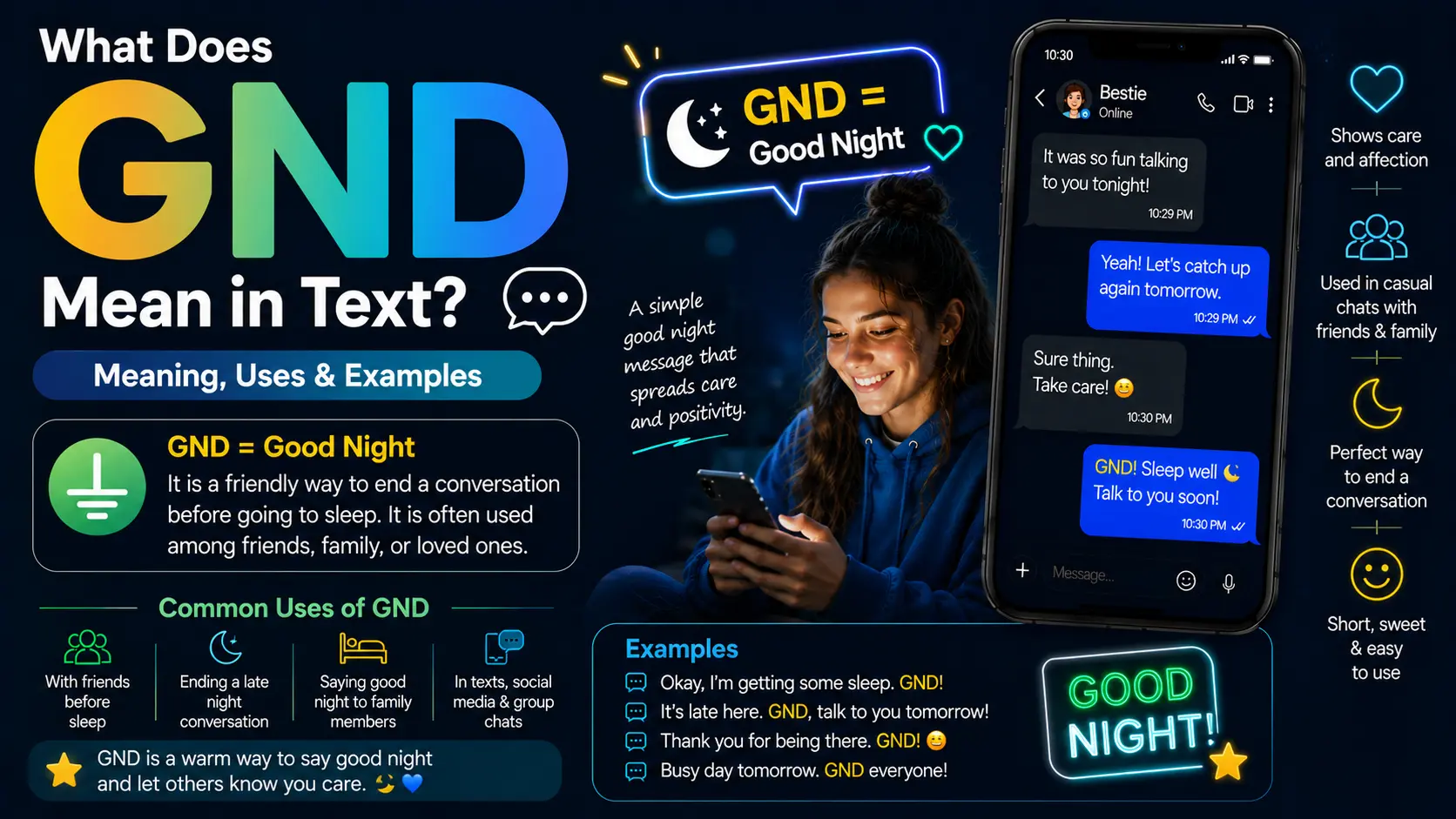
If you’ve received a message that simply says “GND”, you’re probably wondering what the sender meant. Unlike popular abbreviations such as “LOL” or “BRB,” GND is one of those short forms that can have different meanings depending on where you see it and who sends it.
In texting, social media, gaming chats, and online communities, people often shorten words to save time or make conversations flow more naturally. The challenge is that not every abbreviation has one universal meaning. A three-letter acronym like GND can represent a casual goodbye, a technical term, or even a community-specific expression.
That is why so many people search for “what does GND mean in text”. They want to understand the message correctly instead of guessing and responding awkwardly.
In this guide, you’ll learn the most common meanings of GND in text messages, where it came from, how people use it in real conversations, and when you should or should not use it yourself.
GND Meaning in Text: Quick Meaning
In everyday texting, GND usually stands for one of several meanings depending on the conversation.
The most common interpretations include:
- Good Night Dear or Good Night Darling
- Ground (especially in technical or gaming discussions)
- A shortened abbreviation understood within a specific friend group or online community
When someone sends GND before bedtime, they are often wishing someone a good night in a quick, affectionate way.
Simple Examples
“It’s getting late. GND ❤️”
“Talk tomorrow. GND!”
“I’m heading offline now. GND everyone.”
In a technical conversation, however, the meaning changes completely.
For example:
“Connect the black wire to GND.”
Here, GND means ground, referring to an electrical connection rather than a text abbreviation.
The surrounding conversation always tells you which meaning is intended.
Quick Summary
- Most common in personal texting: Good Night Dear
- Common in electronics and engineering: Ground
- Occasionally used with custom meanings inside gaming groups or private chats
- Context is the key to understanding it correctly
Origin and Background of GND
Like many internet abbreviations, GND did not begin with a single meaning. Instead, it developed in different communities for different purposes.
The Technical Origin
One of the oldest meanings of GND comes from electronics and electrical engineering.
For decades, engineers have used GND as the standard abbreviation for ground on circuit diagrams, computer hardware, batteries, power supplies, and electronic devices.
Anyone who has built a computer, repaired electronics, or studied electrical engineering has probably seen GND printed on a circuit board.
Because this abbreviation already existed long before smartphones became popular, many people still immediately associate GND with electronics rather than texting.
The Rise of Text Messaging
As mobile texting became part of daily life, people started shortening common phrases to save time.
Expressions like these quickly became normal:
- GM for Good Morning
- GN for Good Night
- TY for Thank You
- BRB for Be Right Back
Some users naturally expanded GN into GND, meaning Good Night Dear or Good Night Darling, especially when chatting with close friends, partners, or family members.
Although GN remains much more common, GND appears often enough in personal conversations that many people recognize it instantly.
Social Media Influence
Social media accelerated the spread of abbreviations.
Platforms with fast-moving conversations encouraged shorter messages that could be typed quickly.
People began using abbreviations on:
- Instagram direct messages
- Snapchat chats
- TikTok comment sections
- WhatsApp conversations
- Facebook Messenger
- Discord servers
In these environments, GND became another example of personalized texting shorthand.
Unlike official dictionary words, texting abbreviations evolve naturally. A phrase becomes popular because people find it convenient, not because anyone formally approves it.
Community-Based Meanings
One interesting aspect of internet language is that not every abbreviation means the same thing everywhere.
Different online communities often develop their own vocabulary.
For example:
- A gaming group may use GND with an inside joke.
- A programming team may immediately think of electrical ground.
- Close friends may always understand it as “Good Night Dear.”
- Family members might use it as a warm bedtime message.
This flexibility explains why newcomers sometimes become confused after seeing the same abbreviation used in completely different conversations.
Why Context Matters More Than the Letters
Modern digital communication relies heavily on context.
A message containing only three letters may seem unclear by itself, but when combined with previous messages, emojis, or the topic of discussion, its meaning usually becomes obvious.
Compare these examples:
Example 1
“I’m exhausted today. GND ❤️”
This clearly means a bedtime wish.
Example 2
“The sensor isn’t working because GND isn’t connected.”
This obviously refers to an electrical ground connection.
The exact same abbreviation creates two entirely different meanings because the surrounding conversation changes the interpretation.
How GND Reflects Modern Communication
Shortened expressions like GND reveal an interesting shift in the way people communicate online.
Today’s conversations often prioritize:
- Speed
- Convenience
- Familiarity
- Shared understanding
Friends who text every day rarely need complete sentences to understand one another.
Someone who receives “GND 😊” from a close friend immediately recognizes the warmth behind the message without needing the full phrase written out.
At the same time, people outside that relationship may not recognize the abbreviation at all. This creates small language communities where meaning depends on shared experiences rather than formal grammar.
That is one reason internet slang changes so quickly. New abbreviations appear, gain popularity for a while, and sometimes disappear as communication styles evolve.
Understanding these expressions is less about memorizing every acronym and more about paying attention to the people, platforms, and situations in which they are used.
Real-Life Conversations Using GND
One of the easiest ways to understand what GND means in text is by seeing how real people use it in everyday conversations. While the exact meaning depends on context, these examples show the most common way it appears in personal messaging.
WhatsApp Conversation
Person A:
Today felt so long. I can barely keep my eyes open.
Person B:
You should get some rest.
Person A:
Yeah, I’m going to sleep now. GND! 🌙
Person B:
Sleep well. Talk tomorrow!
Why it works:
Here, GND means Good Night Dear. It’s a warm and affectionate way to end the conversation without typing the full phrase.
Instagram DM Conversation
Person A:
Thanks for checking on me today. It really meant a lot.
Person B:
Of course. I hope tomorrow is better.
Person A:
I’m feeling much calmer now. GND ❤️
Person B:
Sweet dreams!
Why it works:
On Instagram, people often use abbreviations to keep conversations casual and friendly. The heart emoji makes the meaning even clearer.
TikTok Comments
Creator:
Stayed up editing this until 2 AM 😂
Commenter 1:
You deserve some sleep.
Commenter 2:
Exactly! GND and recharge for tomorrow.
Creator:
Haha, I definitely will.
Why it works:
Although less common in public comments, GND can be used playfully to encourage someone to get some rest.
Text Message Between Friends
Person A:
Big exam tomorrow. Wish me luck.
Person B:
You’ve studied hard. You’ll do great.
Person A:
Thanks! GND.
Person B:
Good luck tomorrow!
Why it works:
Among close friends, even a short abbreviation feels personal because both people already understand what it means.
Family Chat
Mom:
Don’t forget your doctor’s appointment tomorrow morning.
Son:
I won’t. Thanks for reminding me.
Mom:
Okay, GND.
Son:
Love you. Good night!
Why it works:
Some families naturally create their own texting habits. Once everyone understands the abbreviation, it becomes part of their daily communication.
Why These Conversations Feel Natural
Texting is different from formal writing.
People rarely worry about perfect grammar when chatting with someone they know well. Instead, they focus on expressing emotion quickly and naturally.
A short message like “GND ❤️” may only contain a few characters, yet it communicates several things at once:
- The conversation is ending.
- The sender wishes the other person well.
- The tone is warm and caring.
- The relationship is comfortable enough to use abbreviations.
That emotional efficiency explains why shortened phrases continue to thrive across messaging platforms.
Emotional and Psychological Meaning of GND
At first glance, GND looks like nothing more than three letters.
In reality, it often carries much more emotional weight than people realize.
Communication is not just about the words we choose. It is also about the feelings those words create.
When someone sends GND, especially as Good Night Dear, they are usually doing more than saying good night.
They are signaling care, connection, and emotional closeness.
A Small Message That Creates Comfort
Ending the day with a thoughtful message has become a common habit for many people.
Whether it’s a romantic partner, a close friend, or a family member, receiving a bedtime message often creates a sense of reassurance.
Even something as short as GND can communicate:
- I’m thinking about you.
- I hope you sleep well.
- Our conversation matters to me.
- I’ll talk to you again tomorrow.
Those feelings can strengthen relationships over time because consistency often matters more than long messages.
Why People Prefer Abbreviations
Modern communication happens quickly.
Many people send dozens or even hundreds of messages every day.
Abbreviations help reduce typing while keeping conversations warm and personal.
Instead of writing:
“Good night, dear. Sleep well and take care.”
Someone may simply send:
“GND ❤️”
The emotional meaning often stays the same because both people already understand the shorthand.
Digital Habits Shape Emotional Language
Messaging apps have changed how people express affection.
Years ago, people might have written long letters or lengthy emails.
Today, emotions are often communicated through:
- Short phrases
- Emojis
- Stickers
- Voice notes
- Simple abbreviations
That doesn’t necessarily make communication less meaningful.
Instead, people learn to attach emotional value to small digital habits.
A nightly “GND” message can become a comforting routine that both people look forward to.
The Psychology of Familiar Messages
Psychologists often describe routines as emotionally grounding.
When a familiar message arrives every evening, it creates predictability.
Predictability helps people feel connected because they know someone is thinking about them.
For example:
Every night before sleeping, two longtime friends exchange a quick message.
One writes:
“GND 😊”
The other replies:
“Sleep well!”
The conversation lasts only a few seconds, yet repeating this simple habit over months or years strengthens their friendship.
Sometimes, consistency speaks louder than long conversations.
Personal Experience Scenario
Imagine you’ve had a stressful day at work.
Your phone has been full of deadlines, notifications, and responsibilities.
Just before you put it away for the night, a close friend sends:
“GND. Tomorrow will be better.”
The message is short.
It doesn’t solve your problems.
But it reminds you that someone remembered you before ending their day.
That small moment of kindness can leave a surprisingly lasting impression.
Many people associate bedtime messages with emotional security because they represent care rather than obligation.
What GND Reveals About Modern Communication
The popularity of abbreviations like GND reflects several trends in today’s digital conversations.
People increasingly value communication that is:
- Fast without feeling cold.
- Brief without losing meaning.
- Personal without requiring lengthy explanations.
- Familiar enough to strengthen relationships over time.
Rather than replacing genuine emotion, abbreviations often become symbols of shared understanding.
When two people recognize the same shorthand, they are participating in a small language unique to their relationship.
That shared language builds familiarity, and familiarity often builds trust.
For this reason, GND is more than just another texting abbreviation.
In the right context, it becomes a simple but meaningful way to end the day with warmth, appreciation, and connection.
Real-Life Conversations Using GND
One of the easiest ways to understand what GND means in text is by seeing it used in realistic conversations. The same abbreviation can feel warm, casual, or completely technical depending on the situation.
Below are conversations that reflect how people actually use GND across popular messaging platforms.
WhatsApp Conversation
Person A:
I can’t believe tomorrow’s meeting starts at 8.
Person B:
I know. We’d better get some sleep.
Person A:
Definitely. GND! Hope tomorrow goes well.
Person B:
Thanks! GND 😊
Meaning:
Here, GND means Good Night Dear or simply a warm version of “Good night.” The emoji reinforces the friendly tone.
Instagram DM
Person A:
Your trip photos were amazing!
Person B:
Thank you! It was such a fun week.
Person A:
You deserve the break. Sleep well.
Person B:
Thanks! GND ❤️
Meaning:
The abbreviation adds warmth without making the message overly formal. Close friends often communicate this way.
TikTok Comments
Person A:
I’ve been watching videos for three hours.
Person B:
Same 😂
Person A:
Time to sleep.
Person B:
GND everyone. See you tomorrow!
Meaning:
In public comment sections, GND is simply a quick goodbye before logging off.
Text Message Between Partners
Person A:
Today was stressful, but talking to you made it better.
Person B:
I’m glad. Tomorrow will be easier.
Person A:
I hope so.
Person B:
GND ❤️ Sweet dreams.
Meaning:
In romantic conversations, GND feels affectionate and caring. It replaces a longer bedtime message while keeping the emotional connection.
Group Chat Example
Person A:
Anyone still awake?
Person B:
Barely.
Person C:
I’m signing off.
Person B:
Same here. GND everyone!
Person A:
Night! Talk tomorrow.
Meaning:
Here, GND is used as a friendly farewell to the whole group.
Technical Chat Example
Person A:
Why won’t the LED turn on?
Person B:
Check whether GND is connected properly.
Person A:
That fixed it!
Meaning:
This has nothing to do with saying good night. In electronics, GND refers to the ground connection.
Emotional and Psychological Meaning of GND
Although GND is only three letters, it often carries more emotion than people realize.
When someone sends “Good Night Dear” in its shortened form, they are usually doing more than ending a conversation. They are acknowledging the other person before going offline.
That small gesture can communicate care, comfort, and consistency.
It Creates a Sense of Connection
Modern conversations happen throughout the day.
People exchange updates, jokes, photos, and voice notes whenever they have a free moment. Ending the day with a simple “GND” signals that the conversation matters enough to end on a positive note.
It tells the other person:
- I’m thinking about you.
- I hope you sleep well.
- We’ll talk again tomorrow.
Those messages may never be written explicitly, but they are often understood emotionally.
It Shows Affection Without Being Overly Dramatic
Not everyone enjoys writing long emotional messages.
Some people prefer small expressions that still communicate warmth.
Instead of saying:
“I sincerely hope you have a peaceful night and get enough rest.”
They simply type:
“GND ❤️”
The emotional meaning stays surprisingly strong despite the short length.
It Builds Daily Habits
Many friendships and relationships develop comforting routines.
Some people always send:
- Good morning
- Good night
- Have a safe trip
- Let me know when you get home
These habits create reliability.
Over time, a nightly “GND” becomes less about the words themselves and more about the consistency behind them.
Missing that message can even feel noticeable because people become accustomed to the routine.
It Reflects Today’s Communication Style
Digital conversations have changed how people express emotions.
Instead of lengthy letters or emails, emotions are now often communicated through:
- Short abbreviations
- Emojis
- Stickers
- GIFs
- Voice notes
GND fits naturally into this style.
Its simplicity makes it quick to type while still carrying emotional value.
Why People Prefer Abbreviations
There are several psychological reasons people shorten common expressions.
Convenience
Typing three letters is faster than writing an entire sentence.
Familiarity
Friends who message every day often understand each other’s shortcuts without explanation.
These shared habits create a stronger sense of belonging.
Emotional Comfort
Using familiar abbreviations can make conversations feel relaxed and informal.
It removes pressure to sound perfect while still expressing kindness.
Digital Identity
Many people develop their own texting style.
Some always type full sentences.
Others use lowercase letters.
Some rarely use punctuation.
Others rely heavily on emojis.
Using GND can simply become part of someone’s personal communication style.
A Personal-Style Scenario
A close friend of mine has a demanding work schedule.
Even on the busiest days, our conversations sometimes consist of only a few messages.
Almost every evening, one of us sends:
“GND. Talk tomorrow.”
It isn’t a long conversation.
It isn’t deeply emotional.
Yet it quietly reminds both of us that our friendship continues despite busy schedules.
That small routine feels reassuring because consistency often matters more than lengthy conversations.
Many people have similar experiences with family members, partners, or lifelong friends.
Using GND in Different Contexts
Understanding the context helps prevent misunderstandings.
Let’s look at where GND fits naturally.
On Social Media
Social media conversations move quickly.
Users often prefer short replies instead of complete sentences.
Examples include:
- GND ❤️
- GND everyone!
- GND. See you tomorrow.
- GND, chat!
In these spaces, the abbreviation feels casual and friendly.
Between Friends
Friends often use GND after long conversations.
It feels natural because the relationship is already informal.
Examples:
- GND! Don’t stay up too late.
- GND 😊
- GND. Good luck tomorrow.
Adding an emoji usually makes the message feel even warmer.
In Romantic Relationships
Partners may use GND as a sweet bedtime message.
Sometimes it replaces:
- Good night, dear.
- Good night, darling.
- Sleep well, love.
Although short, it still communicates affection when both people understand the abbreviation.
Family Conversations
Parents, siblings, cousins, and relatives may also use GND.
For example:
“Love you. GND.”
In family chats, it often feels caring rather than romantic.
The relationship determines the emotional meaning.
Professional Settings
Using GND at work is generally uncommon.
Business conversations usually benefit from clearer language such as:
- Have a good evening.
- Sleep well.
- Talk tomorrow.
- See you in the morning.
Unless colleagues already communicate informally, spelling out your message is usually the safer choice.
Casual vs. Serious Tone
GND naturally creates a casual tone.
It works well when both people already share an informal relationship.
In more serious conversations, however, abbreviations may appear too relaxed.
For example, if someone is discussing a difficult personal situation, ending with only “GND” might seem less thoughtful than writing:
“I hope you get some rest tonight. Take care.”
Matching your tone to the situation is an important part of effective digital communication.
The best communicators know that even small abbreviations should fit the relationship, the platform, and the emotional context of the conversation.
When NOT to Use GND
Although GND is a friendly and convenient abbreviation, it is not appropriate for every conversation. Like many texting shortcuts, its effectiveness depends on the relationship, the platform, and the situation.
Knowing when not to use GND can help you communicate more clearly and avoid unintended misunderstandings.
In Formal Business Communication
Professional emails, client messages, and workplace conversations generally call for complete, polished language.
Instead of writing:
“GND!”
A better choice would be:
- Have a good evening.
- Wishing you a restful night.
- See you tomorrow.
- Take care.
Many professionals may not recognize the abbreviation, and even if they do, it can appear overly casual in a business setting.
During Serious or Emotional Conversations
If someone has shared upsetting news or is going through a difficult time, a short abbreviation may feel impersonal.
For example, imagine a friend saying they had a stressful day or received bad news.
Replying with only:
“GND.”
could seem rushed.
A more thoughtful response might be:
“I’m sorry today was so difficult. I hope you can get some rest tonight. We’ll talk tomorrow.”
The extra words show empathy and emotional support.
When the Other Person May Not Know the Meaning
Not everyone is familiar with internet abbreviations.
Older family members, new acquaintances, or people who rarely use social media may not understand GND at all.
If there’s any doubt, writing “Good night” instead of “GND” avoids confusion.
Clear communication is always better than assuming someone knows your shorthand.
In International Conversations
Internet slang varies from country to country.
Someone from another region may interpret GND differently, especially if they have a technical background where GND commonly means ground.
When chatting with people from different cultures or language backgrounds, using full words often creates a smoother conversation.
When Clarity Is Important
Suppose you’re discussing electronics, software, and everyday life in the same conversation.
A sentence like:
“Don’t forget GND.”
could refer to bedtime or an electrical connection.
Adding a few extra words removes the ambiguity.
For example:
“Don’t forget to connect the GND wire.”
or
“GND! Sleep well.”
Context makes all the difference.
Common Misunderstandings About GND
Because GND has multiple meanings, misunderstandings are fairly common.
Let’s look at some of the mistakes people make.
Mistaking It for “Good Night”
Many people assume GND is simply another spelling of GN.
While that is often true, some users specifically intend it to mean Good Night Dear or Good Night Darling, adding a warmer, more affectionate tone.
The emotional context matters.
Confusing It With the Technical Meaning
People who work in engineering, electronics, or computer hardware often think of ground first.
Imagine receiving this message from a close friend:
“GND ❤️”
An engineer might jokingly think about wiring before realizing it’s a bedtime message.
Although this confusion is usually harmless, it highlights how abbreviations depend on context.
Assuming Everyone Uses It
Unlike abbreviations such as LOL or OMG, GND is not universally recognized.
Some people use it daily, while others have never encountered it.
If someone asks what it means, they’re not necessarily unfamiliar with texting. They may simply belong to a different online community.
Thinking It Has Only One Meaning
Internet language evolves quickly.
A single abbreviation can develop several meanings across different platforms and interest groups.
GND is a perfect example.
It can represent:
- Good Night Dear
- Good Night Darling
- Ground
- A private abbreviation understood only within a specific group
Always consider the surrounding conversation before deciding what the sender intended.
Believing It’s Official Internet Slang
Some people expect every abbreviation to have one dictionary definition.
Texting language doesn’t work that way.
Many abbreviations grow naturally within communities.
Their popularity depends on how often people use them rather than whether they appear in a formal reference guide.
GND Compared With Similar Expressions
The following table shows how GND compares with other common texting abbreviations and expressions.
| Expression | Meaning | Typical Tone | Best Used When |
|---|---|---|---|
| GND | Good Night Dear or Good Night Darling | Warm, caring | Close friends, family, partners |
| GN | Good Night | Neutral | Everyday conversations |
| Sweet dreams | Wish someone pleasant sleep | Affectionate | Family, friends, romantic partners |
| TC | Take Care | Supportive | Casual and respectful conversations |
| TTYL | Talk To You Later | Friendly | Ending a conversation without mentioning bedtime |
| BRB | Be Right Back | Temporary | Leaving briefly, not ending the conversation |
| GM | Good Morning | Positive | Starting a new day |
| Bye | Goodbye | Neutral | General conversation ending |
Key Insight
GND is more personal than a simple GN, yet less expressive than writing a full good-night message. It strikes a balance between efficiency and warmth, making it popular among people who text regularly. As with most internet abbreviations, choosing the right expression depends on your relationship with the other person and the tone you want to create.
Variations and Related Types of GND
Although GND itself has a few common meanings, people often pair it with similar abbreviations or slightly different expressions. Here are some popular variations you may encounter.
1. GN
Meaning: Good Night
The most common bedtime abbreviation used across nearly every messaging platform.
2. GND ❤️
Meaning: Good Night Dear with affection
The heart emoji adds warmth and emotional closeness.
3. GND 😊
Meaning: Friendly good night
A smiling emoji softens the message and makes it feel cheerful.
4. GND Everyone
Meaning: Good night to a group
Often used before leaving a group chat, gaming session, or online discussion.
5. GNSD
Meaning: Good Night, Sweet Dreams
A slightly longer abbreviation that wishes someone a peaceful night’s sleep.
6. SD
Meaning: Sweet Dreams
Usually sent after saying good night or on its own as a caring bedtime wish.
7. Sleep Well
Meaning: Wishing someone restful sleep
Not an abbreviation, but a common alternative that feels more personal and complete.
8. Night!
Meaning: Informal way of saying good night
A quick, relaxed farewell between friends or family members.
9. TTYL
Meaning: Talk To You Later
Used when ending a conversation without specifically referring to bedtime.
10. CU Tomorrow
Meaning: See you tomorrow
A casual way to end an evening conversation while looking forward to the next day.
How to Respond When Someone Uses GND
Receiving “GND” is usually a sign that the other person is ending the conversation for the night. A thoughtful response helps keep the interaction warm and positive. Your reply can be casual, funny, affectionate, or respectful depending on your relationship.
Casual Replies
These responses work well with friends, classmates, siblings, or anyone you chat with regularly.
- GN! Sleep well.
- You too! Have a great night.
- Good night! Talk tomorrow.
- Rest up. See you in the morning.
- Night! Take care.
These replies are simple, friendly, and natural.
Funny Replies
If you and the other person enjoy joking around, a lighthearted response can make the conversation memorable.
- Only if you promise not to text me at 2 a.m. 😂
- Sweet dreams. Don’t let your alarm betray you!
- Good night! Try not to dream about homework.
- Sleep well. Tomorrow’s coffee is waiting.
- See you after eight hours of charging. 😄
Humor works best when both people are comfortable with playful conversations.
Mature Replies
Sometimes a thoughtful response feels more meaningful than a short abbreviation.
Examples include:
- Thank you. I hope you have a peaceful night too.
- Get some rest. Tomorrow is a new day.
- Sleep well and take care of yourself.
- Wishing you a relaxing evening.
- Thanks for checking in. Talk tomorrow.
These responses are especially appropriate after longer or more personal conversations.
Respectful Replies
If you’re speaking with someone older, a colleague, or an acquaintance, keeping your response polite is a good choice.
Examples:
- Thank you. Have a wonderful evening.
- Good night. Wishing you a restful sleep.
- Take care and sleep well.
- Thank you. We’ll continue tomorrow.
- Have a pleasant night.
Respectful language creates a positive impression without sounding overly formal.
Regional and Cultural Usage
Internet abbreviations often travel across borders, but they are not always interpreted in the same way. Culture, language, and online habits all influence how people understand GND.
Western Culture
In countries such as the United States, Canada, the United Kingdom, and Australia, people frequently use texting shortcuts in daily conversations.
While GN is far more common, some people use GND to mean Good Night Dear or Good Night Darling, especially in close relationships.
Outside of texting, many people with technical backgrounds immediately recognize GND as ground because of its long-standing use in electronics.
Asian Culture
Across many Asian countries, messaging apps are a central part of everyday communication.
Young people often mix English abbreviations with their native languages.
Because of this, GND may appear in conversations between friends or couples who enjoy using English internet slang.
However, many users still prefer typing the complete phrase “Good night” because it is universally understood.
Middle Eastern Culture
In many Middle Eastern communities, online communication balances modern internet trends with cultural politeness.
English abbreviations are common among younger users, but older generations may not recognize them.
Using GND with close friends is generally acceptable, while full expressions are often preferred in more formal or family-oriented conversations.
Global Internet Usage
The internet has created shared communication habits that cross national boundaries.
Gaming communities, online forums, social media platforms, and messaging apps expose users to abbreviations from around the world.
As a result, someone may learn GND from an online friend in another country without ever hearing it in everyday life.
This global exchange is one reason internet slang evolves so quickly.
Generational Differences
Gen Z
Gen Z tends to embrace abbreviations, emojis, memes, and internet slang as part of everyday communication.
Many younger users enjoy creating new shortcuts or adapting existing ones.
For them, GND feels natural in casual conversations.
Millennials
Millennials also use texting abbreviations, though many prefer more familiar ones like GN, LOL, or TTYL.
Some may use GND, while others have never encountered it.
Overall, Millennials often balance shorthand with complete sentences depending on the situation.
Is GND Safe for Kids?
Yes, GND is generally safe for kids when it is being used to mean Good Night Dear, Good Night Darling, or simply Good Night.
It is not considered offensive, explicit, or inappropriate.
However, parents and educators should encourage children to pay attention to context. Since GND can also refer to ground in technical discussions or have different meanings in niche online communities, it is always helpful to ask for clarification if something seems unclear.
Teaching children that internet abbreviations can have multiple meanings helps them become more confident and responsible digital communicators.
Frequently Asked Questions
What does GND mean in text messages?
Most commonly, GND means Good Night Dear or Good Night Darling. In technical conversations, it usually stands for ground.
Is GND the same as GN?
Not exactly. GN simply means Good Night, while GND often adds a more affectionate tone by meaning Good Night Dear or Good Night Darling.
Is GND romantic?
It can be, but not always.
Between romantic partners, GND may express affection. Between friends or family members, it is often just a caring way to say good night.
Can GND have technical meanings?
Yes. In electronics, engineering, and computer hardware, GND is the standard abbreviation for ground, referring to an electrical reference point.
Should I use GND in professional emails?
Generally, no.
Professional communication is usually clearer and more appropriate when you write “Have a good evening” or “Good night” instead of using abbreviations.
Why do people use GND instead of writing Good Night?
People often use abbreviations because they are quicker to type and have become part of everyday digital communication. They also create a relaxed and familiar tone.
How do I know which meaning of GND someone intends?
Look at the context.
If the conversation is about bedtime or ending the day, it likely means Good Night Dear. If the discussion involves electronics or wiring, it almost certainly means ground.
Conclusion
Understanding what does GND mean in text becomes much easier once you consider the context of the conversation.
In everyday messaging, it is most commonly used as a warm abbreviation for Good Night Dear or Good Night Darling, helping people end conversations with kindness while keeping messages short and natural. In technical fields, however, the same three letters represent ground, proving that context always matters.
As digital communication continues to evolve, abbreviations like GND remind us that language is constantly adapting to fit faster, more connected conversations. The best approach is not to memorize every internet shortcut but to understand the people, relationships, and situations in which they are used.
The next time someone sends you “GND,” you’ll be able to recognize its meaning with confidence and respond in a way that feels natural, thoughtful, and appropriate.