
The heart symbol may look simple, but in digital communication, it carries layers of meaning that go far beyond love. If you’ve ever received a heart in a text message, social media comment, or direct message and paused to wonder what it really meant, you are not alone.
People search for “what does heart mean in text” because the symbol can feel emotionally loaded. Sometimes it means affection. Sometimes it signals support. Other times, it may simply replace words when someone wants to keep a message short but warm.
The meaning of a heart in text depends heavily on context, tone, relationship, and even the platform where it appears. A red heart from a romantic partner feels very different from a heart reaction on a social media post.
Understanding how people use hearts in modern communication helps avoid misunderstandings and makes digital conversations feel easier to interpret.
What Does Heart Mean in Text? Quick Meaning
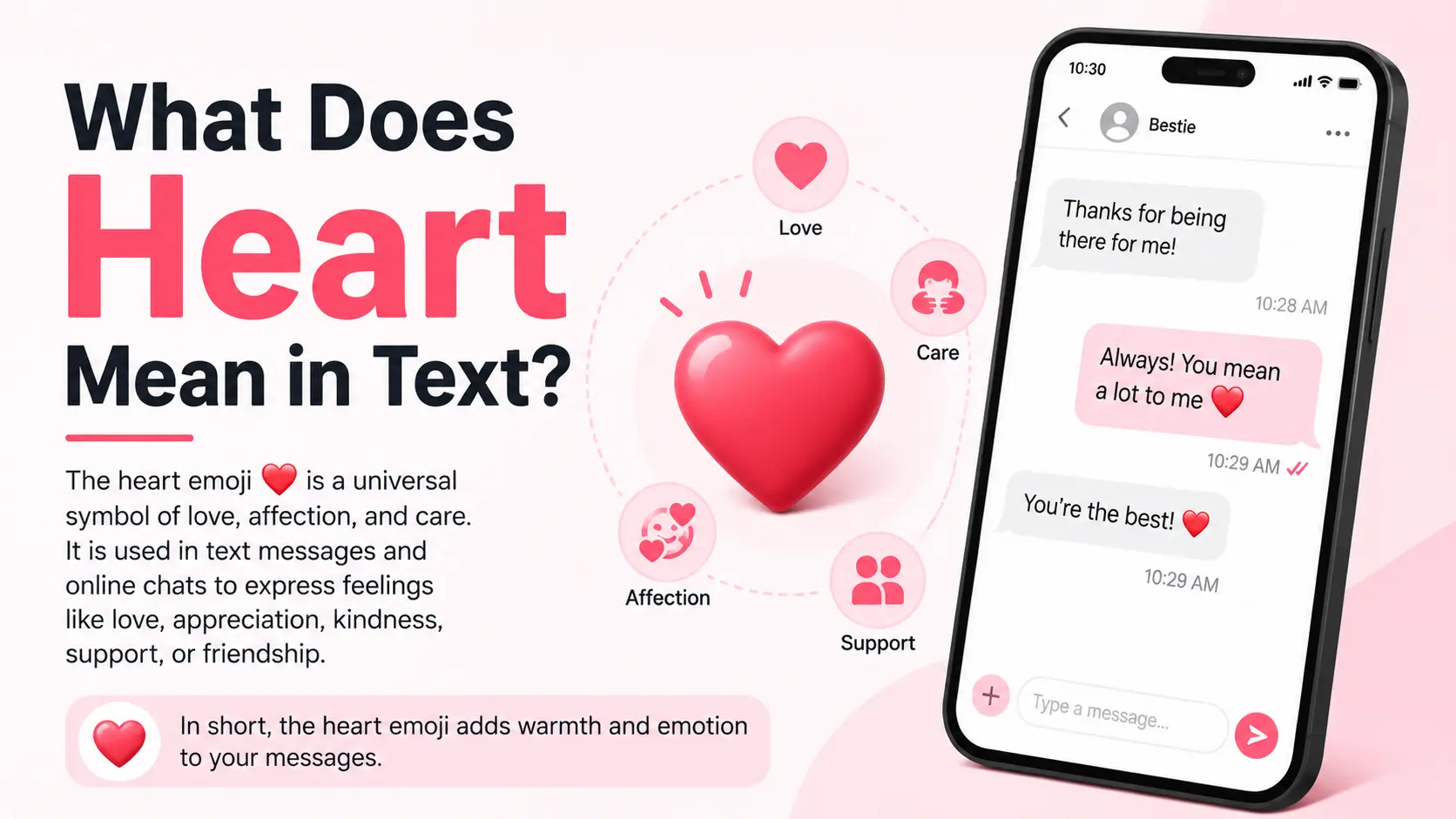
A heart in text usually represents emotion, connection, appreciation, care, or affection.
Depending on the situation, it may mean:
- Love or romantic interest
- Friendship and emotional closeness
- Support or encouragement
- Gratitude or appreciation
- Agreement or positive reaction
- Sympathy during emotional moments
The meaning changes based on who sends it and how often they use it.
Quick Examples
“Thanks for checking on me ❤️”
“That photo looks amazing 💙”
“Good luck with your exam 💕”
In each case, the heart adds warmth that plain text may not fully express.
Origin & Background of the Heart Symbol in Communication
The heart symbol has existed for centuries as a visual representation of emotion and affection. Long before smartphones, hearts appeared in handwritten letters, greeting cards, and romantic messages.
In traditional communication, drawing a heart symbol often expressed love or admiration. As texting and social media became part of everyday life, the heart evolved into a digital shortcut for emotional expression.
Early internet chatrooms and instant messaging platforms introduced simple text-based hearts such as “<3.” This symbol became popular because it resembled a sideways heart.
Later, emojis transformed the way people communicate feelings online. Mobile keyboards introduced colorful heart emojis, allowing users to express emotion without typing long explanations.
Social media platforms also influenced the heart’s meaning.
For example:
- Instagram popularized the heart as a “like” feature
- TikTok made hearts part of engagement culture
- Messaging apps turned hearts into emotional reactions
- Facebook introduced reaction hearts to posts and comments
Over time, the heart became more than a romantic symbol. It became part of modern emotional language.
Real-Life Conversations Using Heart in Text
Understanding how hearts appear in real conversations makes the meaning easier to interpret.
WhatsApp Conversation
Person A: “I finally got the job offer today.”
Person B: “That’s amazing news ❤️ I knew you could do it.”
In this example, the heart expresses support, excitement, and emotional closeness.
Instagram DM Conversation
Person A: “Thank you for always checking in on me.”
Person B: “Of course 💕 always here for you.”
Here, the heart suggests warmth and emotional comfort.
TikTok Comment Section
Person A: “This video made me smile after a rough day.”
Person B: “Sending love ❤️”
The heart communicates kindness and shared empathy.
Text Message Conversation
Person A: “Drive safe and message me when you get home.”
Person B: “Will do ❤️”
In this situation, the heart adds care and reassurance.
Emotional & Psychological Meaning of Heart in Text
A heart emoji or symbol often communicates feelings that people struggle to say directly.
Digital communication removes facial expressions, tone of voice, and physical gestures. Hearts help fill that emotional gap.
When someone sends a heart, they may be trying to:
- Build emotional closeness
- Show appreciation
- Reduce emotional distance
- Offer comfort
- Signal affection
- Make a message feel softer
Psychologically, symbols often carry stronger emotional weight than words.
A short “thank you” feels polite.
A “thank you ❤️” feels personal and sincere.
That small addition changes how a message is perceived.
Many people use hearts because they create warmth without requiring vulnerability. Instead of openly expressing deep emotions, a heart symbol can communicate care in a subtle way.
A Real-Life Scenario
Imagine someone checking on a friend during a stressful week.
“Hope you’re okay ❤️”
Without the heart, the sentence feels neutral.
With the heart, the message feels emotionally supportive.
That tiny symbol can make people feel seen and cared for.
Usage in Different Contexts
The meaning of a heart in text changes depending on the environment.
Social Media
On social media, hearts often represent approval or appreciation.
People use hearts to:
- React to posts
- Show support
- Compliment photos
- Acknowledge emotional content
- Build engagement
A heart under a post may simply mean, “I like this.”
It does not always suggest romance.
Friends & Relationships
Among friends, hearts often express closeness and loyalty.
Friends may use hearts to:
- Celebrate achievements
- Comfort each other
- Show emotional support
- Add warmth to casual conversations
In romantic relationships, hearts usually hold stronger emotional meaning.
They may communicate:
- Love
- Attraction
- Intimacy
- Missing someone
- Affection
The frequency of heart usage also matters.
Someone who regularly sends hearts may use them casually.
Someone who rarely uses hearts may be expressing something more meaningful.
Work or Professional Settings
Hearts are less common in professional communication.
In some friendly workplaces, a heart reaction may appear in team chats or supportive messages.
Example:
“Great presentation today ❤️”
However, workplace communication often requires caution.
A heart can sometimes appear overly personal or unprofessional.
Neutral reactions are usually safer in formal environments.
Casual vs Serious Tone
A heart can change the emotional tone of a sentence.
Compare these:
“Thanks.”
“Thanks ❤️”
The second version feels warmer and more personal.
This is why hearts are often used to soften messages.
When NOT to Use a Heart in Text
Although hearts are common, there are moments when they may not be appropriate.
Formal Business Conversations
Using a heart in professional emails or serious workplace discussions may create confusion.
Some people may interpret it as overly personal.
Sensitive Situations
Hearts can sometimes feel misplaced during serious conversations.
For example, a heart may not always fit legal matters, conflict resolution, or emotionally tense discussions.
Tone matters.
New Relationships
Sending hearts too early in a romantic connection may create mixed signals.
One person may see it as friendly.
The other may interpret it as romantic interest.
Cultural Differences
Not everyone views heart emojis the same way.
In some cultures, hearts are reserved for close emotional relationships.
Using them casually may feel too intimate.
Common Misunderstandings About Heart in Text
Hearts can easily create confusion because people interpret symbols differently.
Assuming It Always Means Romance
One of the biggest misunderstandings is believing every heart means love.
Many people use hearts casually with friends and family.
Ignoring Emoji Habits
Some individuals send hearts frequently to almost everyone.
Others rarely use them.
Understanding personal texting habits matters.
Reading Too Much Into It
A single heart does not always carry deep emotional meaning.
Sometimes it simply means:
- “I appreciate this”
- “I agree”
- “I care”
- “Nice message”
Misreading Color Meaning
Different heart colors often have unique emotional tones.
A red heart may suggest love.
A yellow heart may suggest friendship.
A black heart may imply humor, sarcasm, or dark aesthetic style.
Comparison Table
| Expression | Meaning | Emotional Tone | Common Usage |
|---|---|---|---|
| Heart ❤️ | Affection, care, warmth | Emotional | Relationships, support |
| Thumbs Up 👍 | Agreement or approval | Neutral | Casual replies |
| Smiley 😊 | Happiness or friendliness | Light | Everyday chats |
| Hug Emoji 🤗 | Comfort and emotional closeness | Supportive | Caring conversations |
| Broken Heart 💔 | Sadness or heartbreak | Negative | Emotional situations |
| Fire 🔥 | Attraction or excitement | Energetic | Compliments, trends |
| Star ⭐ | Admiration or praise | Positive | Achievements |
Key Insight
The heart stands out because it carries emotional depth. Unlike neutral reactions, hearts often make communication feel personal. Even a small symbol can influence how someone interprets an entire message.
Variations and Types of Heart Meanings
Different heart emojis communicate different emotional tones.
❤️ Red Heart
Classic love, deep affection, or emotional closeness.
💙 Blue Heart
Trust, loyalty, calm connection, or friendship.
💛 Yellow Heart
Friendship, happiness, positivity, and warmth.
💚 Green Heart
Nature, health, support, or emotional balance.
🖤 Black Heart
Dark humor, edgy personality, sarcasm, or emotional depth.
🤍 White Heart
Purity, kindness, peaceful support, or sympathy.
💜 Purple Heart
Luxury, admiration, fandom culture, or affection.
💕 Two Hearts
Romantic affection, excitement, or emotional connection.
💓 Beating Heart
Strong emotion, excitement, or nervous affection.
💔 Broken Heart
Sadness, emotional pain, disappointment, or heartbreak.
How to Respond When Someone Uses a Heart
Responding to a heart depends on the relationship and tone.
Casual Replies
- “Thanks ❤️”
- “You’re the best”
- “Appreciate that”
- “That means a lot”
Funny Replies
- “Look at you being sweet today”
- “Okay, now I feel special”
- “That heart just made my day”
Mature Replies
- “I appreciate your support”
- “Thank you for thinking of me”
- “That was kind of you to say”
Respectful Replies
- “Sending love back”
- “That means a lot to me”
- “I’m grateful for your kindness”
Regional & Cultural Usage
The meaning of hearts can shift depending on culture and generation.
Western Culture
In many Western countries, hearts are commonly used in both friendships and romantic relationships.
People often use hearts casually in everyday texting.
Asian Culture
In some Asian cultures, emotional expression may be more subtle.
Hearts can still represent affection, but public emotional openness varies depending on age and social norms.
Social media culture has increased emoji usage across younger generations.
Middle Eastern Culture
In Middle Eastern communication, hearts may be used more carefully.
Context and relationship matter strongly.
A heart may carry deeper emotional meaning than in more casual texting cultures.
Global Internet Usage
Online culture has created a shared language where hearts often mean support, positivity, and appreciation.
People across countries understand the symbol even when they speak different languages.
Generational Differences
Gen Z
Gen Z often uses hearts casually and frequently.
Heart emojis may appear in friendships, memes, comments, and reactions.
Millennials
Millennials may use hearts more intentionally.
For some, a heart still feels emotionally meaningful rather than casual.
Is It Safe for Kids?
Yes, heart emojis are generally safe for kids because they usually represent kindness, friendship, or appreciation.
However, parents should understand that emoji meanings can change depending on context.
A heart between friends is often harmless.
In private messaging, context awareness still matters.
Teaching children about healthy communication helps prevent misunderstanding.
Frequently Asked Questions
Does a heart in text always mean love?
No. A heart may mean appreciation, support, friendship, or emotional warmth.
What does a red heart mean in text?
A red heart usually represents love, affection, or strong emotional connection.
Is sending a heart flirting?
Sometimes. It depends on the relationship, tone, and conversation history.
What does a heart reaction mean on social media?
It usually means someone enjoyed, appreciated, or emotionally connected with the content.
Can a heart be platonic?
Yes. Many people use hearts with friends and family members.
Why do people use hearts instead of words?
Hearts communicate emotion quickly and make messages feel warmer.
Does the color of a heart matter?
Yes. Different heart colors often carry different emotional meanings.
Conclusion
Understanding what a heart means in text becomes easier once you look beyond the symbol itself.
A heart is not just decoration. It acts as emotional language in digital communication.
It may represent affection, support, friendship, appreciation, or comfort.
The meaning depends on who sends it, where it appears, and the relationship involved.
Modern communication often moves quickly, and people do not always have time to explain emotions in detail.
That is why hearts remain powerful.
A small symbol can carry reassurance, kindness, connection, and emotional warmth.
The next time you receive a heart in text, pay attention to the conversation around it.
Context usually reveals the real meaning.