
If you’ve ever received a message saying, “I’m such an INFP,” or noticed someone listing “INFP” in their social media bio, you may have wondered what those four letters actually mean.
Unlike many texting abbreviations that stand for short phrases, INFP is a personality type. It comes from a well-known personality framework and is often used online to describe someone’s way of thinking, feeling, and interacting with the world.
People search for “what does INFP mean in text” because the term appears everywhere. You can find it in text messages, Instagram bios, TikTok videos, dating profiles, personality discussions, and online communities. Without context, it can seem like slang. In reality, it represents a specific personality category that many people strongly identify with.
In this guide, you’ll learn exactly what INFP means, where it came from, how people use it in conversations, and what it reveals about modern digital communication.
INFP Meaning in Text – Quick Meaning
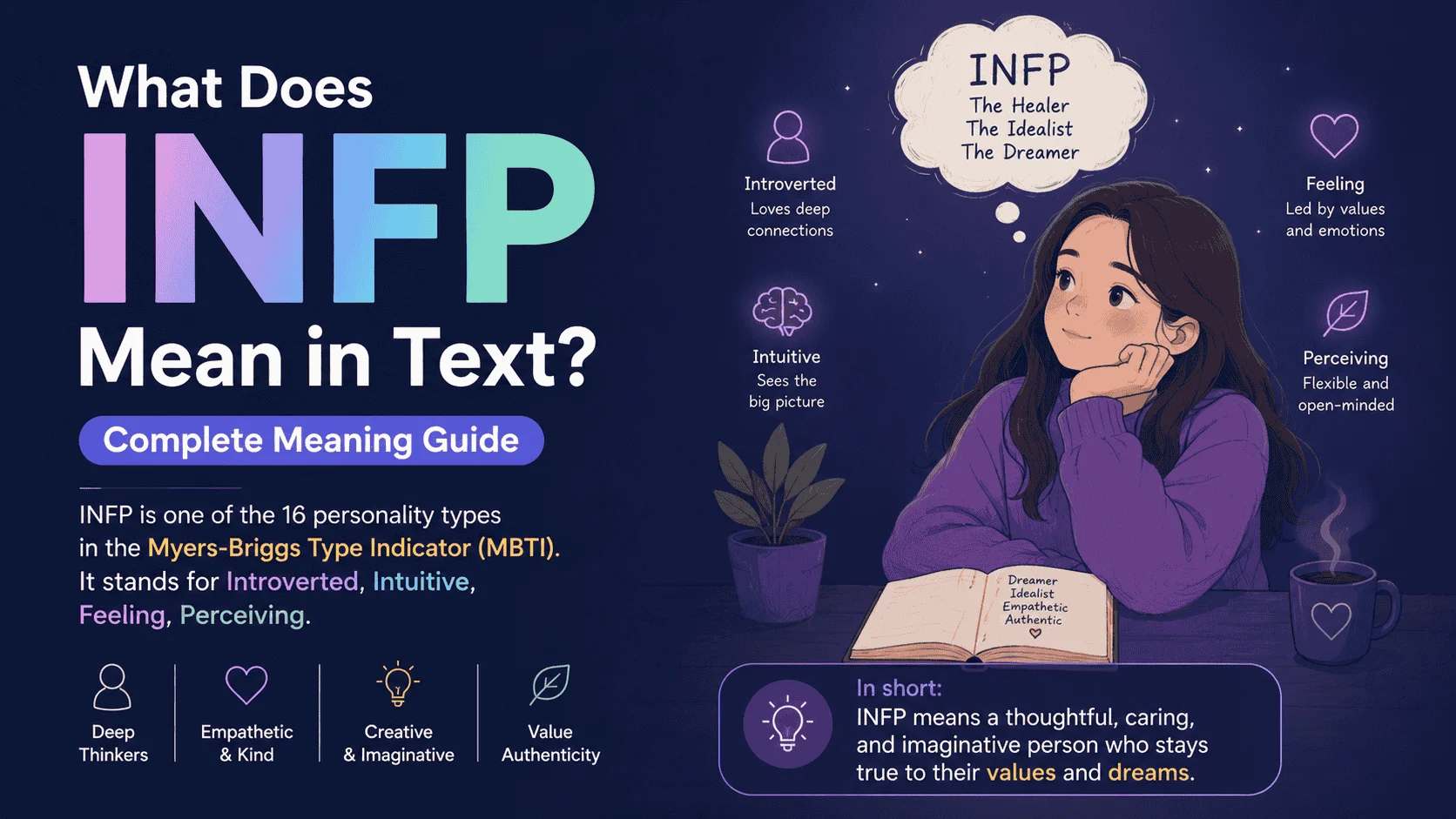
INFP stands for:
- I = Introversion
- N = Intuition
- F = Feeling
- P = Perceiving
It is one of the 16 personality types commonly associated with the Myers-Briggs personality framework.
When someone uses INFP in a text, they are usually describing their personality traits, emotional style, or personal identity.
Simple Definition
An INFP is often described as:
- Thoughtful
- Creative
- Idealistic
- Empathetic
- Emotionally aware
- Independent
Examples
“I’m an INFP, so I need some alone time after social events.”
“That movie made me cry. Classic INFP behavior.”
“As an INFP, I overthink everything.”
In texting, the term is usually used humorously, self-reflectively, or as a way to explain personal behavior.
Origin & Background
INFP originated from the Myers-Briggs Type Indicator (MBTI), a personality assessment developed during the 20th century.
The framework was inspired by the psychological theories of Swiss psychiatrist Carl Jung, whose work focused on personality preferences and human behavior.
Over time, personality typing became popular in schools, workplaces, counseling settings, and self-development communities.
Rise on Social Media
The internet dramatically expanded the popularity of personality types.
Platforms such as:
- TikTok
- YouTube
- Discord
turned personality discussions into a global trend.
Many users began creating content like:
- “Signs you’re an INFP”
- “Dating an INFP”
- “INFP struggles”
- “INFP memes”
As a result, the term moved beyond psychology discussions and entered everyday texting culture.
Today, people often use INFP almost like an identity label.
Real-Life Conversations
WhatsApp Conversation
Person A: Why didn’t you come to the party?
Person B: Too many people. My INFP side couldn’t handle it.
Person A: Fair enough. Next time we’ll do something smaller.
Instagram DM
Person A: You always post poetry and sunset photos.
Person B: Haha, that’s the INFP personality showing.
Person A: Honestly, it fits you perfectly.
TikTok Comments
Person A: This video describes my life.
Person B: Same. Are you an INFP too?
Person A: Yes! That’s why it feels so relatable.
Text Message
Person A: Why do you analyze every conversation afterward?
Person B: Because I’m an INFP and my brain never stops thinking.
Person A: That actually explains a lot.
Emotional & Psychological Meaning
When someone says they are an INFP, they are often communicating more than just a personality category.
They may be expressing:
- Sensitivity
- Authenticity
- Emotional depth
- Creativity
- A desire for meaningful connections
Many people use INFP as a shorthand way to explain their emotional experiences.
Instead of describing their entire personality, they simply mention their type.
Why People Use It
People often feel understood when they discover a personality description that matches their experiences.
For example, someone who constantly feels emotionally affected by movies, music, or personal conversations may finally find a description that resonates with them.
A common scenario might look like this:
A person spends years wondering why they enjoy quiet reflection more than large social gatherings. After learning about personality types, they discover INFP and feel that many of the characteristics match their experiences. From then on, they may casually mention it in conversations to explain their preferences.
Usage in Different Contexts
Social Media
On social media, INFP is frequently used in:
- Bios
- Personality quizzes
- Memes
- Self-descriptions
- Trend videos
Many creators build entire communities around personality types.
Friends & Relationships
Friends often use INFP to explain behaviors such as:
- Needing personal space
- Being emotionally expressive
- Enjoying deep conversations
- Avoiding unnecessary conflict
Example:
“I’m not ignoring you. I’m just having an INFP recharge day.”
Work & Professional Settings
In professional environments, people may discuss personality types during:
- Team-building exercises
- Career discussions
- Leadership training
However, INFP is usually mentioned more casually than formally.
Casual vs Serious Tone
Casual
“I’m such an INFP for crying at that commercial.”
Serious
“Understanding my INFP tendencies helped me recognize how I process emotions and decisions.”
The tone depends entirely on context.
When NOT to Use It
Although INFP is widely understood online, there are situations where using it may create confusion.
Avoid Using It When:
- The audience is unfamiliar with personality types.
- Professional communication requires clarity.
- You are making important decisions solely based on personality labels.
- The conversation involves serious psychological evaluation.
Cultural Awareness
Not every culture places the same emphasis on personality typing. Some people may have never encountered MBTI terminology.
In those situations, explaining your behavior directly is often more effective than using the acronym alone.
Common Misunderstandings
Assuming All INFPs Are Identical
People sometimes believe every INFP behaves exactly the same way.
In reality, personality types describe tendencies, not fixed rules.
Thinking INFP Means Shy
Many INFPs enjoy social interaction.
Being introverted does not automatically mean being shy.
Treating It as a Diagnosis
INFP is a personality category, not a medical or psychological diagnosis.
Believing It Predicts Everything
Personality type can offer insight, but it cannot predict every decision, relationship, or life outcome.
Comparison Table
| Expression | Meaning | Similarity to INFP |
|---|---|---|
| INFP | Introverted, intuitive, feeling, perceiving personality type | Main term |
| INFJ | Similar emotional depth but more structured | Closely related |
| INTP | Introverted and analytical | Less emotion-focused |
| ENFP | Similar creativity but more outgoing | Often considered an opposite social style |
| Introvert | Prefers lower social stimulation | Only partially similar |
| Empath | Emotionally sensitive person | Shares emotional awareness |
| Extrovert | Gains energy from social interaction | Opposite tendency |
| MBTI | Personality typing system | Broader framework |
Key Insight
INFP is not simply another word for “introvert.” It represents a combination of emotional, intuitive, and flexible personality traits that many people use to understand themselves and connect with others.
Variations / Types
Although INFP itself is one personality type, related expressions frequently appear online.
1. Healthy INFP
An emotionally balanced and self-aware INFP.
2. Unhealthy INFP
An INFP struggling with emotional overwhelm or avoidance.
3. Creative INFP
Focused heavily on artistic expression and imagination.
4. Romantic INFP
Known for idealistic views of love and relationships.
5. Social INFP
Enjoys people while still needing personal space.
6. Quiet INFP
More reserved and reflective than average.
7. Assertive INFP
Generally more confident and decisive.
8. Turbulent INFP
More sensitive to stress and self-doubt.
9. Dreamer INFP
Frequently associated with imagination and future possibilities.
10. Mature INFP
Uses emotional insight constructively and effectively.
How to Respond When Someone Uses It
Casual Replies
- “That makes sense.”
- “I can totally see that.”
- “Sounds like you.”
Funny Replies
- “So that’s why you’re always overthinking.”
- “Another certified INFP moment.”
- “The personality type strikes again.”
Mature Replies
- “Interesting. How does that influence your decisions?”
- “What parts of the description fit you most?”
Respectful Replies
- “Thanks for sharing that.”
- “It’s always interesting learning how people see themselves.”
- “I appreciate the insight.”
Regional & Cultural Usage
Western Culture
In North America and Europe, personality typing is highly visible online. Many people openly discuss MBTI categories in social and professional contexts.
Asian Culture
Several Asian countries have embraced personality testing as a popular social activity. Discussions about personality types are especially common among younger internet users.
Middle Eastern Culture
Interest in personality frameworks continues to grow, particularly among students and social media communities interested in self-development.
Global Internet Usage
Across the internet, INFP has become a recognizable label that transcends language barriers.
People from different countries often use the acronym exactly the same way.
Generational Differences
Gen Z
- Uses INFP frequently in memes and bios
- Connects personality types with identity and self-expression
- Shares personality content on TikTok and Instagram
Millennials
- Often use personality types for self-discovery
- Discuss personality frameworks in relationships and career growth
- Tend to focus on deeper personal development themes
Is It Safe for Kids?
Yes, INFP is generally safe for kids.
It is simply a personality type description and does not contain offensive, harmful, or inappropriate content.
However, children should understand that personality categories are tools for self-reflection rather than strict definitions of who they are.
FAQs
What does INFP stand for in texting?
It stands for Introversion, Intuition, Feeling, and Perceiving, a personality type often used to describe personal traits.
Is INFP slang?
Not exactly. It is a personality type acronym that has become common in online conversations.
Why do people put INFP in their bio?
They use it to share aspects of their personality and connect with people who have similar traits.
Is INFP a good personality type?
There is no best or worst personality type. Every type has strengths and challenges.
Can an INFP be outgoing?
Yes. Many INFPs enjoy socializing even though they generally need time alone to recharge.
Is INFP only used on social media?
No. People use it in text messages, dating apps, online communities, and everyday conversations.
How common is the term INFP online?
It is extremely common in personality-related communities and has become a widely recognized internet term.
Conclusion
Understanding what INFP means in text helps decode a growing part of online communication. Rather than being traditional slang, INFP represents a personality type that many people use to explain their emotions, preferences, and worldview.
Whether you encounter it in a text message, TikTok comment, Instagram bio, or casual conversation, the term usually reflects self-awareness and personal identity rather than a secret internet code.
The next time someone says they’re an INFP, you’ll know they’re sharing something about how they experience the world, connect with others, and understand themselves. Knowing that context makes modern digital conversations much easier to navigate and far more meaningful.