
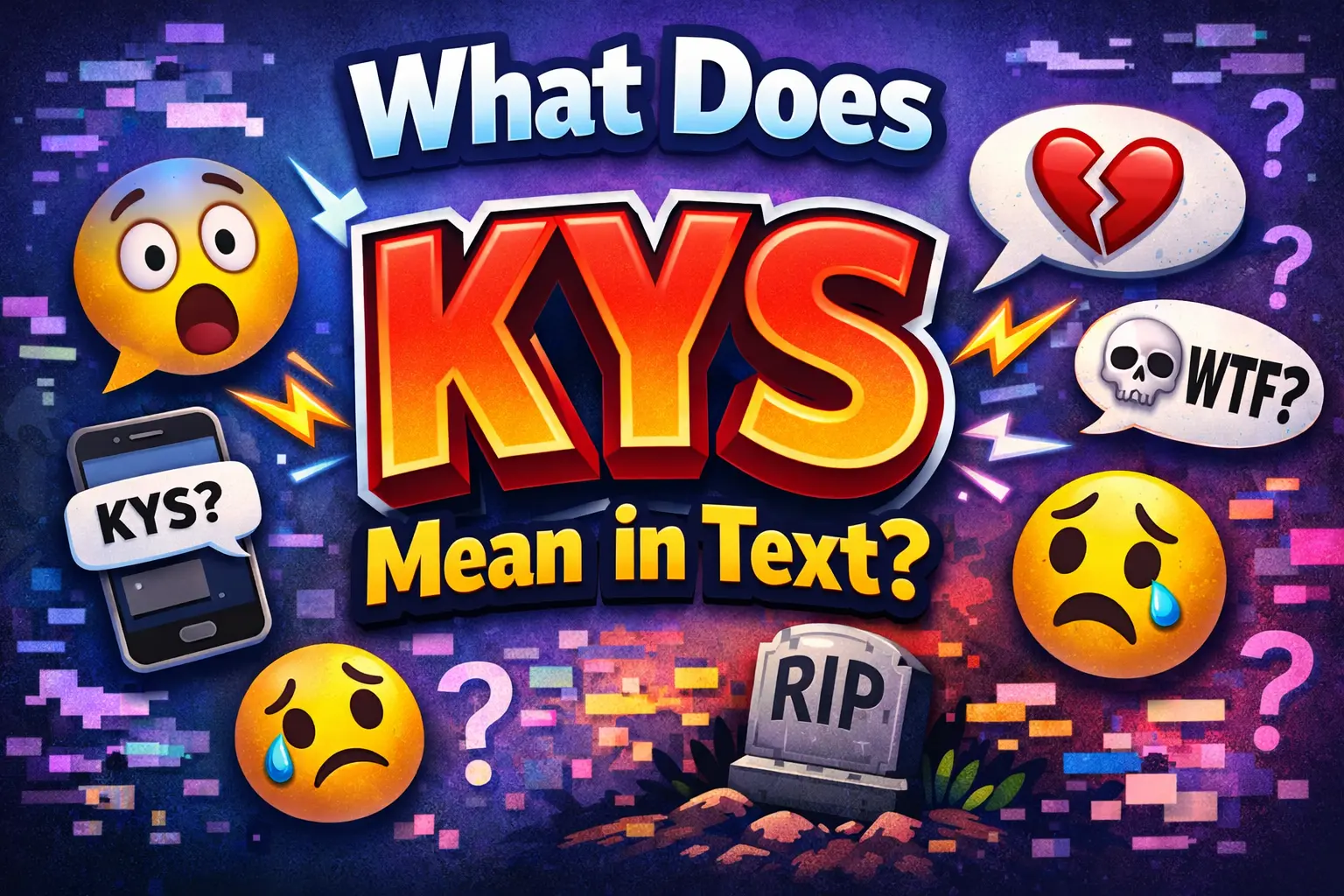
If you’ve come across the phrase “KYS” in a message, comment, or chat, it can feel confusing or even shocking. It’s one of those internet abbreviations that carries a strong emotional weight, yet people use it in very different ways depending on the context.
Some people search for “what does KYS mean in text” because they saw it in a heated argument. Others encounter it in memes or casual conversations and aren’t sure if it’s serious or just dark humor.
This article clears that confusion.
You’ll learn what KYS actually means, where it came from, how people use it today, and most importantly, when it crosses the line from joke to harmful language.
KYS – Quick Meaning
KYS stands for:
“Kill Yourself.”
It is typically used in text messages, online chats, or social media comments.
Key points:
- It is often used as an insult or expression of frustration
- Sometimes used jokingly among close friends
- Can be deeply offensive or harmful depending on tone
Example uses:
- “You lost again? KYS.”
- “Bro forgot the homework… kys 😂”
- “Stop posting this stuff, kys.”
Even in lighter contexts, the phrase carries serious undertones.
Origin & Background
KYS originated from early internet forums and gaming communities where harsh trash talk was common. In competitive online spaces, players often used extreme language to express frustration or dominance.
Over time, the phrase spread across platforms like:
- Online gaming chats
- Forums such as Reddit
- Social media apps like Instagram and TikTok
As internet culture evolved, so did the meaning.
In some circles, especially among younger users, KYS became part of dark humor. People started using it sarcastically with friends, not intending literal harm.
However, the original meaning never disappeared.
This dual nature is what makes KYS so risky. It can be interpreted as either a joke or a serious attack depending on context, tone, and relationship.
Real-Life Conversations
Here’s how KYS shows up in real conversations.
1. WhatsApp Chat
Person A: I just deleted the entire project by mistake
Person B: Bro… kys 😭
Person A: I swear I might actually cry
2. Instagram DMs
Person A: You really posted that photo?
Person B: What’s wrong with it?
Person A: Nothing just… kys 💀
3. TikTok Comments
Person A: This dance is so cringe
Person B: then scroll bro kys
4. Text Message
Person A: I ate your snacks
Person B: KYS 😡
Person A: Chill I’ll buy more
These examples show how tone shifts meaning. Sometimes it feels playful. Other times, it comes across as aggressive or dismissive.
Emotional & Psychological Meaning
KYS is not just a phrase. It reflects emotion, and often intense emotion.
What it can express:
- Anger or frustration
- Sarcasm or teasing
- Disapproval or annoyance
- Emotional detachment
Why people use it:
- To exaggerate a reaction
- To fit into online humor culture
- To express irritation quickly
- To shock or provoke a response
What it reveals about communication today:
Modern communication often values speed over clarity. Short phrases like KYS carry heavy meaning in just three letters. But they also remove emotional nuance.
A real-life scenario:
Imagine someone already feeling low receives a message saying “kys,” even as a joke. Without tone or facial expression, it can hit much harder than intended.
That’s why context matters more than ever.
Usage in Different Contexts
Social Media
KYS appears frequently in comments and replies, especially during arguments or trolling. It is often used casually, but can escalate conflict quickly.
Friends & Relationships
Among close friends, it may be used jokingly. Still, not everyone is comfortable with it, even in humor.
Work / Professional Settings
It should never be used. It is inappropriate, unprofessional, and potentially harmful.
Casual vs Serious Tone
- Casual: “You forgot again? KYS lol”
- Serious: “Just kys already”
The second example is clearly more aggressive and harmful.
When NOT to Use It
There are situations where using KYS is not just inappropriate but dangerous.
Avoid using it:
- With people you don’t know well
- In serious conversations
- Around sensitive topics
- In professional or academic environments
- With someone who may be emotionally vulnerable
Cultural sensitivity matters
In some cultures, even joking about self-harm is deeply offensive.
Risk of misunderstanding
Without tone or context, your message may come across as cruel rather than humorous.
Common Misunderstandings
1. “It’s always a joke”
Not true. Many people use it seriously or perceive it that way.
2. “Everyone understands internet slang”
Different age groups and cultures interpret it differently.
3. “It’s harmless if I don’t mean it”
Intent does not always match impact.
4. Tone confusion
Text lacks voice and expression, making phrases like KYS easy to misinterpret.
Comparison Table
| Expression | Meaning | Tone | Risk Level |
|---|---|---|---|
| KYS | Kill yourself | Harsh or joking | High |
| GTFO | Get out | Aggressive | Medium |
| Chill | Relax | Neutral | Low |
| LOL | Laughing | Friendly | Low |
| I hate you (joking) | Playful dislike | Depends | Medium |
Key Insight
KYS stands out because it connects to a serious real-world issue. Even when used jokingly, it carries more emotional weight than most slang.
Variations / Types
Here are common variations and related expressions:
- KYS pls
Adds sarcasm but still harsh - kys lol
Attempts to soften with humor - kys 💀
Used in meme culture, often sarcastic - kys bro
More casual tone among friends - kys rn
“Right now” adds urgency and intensity - kms
“Kill myself,” usually self-directed humor - istg kys
Combines frustration with exaggeration - kys jk
Adds “just kidding,” though impact remains - pls kys
Sarcastic politeness - kys 😂
Used in joking tone but still risky
How to Respond When Someone Uses It
Casual replies
- “Relax, it’s not that serious”
- “You good?”
Funny replies
- “After I finish this pizza maybe”
- “Let me schedule it real quick 😂”
Mature replies
- “I know you’re joking, but that’s not cool”
- “Let’s keep it respectful”
Respectful replies
- “Please don’t say that”
- “That kind of language isn’t okay with me”
Your response sets boundaries and shapes the tone of the conversation.
Regional & Cultural Usage
Western culture
More common in dark humor and sarcasm, especially among Gen Z.
Asian culture
Often considered too harsh or disrespectful, even as a joke.
Middle Eastern culture
Generally viewed as inappropriate due to cultural and religious sensitivity.
Global internet usage
Widely recognized, but interpretation varies based on context.
Generational differences
- Gen Z: May use it jokingly among friends
- Millennials: More cautious, aware of its impact
Is It Safe for Kids?
KYS is not appropriate for children.
Even if used jokingly, it introduces harmful language tied to serious mental health issues. Kids may not understand the context and could either misuse it or be negatively affected by it.
Parents and educators should encourage healthier ways of expressing frustration or humor.
FAQs
1. Does KYS always mean something serious?
No, but it can be interpreted seriously depending on context.
2. Is KYS considered cyberbullying?
Yes, especially when used aggressively or repeatedly.
3. Why do people use KYS jokingly?
It has become part of dark humor culture online.
4. Should I be offended if someone says KYS?
It depends on context, but it’s okay to set boundaries.
5. Is it illegal to say KYS?
Not usually, but it can violate platform policies and lead to bans.
6. What’s a safer alternative?
Use humor without harmful language, like “you’re wild” or “no way 😂”.
7. Can KYS affect mental health?
Yes, especially for vulnerable individuals.
Conclusion
KYS is a small phrase with a heavy impact.
While some people use it casually or jokingly, its core meaning remains serious. That’s what makes it tricky. It can shift from humor to harm in an instant.
Understanding the context, the relationship, and the emotional state of the other person is essential before using or reacting to it.
Communication today moves fast, but thoughtful words still matter.
Choosing safer, more respectful language doesn’t make you less expressive. It makes you more aware, and that’s what truly strengthens communication.