
If you’ve received a message saying “LYMY”, you may have paused for a second and wondered what it actually means. Unlike common texting abbreviations such as LOL or BRB, LYMY is less familiar, which often leads to confusion.
So, what does LYMY mean in text?
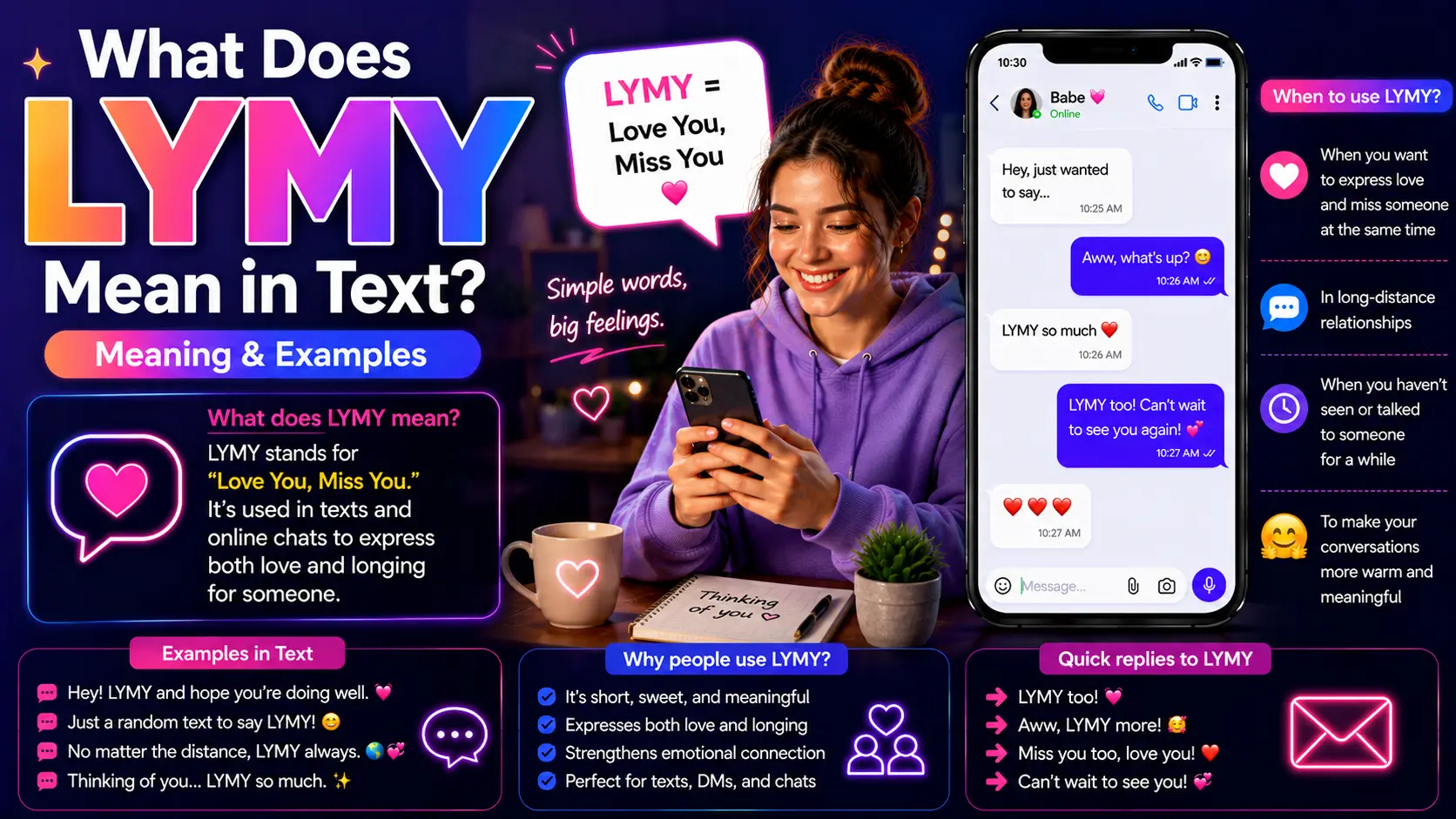
In most texting and social media conversations, LYMY stands for “Love You, Mean It.” It is a warm and sincere way of telling someone that your feelings are genuine. Instead of saying a simple “love you,” adding “mean it” emphasizes honesty and emotional commitment.
People commonly use LYMY in text messages, Snapchat, Instagram DMs, WhatsApp chats, and even comments on social media posts. Whether it’s between close friends, family members, or romantic partners, the abbreviation adds an extra layer of reassurance.
This guide explains exactly what LYMY means, where it came from, how people use it today, and when it may not be the right choice.
LYMY Meaning in Text: Quick Definition
LYMY = Love You, Mean It
It expresses sincere affection and confirms that the speaker genuinely means what they are saying.
Quick facts
- Full form: Love You, Mean It
- Tone: Warm, caring, reassuring
- Common platforms: Text messages, WhatsApp, Instagram, Snapchat, TikTok
- Often used between: Friends, couples, siblings, parents, and close family
Examples
“Drive safely! LYMY ❤️”
“Thanks for always being there. LYMY.”
“Good night. LYMY. Sleep well.”
The phrase often appears at the end of conversations as an emotional goodbye.
Origin and Background
Unlike internet slang created mainly for speed, LYMY comes from a spoken expression that existed long before smartphones.
People have been saying “Love you, mean it” for years in everyday conversations. Parents often said it to children before school. Friends used it after difficult conversations. Couples ended phone calls with it as a reminder that their feelings were genuine.
As texting became more common, users shortened the phrase into LYMY.
Social media also helped popularize it. Emotional captions, friendship posts, graduation messages, and birthday tributes often ended with LYMY because it sounded heartfelt without being overly dramatic.
Today, the abbreviation has become a subtle way of adding emotional sincerity in digital conversations.
Real-Life Conversations
Person A:
Thanks for checking on me today.
Person B:
Always. LYMY ❤️
Instagram DM
Person A:
Your support means everything.
Person B:
You’ve got me forever. LYMY.
TikTok Comments
Person A:
This video reminded me of my best friend.
Person B:
Aww that’s so sweet. LYMY!!
Text Messages
Person A:
Good luck with your interview tomorrow.
Person B:
Thank you. I’ll call afterward. LYMY.
Emotional and Psychological Meaning
At first glance, LYMY may seem like another internet abbreviation. Emotionally, though, it carries much more weight.
Adding “mean it” tells the other person:
- My feelings are genuine.
- I’m not saying this out of habit.
- I truly appreciate you.
- I want you to believe me.
Modern communication often moves quickly. Many people send dozens of messages every day, making emotional words feel routine.
LYMY slows that down.
It reminds the other person that the message comes from the heart.
A relatable situation
Imagine finishing a difficult conversation with a close friend who has been struggling emotionally.
Instead of simply texting, “Love you,” you send:
“Love you. LYMY.”
Those extra letters can provide reassurance that your support is real, especially during stressful moments.
Using LYMY in Different Contexts
Social Media
People include LYMY in captions celebrating friendships, birthdays, anniversaries, graduations, or family memories.
Example:
“Couldn’t have done this without you. LYMY.”
Friends and Relationships
Among friends, LYMY often expresses gratitude and emotional closeness.
In romantic relationships, it reinforces affection and sincerity.
Example:
“I miss you already. LYMY.”
Work or Professional Settings
Generally, LYMY is not appropriate in professional communication.
Business emails, workplace chats, and client conversations should remain professional.
Instead of LYMY, choose expressions like:
- Thank you.
- Appreciate your support.
- Best wishes.
Casual vs Serious Tone
Casually, LYMY can end everyday chats.
In serious conversations, it carries deeper emotional meaning and reassurance.
Its impact depends largely on the relationship between the people communicating.
When Not to Use LYMY
Although positive, LYMY is not suitable everywhere.
Avoid using it:
- In formal business emails.
- With people you barely know.
- During professional interviews.
- With clients or customers.
- When cultural expectations make emotional language uncomfortable.
- If the other person may misunderstand your intentions.
Using affectionate abbreviations in the wrong setting may create awkwardness or confusion.
Common Misunderstandings
Many people misunderstand LYMY because it is relatively uncommon.
Mistake 1
Some assume it simply means “Love You.”
Actually, the phrase emphasizes sincerity.
Mistake 2
Others believe it is exclusively romantic.
In reality, friends and family members use it frequently.
Mistake 3
Some readers mistake it for another abbreviation because they have never seen it before.
Context usually makes the intended meaning clear.
Mistake 4
People sometimes think it sounds dramatic.
In most conversations, it simply communicates warmth and genuine care.
Comparison Table
| Expression | Meaning | Emotional Strength | Typical Use |
|---|---|---|---|
| LYMY | Love You, Mean It | Very sincere | Friends, family, partners |
| ILY | I Love You | Strong | Romantic or close relationships |
| LYT | Love You Tons | Warm | Friends and family |
| XOXO | Hugs and kisses | Playful | Messages and cards |
| TTYL | Talk To You Later | Neutral | Ending conversations |
| IDC | I Don’t Care | Opposite emotional tone | Casual texting |
Key Insight
LYMY stands out because it combines affection with reassurance. Rather than simply expressing love, it confirms that the emotion is intentional and genuine.
Variations and Related Expressions
1. ILY
I Love You.
The most common expression of affection.
2. ILYSM
I Love You So Much.
Adds stronger emotional intensity.
3. LYT
Love You Tons.
Friendly and cheerful.
4. LUV U
A casual spelling of “Love You.”
Popular in everyday texting.
5. XOXO
Hugs and kisses.
Often appears in greetings and farewells.
6. SM
So Much.
Can strengthen emotional messages.
Example:
“Miss you SM.”
7. BFF
Best Friends Forever.
Celebrates close friendship.
8. HUGS
A written expression of comfort and care.
Often used during difficult moments.
9. TC
Take Care.
A thoughtful way to end conversations.
10. GN ❤️
Good Night.
Frequently paired with affectionate messages.
How to Respond When Someone Says LYMY
Casual replies
- Love you too!
- Same here!
- You too ❤️
- Always!
Funny replies
- You’re making me emotional.
- Stop being so sweet.
- Fine, now I have to smile.
- That totally made my day.
Mature replies
- Thank you. That truly means a lot.
- I appreciate hearing that.
- I feel the same way.
- I’m grateful to have you.
Respectful replies
- Wishing you all the best too.
- Thank you for your kindness.
- Your support means a lot.
- Sending positive thoughts your way.
Regional and Cultural Usage
Western Culture
In many Western countries, openly expressing affection between friends and family is common. LYMY fits naturally into everyday conversations.
Asian Culture
Some Asian cultures express affection more subtly. LYMY may be used more often in private messages than in public posts.
Middle Eastern Culture
Usage depends on family traditions and personal relationships. Close relatives and trusted friends may use similar expressions, while public displays of affection are often more reserved.
Global Internet Usage
Online communities have made LYMY recognizable across many countries.
Even users whose first language is not English sometimes adopt it because internet slang spreads quickly.
Gen Z vs Millennials
Gen Z
Often mixes LYMY with emojis, GIFs, and memes.
Example:
“LYMY 🫶🥹”
Millennials
More likely to use it in heartfelt conversations, birthdays, or meaningful life events.
Is LYMY Safe for Kids?
Yes.
LYMY is generally considered a safe abbreviation because it communicates kindness, affection, and emotional support.
Parents should still encourage children to understand the context of online conversations and use affectionate language appropriately with trusted people.
Frequently Asked Questions
What does LYMY stand for?
It usually means Love You, Mean It, expressing sincere affection.
Is LYMY romantic?
Not always. Friends, parents, siblings, and close relatives also use it.
Is LYMY popular on social media?
Yes. It appears in captions, DMs, comments, and text conversations.
Can I use LYMY with friends?
Absolutely. Many close friends use it to express appreciation and emotional support.
Is LYMY appropriate at work?
Generally no. Professional communication should remain neutral and formal.
Does LYMY always mean love?
It usually expresses genuine care or affection, but the exact meaning depends on the relationship and context.
Why do people say “mean it”?
It reassures the other person that the words are sincere rather than automatic or routine.
Conclusion
If you’ve ever wondered what does LYMY mean in text, the answer is simple yet meaningful.
LYMY stands for “Love You, Mean It.” It goes beyond a standard expression of affection by adding reassurance that the feelings are genuine. Whether shared between friends, family members, or romantic partners, it creates a stronger emotional connection in everyday conversations.
As digital communication becomes faster, thoughtful expressions like LYMY remind us that even a short message can carry genuine warmth. Understanding abbreviations like this helps you communicate with more confidence and interpret messages more accurately.
The next time someone sends you “LYMY,” you’ll know they’re doing more than ending a conversation. They’re making sure you know they truly mean every word.