
In today’s digital conversations, even simple words can carry deeper meanings. One word that often creates confusion is “odd.” You may see it in a text message, a TikTok comment, or an Instagram DM and wonder what the person actually means.
Is it an insult? A joke? A red flag? Or just a casual observation?
The truth is that “odd” can mean different things depending on tone, context, and relationship. Sometimes it points out strange behavior in a harmless way. Other times, it hints at emotional discomfort, social awkwardness, or suspicion.
Understanding how people use “odd” in texting helps you avoid misunderstandings and respond more confidently in conversations.
What Does Odd Mean in Text?
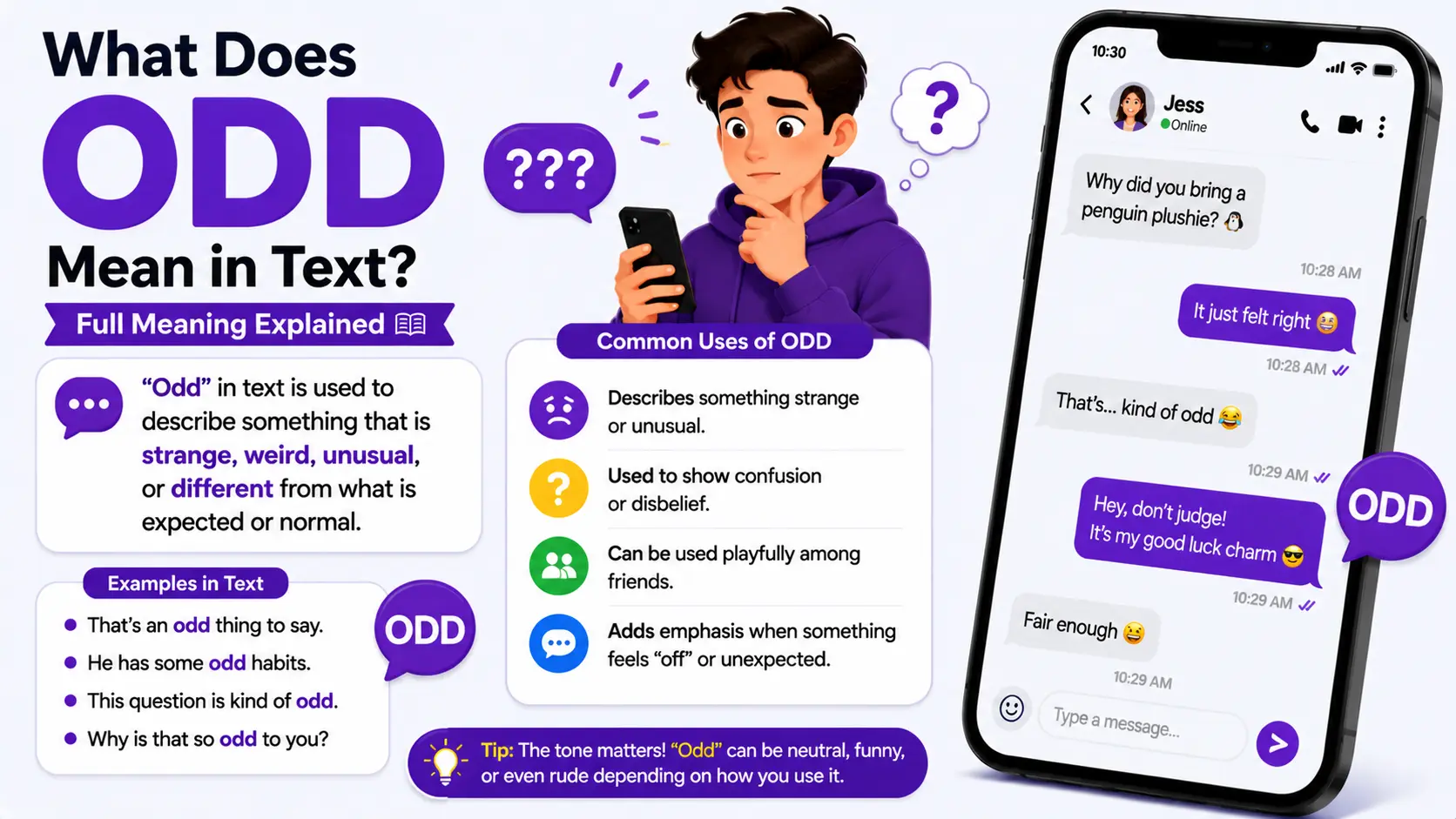
In texting and online conversations, “odd” usually means:
- Strange or unusual
- Unexpected behavior
- Something that feels slightly off
- Socially awkward or confusing
- Different from what’s considered normal
It can be playful, judgmental, curious, or even concerned depending on how it’s used.
Simple Examples
“That reply was kinda odd.”
“Why is he acting so odd today?”
“This whole situation feels odd.”
In most cases, the word does not mean something terrible. It often describes a feeling that something is unusual or emotionally unclear.
Origin & Background of the Word “Odd”
The word “odd” has existed in English for centuries. Originally, it referred to something left over or unmatched, like an “odd number” that cannot be divided evenly by two.
Over time, the meaning expanded into social behavior and personality traits. People began using it to describe anything unusual, eccentric, or outside normal expectations.
In internet culture, the word became even more flexible.
Social media changed how people communicate emotions. Instead of directly calling someone rude, creepy, awkward, or suspicious, users often soften the judgment by saying “that’s odd.”
This indirect communication style became especially common among Gen Z users on platforms like TikTok, Snapchat, and Instagram.
Why?
Because modern online communication often avoids harsh confrontation. Saying “odd” creates emotional distance while still expressing discomfort.
For example:
- “That comment was odd” sounds softer than “That comment was creepy.”
- “He’s acting odd” sounds less aggressive than “He’s being weird.”
That subtle difference matters a lot in digital communication.
Real-Life Conversations Using “Odd”
WhatsApp Conversation
Person A:
Did Sarah leave the group chat?
Person B:
Yeah, without saying anything. Kinda odd honestly.
Instagram DM
Person A:
He viewed my story immediately but ignored my text.
Person B:
That’s oddly specific behavior.
TikTok Comments
Person A:
Why does this creator always delete comments?
Person B:
That’s odd. Makes it look suspicious.
Text Message
Person A:
You’ve been quiet all day. Everything okay?
Person B:
Yeah, just feeling odd lately.
These examples show how the word can describe actions, moods, or emotional energy.
Emotional & Psychological Meaning
The word “odd” often carries emotional subtext.
People rarely use it only for literal description. Instead, they use it to express uncertainty, discomfort, curiosity, or emotional distance.
When someone says:
“That’s odd.”
They may actually mean:
- “I don’t trust this.”
- “Something feels emotionally off.”
- “I don’t understand this behavior.”
- “This makes me uncomfortable.”
- “I expected something different.”
In modern communication, subtle wording matters. Many people prefer indirect language because it feels safer socially.
I once saw a friend receive a dry one-word reply after a long emotional message. She stared at the screen and quietly said:
“That feels odd.”
She wasn’t talking about grammar. She was reacting to emotional imbalance.
That’s how the word often works online. It describes emotional intuition more than facts.
Usage in Different Contexts
Social Media
On social platforms, “odd” is commonly used to comment on behavior, trends, or interactions.
Examples:
- “This trend is oddly addictive.”
- “Why is this video so oddly satisfying?”
- “That influencer’s apology felt odd.”
In this space, the word may be humorous, suspicious, or analytical.
Friends & Relationships
Among friends, “odd” often signals concern or confusion.
Examples:
- “You’ve been acting odd lately.”
- “That date sounded odd.”
- “His reaction was oddly cold.”
In relationships, tone becomes very important. It can sound caring or critical depending on delivery.
Work & Professional Settings
In professional environments, “odd” is softer than words like “unprofessional” or “inappropriate.”
Example:
- “It seemed odd that the meeting started without the manager.”
Here, the word keeps communication polite while still pointing out inconsistency.
Casual vs Serious Tone
Casual Use
- “That’s odd lol.”
- “Odd choice but okay.”
Usually playful or lighthearted.
Serious Use
- “His behavior became increasingly odd.”
- “There’s something odd about this situation.”
This version suggests concern or suspicion.
When NOT to Use It
Although “odd” seems harmless, it can sometimes offend people.
Avoid using it when:
- Someone shares a personal struggle
- Cultural differences are involved
- Mental health topics are discussed
- You lack context about a person’s behavior
- The situation is emotionally sensitive
Calling someone “odd” directly may sound dismissive or judgmental.
For example:
Instead of:
“You’re odd.”
Try:
“I don’t fully understand what you mean.”
That small shift feels more respectful.
Common Misunderstandings
Thinking It Always Means “Weird”
Not necessarily.
Sometimes “odd” simply means unexpected, not bad.
Example:
“It’s odd seeing snow in April.”
No judgment there.
Confusing Playfulness With Criticism
Text tone is hard to read.
“Odd” with emojis may sound funny:
“That’s odd 😂”
Without emojis, it can feel cold:
“That’s odd.”
Literal vs Figurative Meaning
Literal meaning:
- Odd number
- Odd timing
Figurative meaning:
- Emotionally strange
- Socially uncomfortable
- Suspicious energy
Most online uses are figurative.
Comparison Table
| Expression | Meaning | Tone |
|---|---|---|
| Odd | Strange or unexpected | Mild |
| Weird | Unusual in a stronger way | Casual or critical |
| Suspicious | Feels dishonest or unsafe | Serious |
| Awkward | Social discomfort | Emotional |
| Random | Unexpected but often harmless | Playful |
| Normal | Typical behavior | Neutral |
| Creepy | Disturbing or unsettling | Negative |
Key Insight
“Odd” sits in the middle ground. It is softer than “creepy” but stronger than “random.” That balance is why people use it so often online.
Variations & Types of “Odd” in Texting
1. “Kinda Odd”
Means mildly strange without sounding too harsh.
2. “Oddly Enough”
Used before surprising information.
Example:
“Oddly enough, we went to the same school.”
3. “Odd Behavior”
Suggests actions that seem emotionally unusual.
4. “Odd Vibes”
Popular on TikTok and Instagram. Refers to uncomfortable emotional energy.
5. “Oddly Satisfying”
Describes content that feels relaxing or pleasing in an unexpected way.
6. “Acting Odd”
Used when someone’s personality suddenly changes.
7. “That’s Odd”
A general reaction to something confusing.
8. “Odd One Out”
Means someone feels different or excluded.
9. “Odd Energy”
Suggests emotional tension or uncomfortable social atmosphere.
10. “Odd Flex”
Internet slang for showing off in a strange or unnecessary way.
Example:
“Buying five phones at once is an odd flex.”
How to Respond When Someone Uses “Odd”
Your reply depends on the tone and situation.
Casual Replies
- “Yeah, I noticed that too.”
- “Pretty strange honestly.”
- “I thought the same thing.”
Funny Replies
- “I prefer the word mysterious.”
- “That’s my hidden talent.”
- “Keeps life interesting.”
Mature Replies
- “I understand why it seemed unusual.”
- “Maybe there’s more context behind it.”
- “I didn’t mean for it to come across that way.”
Respectful Replies
- “Thanks for telling me.”
- “I appreciate your honesty.”
- “Let me explain what I meant.”
Good communication matters more than defending yourself immediately.
Regional & Cultural Usage
Western Culture
In Western online culture, “odd” is often casual and conversational.
It may describe:
- Humor
- Personality quirks
- Dating behavior
- Internet drama
The word is usually not extremely offensive.
Asian Culture
In many Asian cultures, indirect communication is common. Words like “odd” may be used carefully to avoid direct criticism.
Someone may say:
“That feels a bit odd.”
Even when they strongly disagree.
Middle Eastern Culture
In some Middle Eastern social settings, calling someone “odd” directly may feel disrespectful, especially toward elders or family members.
Tone and relationship matter heavily.
Global Internet Usage
Globally, the word has become part of online reaction culture.
People use it to describe:
- Strange comments
- Unusual trends
- Social discomfort
- Suspicious online behavior
TikTok especially helped popularize emotional phrases like:
- “Odd vibes”
- “Odd energy”
- “Odd behavior”
Gen Z vs Millennials
Gen Z
Uses “odd” emotionally and ironically.
Examples:
- “This gives odd energy.”
- “That interaction felt odd.”
Millennials
More likely to use it literally or conversationally.
Examples:
- “That’s an odd coincidence.”
- “Odd timing.”
Generational communication styles shape interpretation.
Is It Safe for Kids?
Generally, yes.
The word “odd” itself is not inappropriate or offensive. Kids often hear it in school, cartoons, books, and conversations.
However, context matters.
If used repeatedly toward a child, it can feel isolating or hurtful.
For example:
“You’re odd.”
may affect confidence differently than:
“That situation seems odd.”
Parents and educators should encourage respectful language and emotional awareness.
FAQs
What does “odd” mean in texting?
It usually means strange, unusual, or emotionally off in some way.
Is calling someone odd rude?
It can be, depending on tone and context. Sometimes it sounds playful, while other times it feels judgmental.
What does “odd vibes” mean?
It refers to uncomfortable or suspicious emotional energy in a person or situation.
Is “odd” the same as “weird”?
Not exactly. “Odd” is usually softer and less harsh than “weird.”
Why do people say “that’s odd” online?
People use it to express confusion, suspicion, or emotional discomfort without sounding too aggressive.
Can “odd” be positive?
Yes. Phrases like “oddly satisfying” or “oddly charming” are positive uses.
What does “acting odd” mean?
It means someone’s behavior seems different, unusual, or emotionally unexpected.
Conclusion
The word “odd” may look simple, but in modern texting culture, it carries emotional nuance, social signals, and subtle meaning.
Sometimes it points to harmless strangeness. Other times, it reveals confusion, discomfort, curiosity, or emotional distance.
What makes the word so powerful online is its flexibility. It allows people to express feelings without sounding overly harsh or confrontational.
Understanding context is everything.
The next time someone says something feels “odd,” pay attention to the tone, relationship, and emotional setting behind the message. That deeper awareness helps you communicate more clearly and respond with confidence instead of confusion.