
If you’ve been scrolling through TikTok comments, reading Instagram DMs, or chatting with friends, you may have come across the word BIH and wondered what it actually means. At first glance, it looks like a typo, an acronym, or even a random internet word. In reality, it has become a recognizable piece of online slang with its own personality and tone.
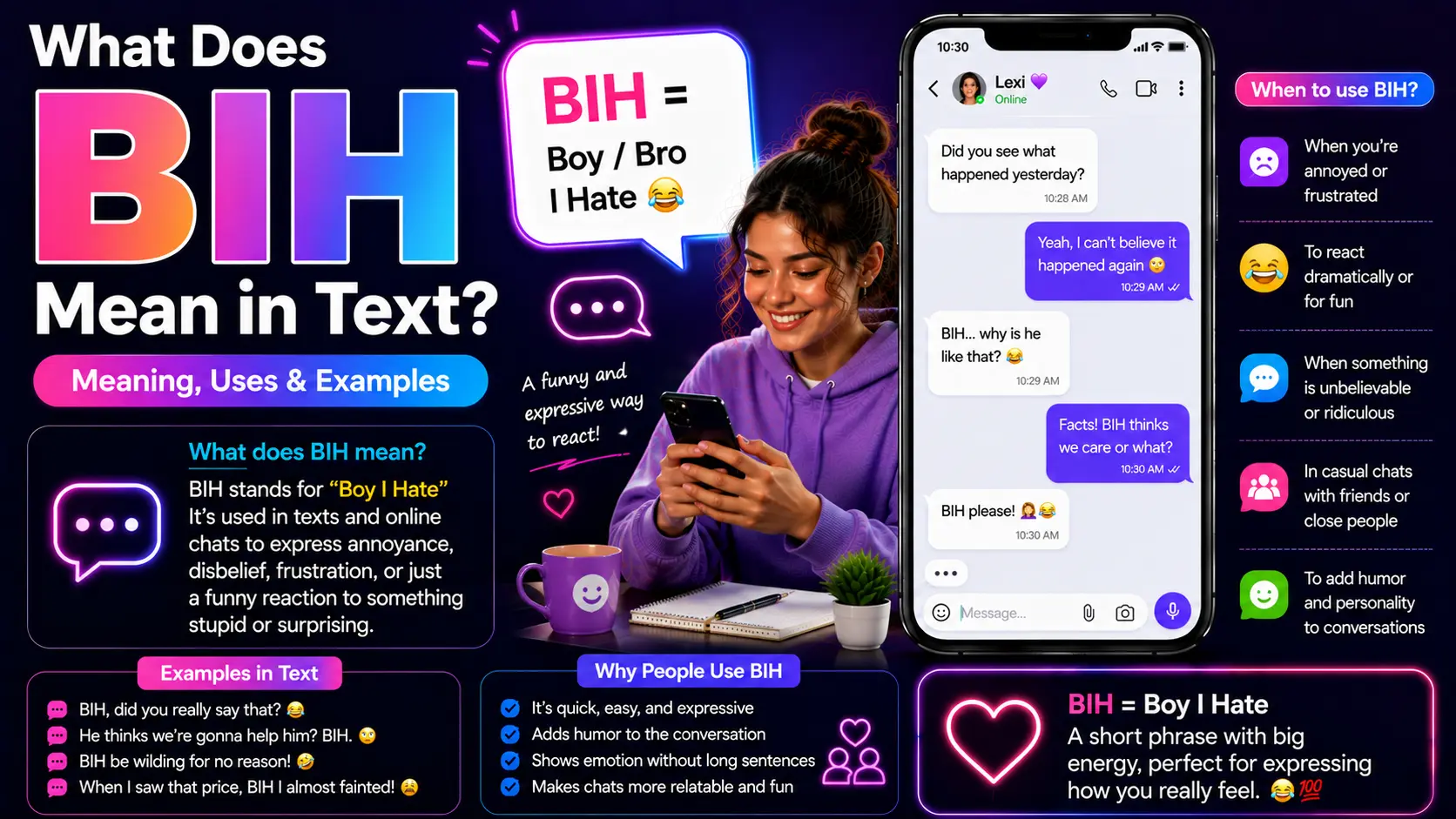
So, what BIH mean in text?
In most online conversations, BIH is a playful slang spelling of the word “bitch.” Instead of using the original spelling, many people write BIH to make the expression sound lighter, funnier, or less offensive. Depending on the conversation, it can be used affectionately between close friends, as a compliment, as a playful greeting, or even as a teasing remark.
Like many internet expressions, its meaning depends heavily on context. The same word can sound supportive in one conversation and rude in another. Understanding the tone behind it is just as important as understanding the word itself.
In this guide, you’ll learn exactly what BIH means in text, where it came from, how people use it across different social media platforms, and when it’s best to avoid using it.
BIH Meaning in Text: Quick Meaning
The simplest answer is:
BIH is an informal slang version of the word “bitch.” People intentionally remove some letters to create a softer, more playful spelling.
Instead of sounding harsh, BIH often feels humorous, expressive, or friendly among people who already know each other well.
Quick Definition
BIH means:
- A playful nickname for a friend
- A funny way to express excitement
- A teasing expression
- An energetic greeting
- A slang replacement for the original word
The meaning changes depending on the relationship between the people talking.
Example Meanings
Example 1
“BIH, you actually did it!”
Meaning:
“I’m so excited for you!”
Example 2
“Come here, BIH.”
Meaning:
A playful way to call a close friend.
Example 3
“That outfit is fire, BIH!”
Meaning:
A fun compliment.
Although BIH comes from a stronger word, it is often used without hostile intent. Many people use it simply because it has become part of internet culture and everyday digital conversations.
Origin & Background of BIH
Internet slang changes quickly, and BIH is a perfect example of how language evolves online.
Originally, BIH developed as an altered spelling of “bitch.” Instead of writing the full word, internet users shortened and softened it to create a version that sounded less aggressive.
Over time, the new spelling took on a personality of its own.
Early Internet Culture
Creative spellings have always been popular online.
People often change words to:
- Sound funnier
- Avoid sounding overly serious
- Create an inside joke
- Match a particular online personality
- Express emotion differently
BIH became one of many playful spellings that spread naturally through texting and social media.
Influence of Music
Modern hip-hop, rap, and internet personalities played a major role in making BIH more recognizable.
Artists and influencers often pronounce certain words differently for rhythm, humor, or style. Fans adopted these pronunciations in written conversations, eventually turning BIH into common online slang.
Today, many people use BIH because they’ve heard it in songs, livestreams, reaction videos, or humorous online clips.
Social Media Growth
Platforms like TikTok helped BIH become even more popular.
Short-form videos encourage expressive language that feels casual and entertaining. As creators used BIH in captions, voiceovers, and comments, millions of viewers began using it naturally.
Instagram also contributed to its popularity, especially in memes, reels, and private messages.
On platforms like Snapchat and X, BIH often appears in playful conversations between friends who already understand each other’s sense of humor.
Why People Prefer BIH
Many users choose BIH instead of the original word because it feels:
- Less confrontational
- More humorous
- More expressive
- Trendier
- Easier to use jokingly
It creates emotional distance from the harsher meaning while still carrying the same playful energy.
That doesn’t mean everyone interprets it positively. People who are unfamiliar with internet slang may still find it disrespectful, which is why understanding your audience matters.
Real-Life Conversations
Seeing BIH used naturally makes its meaning much easier to understand.
Below are realistic examples from different messaging platforms.
WhatsApp Conversation
Person A:
Guess who finally passed the driving test?
Person B:
BIH! I knew you could do it!
Person A:
Thank you! I’m still shaking.
Person B:
You deserve it. Let’s celebrate tonight.
Instagram DM
Person A:
Just posted new vacation pictures.
Person B:
BIH, you’re living your best life!
Person A:
Haha, I needed this trip.
Person B:
You look so happy.
TikTok Comments
Creator:
Finally learned this dance.
Commenter 1:
BIH, you absolutely nailed it!
Commenter 2:
This deserves way more likes.
Creator:
Thanks! That means a lot.
Text Message
Person A:
I got the internship!
Person B:
BIH!! That’s amazing news!
Person A:
I honestly didn’t think I’d get it.
Person B:
I never doubted you for a second.
These conversations show an important pattern. In friendly situations, BIH usually communicates excitement, encouragement, admiration, or playful affection rather than genuine insult.
However, if used during an argument or with someone you don’t know well, the same word can easily be misunderstood. That is why context, relationship, and tone always matter more than the word itself.
Emotional & Psychological Meaning
Modern texting is about more than simply exchanging information. People also use language to express personality, humor, closeness, and emotion. BIH fits into this style of communication because it often adds energy and emotion that a plain sentence might not convey.
When someone says, “BIH, you look amazing,” they usually are not focusing on the literal meaning of the word. Instead, they are expressing excitement, admiration, or playful affection.
What Emotion Does BIH Express?
Depending on the situation, BIH can communicate:
- Excitement
- Surprise
- Playfulness
- Confidence
- Affection between friends
- Friendly teasing
- Celebration
- Enthusiasm
The emotion comes from the relationship between the people involved.
Why People Use It
There are several reasons BIH has become popular online.
It feels expressive.
Simple words sometimes fail to capture excitement. Adding BIH gives a message more personality.
It creates familiarity.
Among close friends, playful slang often signals trust and comfort.
It reflects internet culture.
Many people enjoy using trending expressions because they help conversations feel current and relaxed.
It softens a stronger word.
Although BIH comes from a more offensive term, many users feel the altered spelling sounds less harsh.
What It Reveals About Modern Communication
Internet conversations have become more expressive than formal writing.
People often modify spellings, invent new words, or shorten phrases to create emotion that text alone might not communicate.
BIH is one example of this trend. Rather than focusing only on grammar, users choose words that match the feeling they want to share.
A Personal-Style Scenario
Imagine your best friend finally gets accepted into their dream university after months of waiting.
Instead of simply texting, “Congratulations,” you might write:
“BIH! You actually did it! I’m so proud of you.”
The message feels more energetic, personal, and emotionally connected because it reflects the excitement of the moment.
Usage in Different Contexts
Although BIH is widely used online, it does not fit every situation. Understanding where it works best can help you avoid awkward misunderstandings.
Social Media
Social media is where BIH appears most often.
You’ll commonly see it in:
- TikTok captions
- Instagram comments
- Snapchat messages
- X posts
- Meme pages
- Live stream chats
Examples include:
“BIH, this is hilarious.”
“Looking good, BIH.”
“You really did that, BIH.”
These uses are usually lighthearted and playful.
Friends and Relationships
Among close friends, BIH can become an affectionate nickname.
Friends may use it while:
- Celebrating achievements
- Sharing jokes
- Complimenting each other
- Reacting to funny stories
- Expressing excitement
For example:
“BIH, I missed you.”
Or:
“BIH, you’re always making me laugh.”
In these situations, the word often strengthens the feeling of closeness.
Romantic Relationships
Some couples also use BIH jokingly.
For example:
“BIH, stop being so cute.”
Whether it feels sweet or disrespectful depends entirely on the couple’s communication style.
Not everyone appreciates this type of humor, so understanding personal boundaries is important.
Work and Professional Settings
Professional environments are different.
Avoid using BIH in:
- Business emails
- Workplace chats
- Job interviews
- Client messages
- Academic writing
- Customer service conversations
Even if coworkers are friendly, slang like BIH can appear unprofessional and may be misunderstood.
Professional communication benefits from clear and respectful language.
Casual vs Serious Tone
BIH works best in casual conversations.
Use it when:
- Chatting with close friends
- Responding to memes
- Commenting on social media
- Sending playful texts
Avoid it during:
- Serious discussions
- Family conflicts
- Professional meetings
- Sensitive conversations
- Formal introductions
Choosing the right tone shows emotional awareness and respect.
When NOT to Use BIH
Although BIH can be playful, there are situations where using it is not appropriate.
With People You Don’t Know
Someone unfamiliar with internet slang may only recognize its connection to the original word.
They could interpret it as an insult instead of a joke.
During Arguments
If emotions are already running high, BIH can make the situation worse.
Even if you intended humor, the other person may hear disrespect.
Professional Communication
Avoid using BIH when communicating with:
- Managers
- Teachers
- Professors
- Clients
- Customers
- Employers
Professional language builds credibility and reduces misunderstanding.
Formal Events
BIH is not suitable for:
- Wedding speeches
- Business presentations
- Official announcements
- School assignments
- Professional networking
Formal settings call for more neutral language.
Around People with Different Cultural Backgrounds
Internet slang does not always translate well across cultures.
Someone who has never encountered BIH may misunderstand your intention completely.
When in doubt, choose more straightforward language.
Common Misunderstandings
Like many slang expressions, BIH is often misunderstood.
Here are the most common misconceptions.
Mistaking It for an Acronym
Some people believe BIH stands for several separate words.
In reality, it usually does not represent an acronym.
It is simply a stylized spelling of another word.
Assuming It Is Always Offensive
One of the biggest misunderstandings is believing BIH is automatically rude.
While it certainly can be offensive, many people use it affectionately with close friends.
The relationship matters more than the spelling itself.
Ignoring Tone
Reading text without hearing someone’s voice makes tone difficult to judge.
Compare these messages:
“BIH!! You look incredible!”
versus
“Yeah… okay, BIH.”
The first sounds supportive.
The second could sound sarcastic or dismissive.
Context changes everything.
Thinking Everyone Uses It the Same Way
Different online communities develop different communication styles.
Some groups use BIH constantly.
Others rarely use it or avoid it altogether.
Understanding your audience helps prevent awkward moments.
Believing It Is Appropriate Everywhere
Popularity does not make slang universally acceptable.
Even though BIH is common on social media, it still does not belong in many professional or formal conversations.
Comparison Table
| Expression | Meaning | Typical Tone | Best Used With |
|---|---|---|---|
| BIH | Playful slang spelling of a stronger word, often used jokingly | Energetic, humorous, affectionate | Close friends, social media |
| Bestie | Close friend | Warm and friendly | Friends |
| Bro | Friend or buddy | Casual | Friends and peers |
| Queen | Compliment showing admiration or confidence | Supportive and uplifting | Friends, social media |
| Sis | Friendly way to address someone | Caring and casual | Friends and online communities |
| Dude | Casual way to address someone | Relaxed | Friends and acquaintances |
| Respect | Expression of admiration | Sincere | Most casual settings |
| Ma’am or Sir | Polite forms of address | Formal and respectful | Professional or formal conversations |
Key Insight
BIH is not simply another slang word. Its meaning depends almost entirely on tone, friendship, and context. Used among people who understand each other’s humor, it can sound playful and supportive. Used with the wrong audience, it can easily come across as disrespectful. Knowing when to use it is just as important as knowing what it means.
Variations and Related Types
Internet slang changes quickly, and BIH appears in several forms depending on the platform and the community using it.
1. BIHH
An extended spelling that adds extra emphasis or excitement.
Example: “BIHH, you are hilarious!”
2. BIHHH
An even more dramatic version used to show strong emotion, excitement, or surprise.
Example: “BIHHH! I can’t believe you won!”
3. BIHHH PLEASE
A humorous way of expressing disbelief or playful disagreement.
Example: “BIHHH PLEASE, you know that’s not true.”
4. BAD BIH
A confident, stylish, or successful person.
Example: “She’s a bad BIH.”
5. RICH BIH
Describes someone jokingly as wealthy or living a luxurious lifestyle.
Example: “Look at you buying designer clothes, rich BIH.”
6. LUCKY BIH
Used playfully when someone experiences good fortune.
Example: “Lucky BIH, you won again!”
7. FUNNY BIH
A lighthearted way to compliment someone’s sense of humor.
Example: “You’re one funny BIH.”
8. SILLY BIH
A playful nickname for someone acting goofy or making jokes.
Example: “You’re such a silly BIH.”
9. PRETTY BIH
A casual compliment highlighting someone’s appearance.
Example: “Looking good, pretty BIH.”
10. Obsessed BIH
Often used jokingly to react to someone’s wild or unexpected behavior.
Example: “You actually jumped into the pool? obsessed BIH!”
How to Respond When Someone Uses BIH
The best reply depends on the tone of the conversation and your relationship with the sender. If the message feels playful and friendly, you can match that energy. If you’re unsure about the intent, a neutral response is usually the safest choice.
Casual Replies
These responses work well with close friends.
- “Haha, you already know!”
- “You’re too funny.”
- “I appreciate that!”
- “You made my day.”
- “Right back at you!”
- “That’s what I’m talking about!”
Funny Replies
If you’re joking around, these can keep the conversation light.
- “Don’t gas me up like that!”
- “Stop, you’re making me blush.”
- “I’m just built different.”
- “You know I’m the favorite.”
- “I’m accepting compliments all day.”
Mature Replies
If you prefer a calm and respectful tone, try these.
- “Thank you, I really appreciate it.”
- “That means a lot to me.”
- “I’m glad you think so.”
- “Thanks for the support.”
Respectful Replies
If you’re not comfortable with the slang itself, you don’t have to use it back.
- “Thanks, I appreciate your kind words.”
- “You’re very thoughtful.”
- “I’m grateful for your encouragement.”
- “Thank you so much.”
Remember, you never have to mirror someone’s language to have a positive conversation. Respond in a way that feels natural to you.
Regional & Cultural Usage
Internet slang travels quickly, but people from different regions and age groups may interpret BIH differently.
Western Culture
In many parts of the United States and other English-speaking countries, BIH is commonly seen in social media posts, memes, and casual texting.
Among younger users, it is often viewed as playful slang rather than a serious insult, especially when used between friends.
However, older adults or people outside online culture may still associate it with the original offensive word.
Asian Culture
In many Asian countries, English internet slang is widely recognized among younger social media users.
People who regularly watch international content on TikTok, Instagram, or YouTube may understand BIH, while others may not recognize it at all.
Because cultural expectations around respectful language can differ, using BIH with strangers is generally not advisable.
Middle Eastern Culture
Many young people who engage with global social media trends understand expressions like BIH.
At the same time, respectful communication is highly valued in many communities. Using slang derived from offensive language may be viewed as inappropriate, especially in public conversations or with older generations.
Choosing your words carefully shows cultural awareness and respect.
Global Internet Usage
The internet has created a shared slang vocabulary that crosses national borders.
BIH appears in:
- TikTok videos
- Instagram captions
- Gaming communities
- Meme pages
- Group chats
- Reaction posts
Even so, its popularity varies from one online community to another. Some people use it daily, while others rarely encounter it.
Gen Z vs. Millennials
Gen Z
Gen Z tends to embrace evolving slang quickly.
Many younger users see BIH as expressive, humorous, and part of everyday online conversation.
Millennials
Millennials may recognize the term but are generally more selective about using it.
Some enjoy internet slang, while others prefer clearer or less provocative language.
The difference often comes down to personal communication style rather than age alone.
Is BIH Safe for Kids?
BIH is not generally recommended for children, even though many people use it playfully.
The term originates from a word that is widely considered offensive. While the altered spelling softens its appearance, the connection remains.
Parents, teachers, and caregivers should help children understand that words can have different meanings depending on context, audience, and tone.
For younger users, it is usually better to encourage respectful language until they are mature enough to understand the social nuances of internet slang.
Frequently Asked Questions
What does BIH mean in text?
BIH is a slang spelling of the word “bitch.” In many online conversations, it is used playfully, affectionately, or humorously among close friends rather than as an insult.
Is BIH an acronym?
No. BIH is generally not an acronym. It is a stylized spelling that became popular through internet culture and social media.
Is BIH offensive?
It can be. The meaning depends on the relationship between the people involved and the tone of the conversation. Friends may use it jokingly, while strangers may find it disrespectful.
Where is BIH most commonly used?
You’ll most often see BIH on TikTok, Instagram, Snapchat, X, and in casual text messages between friends.
Can I use BIH at work?
No. BIH is not appropriate for professional communication, workplace messaging, business emails, or formal situations.
Why do people spell it BIH instead of the original word?
Many people feel the altered spelling sounds lighter, trendier, and less aggressive while still expressing the same playful energy.
Is BIH popular with Gen Z?
Yes. Gen Z users frequently adopt new internet slang, and BIH has become a familiar expression across many social media platforms and online communities.
Conclusion
Understanding what BIH mean in text is about more than learning a single slang word. It is about recognizing how modern communication continues to evolve through humor, creativity, and shared online experiences.
For many people, BIH is a playful way to celebrate a friend, react to exciting news, or add personality to a conversation. In the right setting, it can make messages feel warmer, funnier, and more expressive. In the wrong setting, however, it can easily be misunderstood because of its connection to a stronger, offensive word.
The key is to pay attention to your audience. Close friends who share the same sense of humor may welcome the expression, while coworkers, teachers, family members, or new acquaintances may not.
As with any internet slang, context is everything. By understanding where BIH came from, how it is used, and when it is appropriate, you can join online conversations with greater confidence and avoid unnecessary misunderstandings.
Language continues to change with every generation, but thoughtful communication never goes out of style.