
You have probably seen three little dots in a message and paused for a second.
“Okay…”
“I guess…”
“Hmm…”
Those three dots, called ellipses, look simple but often carry more emotional weight than the words around them. People search “what do ellipses mean in text” because they feel confused by their tone. Sometimes it feels like hesitation. Other times it feels like sarcasm. And occasionally, it just feels unfinished.
The truth is, ellipses are one of the most flexible and misunderstood tools in modern digital communication. They can soften a sentence, create suspense, show awkward silence, or even express emotional distance.
In this guide, we will break down exactly what ellipses mean in text, how people use them in real conversations, and why they have become such a powerful part of online communication.
3️⃣ Ellipses in Text – Quick Meaning
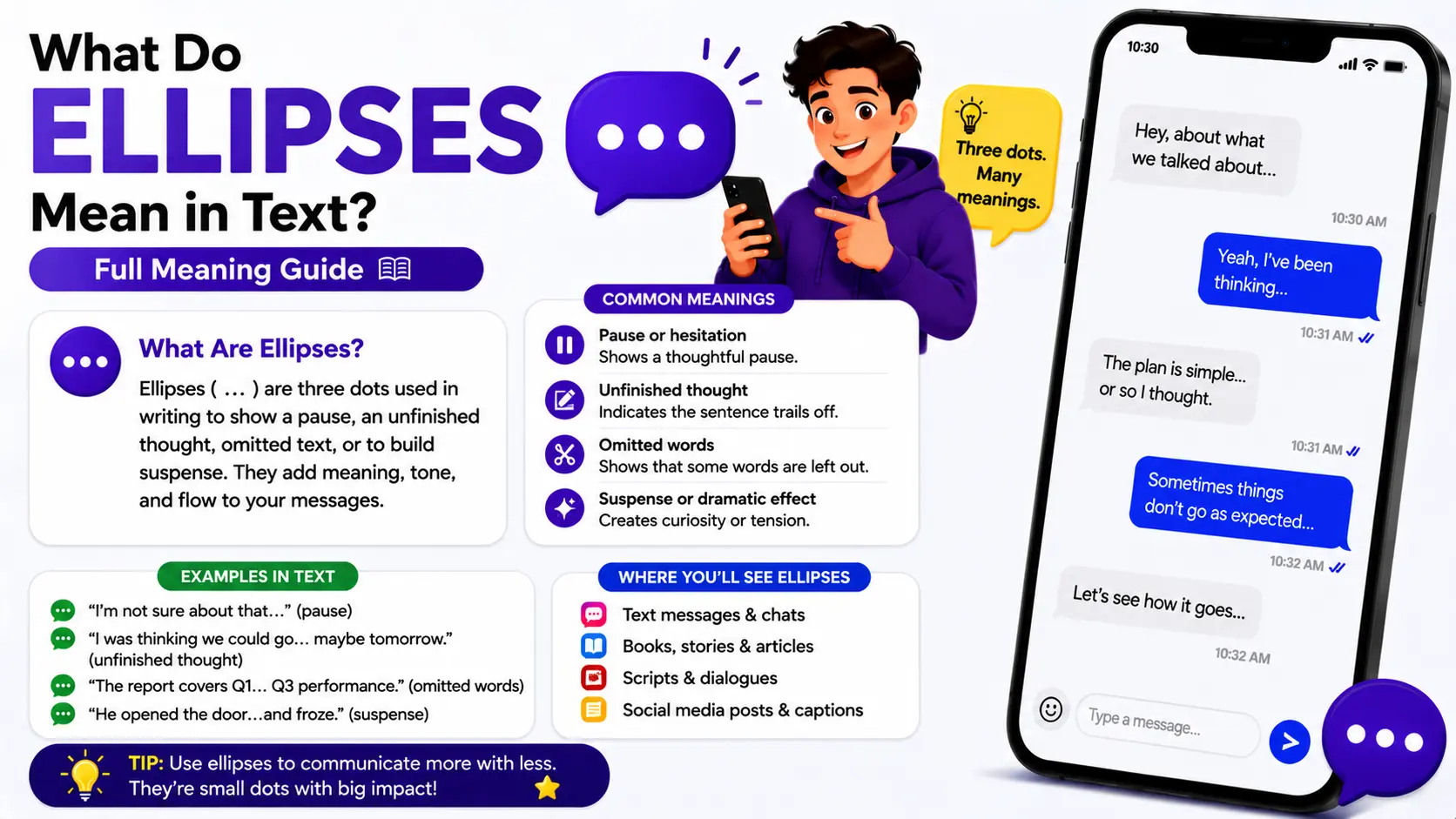
An ellipsis is a punctuation mark made of three dots: “…”
In texting, it usually means something is left unsaid or intentionally paused.
Simple meanings include:
- A pause in thought
- An unfinished idea
- Emotional hesitation
- Awkward silence
- Suspense or mystery
- Passive-aggressive tone (in some cases)
Examples:
- “I thought you said you were coming…”
- “Well… that’s interesting.”
- “I don’t know…”
Ellipses change meaning depending on context, tone, and relationship between speakers.
4️⃣ Origin & Background
Ellipses originally come from the Greek word “elleipsis,” meaning omission or falling short. In traditional writing, they were used to show that words were intentionally left out of a quote.
For example, in literature:
- A writer might shorten a sentence while keeping its meaning intact.
But with digital communication, especially texting and social media, ellipses evolved far beyond grammar rules.
Today, they are deeply shaped by:
- Messaging culture on WhatsApp and iMessage
- Social media posts and comments
- Short attention spans in digital conversation
- The need to express tone without voice or facial expression
On platforms like Instagram and TikTok, ellipses became a way to express emotions that emojis sometimes cannot fully capture.
Over time, they shifted from a grammatical tool to an emotional signal.
5️⃣ Real-Life Conversations (MANDATORY)
WhatsApp Conversation
Person A:
Did you talk to him?
Person B:
Yeah…
Person A:
Is everything okay?
Person B:
Not really.
Here, the ellipsis shows hesitation and emotional discomfort.
Instagram DM Conversation
Person A:
Your post was amazing!
Person B:
Thanks…
Person A:
Why does that sound sad?
Person B:
I didn’t mean it like that, just tired.
Here, the ellipsis creates emotional ambiguity.
TikTok Comment Section
User 1:
This trend is actually fun
User 2:
Fun…
In this case, the ellipsis can suggest sarcasm or disagreement.
Text Message Between Friends
Friend 1:
Are you coming tonight?
Friend 2:
I was thinking about it…
Friend 1:
That sounds like a no.
Friend 2:
Maybe…
This shows uncertainty and emotional hesitation.
6️⃣ Emotional & Psychological Meaning
Ellipses are powerful because they represent silence in written form. In spoken conversation, silence carries emotion. In text, ellipses replace that silence.
They often express:
- Uncertainty
- Emotional restraint
- Soft disagreement
- Passive frustration
- Thoughtful pause
People use ellipses when they do not want to sound too direct. It becomes a buffer between emotion and expression.
Personal-style scenario:
Imagine someone receives a message saying, “We need to talk…”
That ellipsis instantly creates tension. The reader starts thinking about possibilities even before knowing the topic. This is because ellipses trigger anticipation and emotional uncertainty.
In modern communication, ellipses often reveal more about how someone feels than what they actually say.
7️⃣ Usage in Different Contexts
Social Media
On platforms like Instagram or TikTok, ellipses are used to:
- Create suspense in captions
- Show sarcasm in comments
- Add emotional depth to short statements
Example:
“Just another perfect day…”
Friends & Relationships
In personal chats, ellipses often show:
- Emotional hesitation
- Soft disappointment
- Romantic uncertainty
Example:
“I thought you cared…”
Work / Professional Settings
In formal communication, ellipses are used carefully. They may indicate:
- A trailing thought
- A soft suggestion
- Incomplete information
Example:
“We could consider other options…”
Casual vs Serious Tone
- Casual use often feels relaxed or playful
- Serious use often feels emotional or tense
The same punctuation can completely change meaning depending on tone.
8️⃣ When NOT to Use It
Ellipses are not always appropriate.
Avoid using them in:
- Legal or official documents
- Clear instructions or safety messages
- Situations requiring direct communication
- Messages where clarity is important
They can create confusion or unintended emotional tone.
In professional environments, overusing ellipses may make messages seem uncertain or unprofessional.
9️⃣ Common Misunderstandings
Many people misread ellipses.
Common mistakes:
- Thinking they always mean sadness
- Assuming sarcasm in every case
- Believing they indicate negativity
Tone confusion:
A simple “okay…” can be read as:
- Upset
- Passive-aggressive
- Tired
- Neutral (depending on context)
Literal vs figurative meaning:
Ellipses do not always mean something is missing. Sometimes they are just stylistic pauses.
Context is everything.
🔟 Comparison Table
| Expression | Meaning | Tone |
|---|---|---|
| “…” | Pause or omission | Neutral or emotional |
| “okay” | Agreement | Neutral |
| “okay…” | Hesitation or emotion | Uncertain |
| “okay!” | Excitement or positivity | Positive |
| “fine” | Acceptance | Neutral or cold |
| “fine…” | Disappointment or tension | Negative |
Key Insight:
Ellipses are not just punctuation. They are emotional modifiers that shape how the reader interprets the message.
1️⃣1️⃣ Variations / Types
1. Ending Ellipsis
Indicates unfinished thought.
2. Dramatic Ellipsis
Creates suspense or tension.
3. Hesitation Ellipsis
Shows uncertainty.
4. Emotional Ellipsis
Carries sadness or disappointment.
5. Sarcastic Ellipsis
Adds irony to a sentence.
6. Softening Ellipsis
Makes a statement less direct.
7. Awkward Silence Ellipsis
Fills uncomfortable gaps.
8. Reflective Ellipsis
Shows deep thought.
9. Passive-Aggressive Ellipsis
Hints at hidden frustration.
10. Stylistic Ellipsis
Used for aesthetic writing or tone.
1️⃣2️⃣ How to Respond When Someone Uses It
Casual replies:
- “Everything okay?”
- “What’s on your mind?”
Funny replies:
- “That ellipsis looks suspicious”
- “Why does that feel dramatic?”
Mature replies:
- “Take your time, I’m here”
- “Let me know when you’re ready to talk”
Respectful replies:
- “I understand, no pressure”
- “I hear you”
The best response depends on emotional context, not just grammar.
1️⃣3️⃣ Regional & Cultural Usage
Western Culture
Often used for tone, sarcasm, or emotional hesitation in texting.
Asian Culture
Frequently used in polite communication to soften directness.
Middle Eastern Culture
Can appear in translated digital communication, often to show respect or indirectness.
Global Internet Usage
On social media, ellipses are widely understood as emotional cues.
Generational Differences
- Gen Z: Uses ellipses for sarcasm or humor
- Millennials: Uses them for tone softening or emotional expression
1️⃣4️⃣ Is It Safe for Kids?
Yes, ellipses are safe since they are punctuation marks. However, children may misinterpret emotional tone in messages.
It is important for younger users to understand that ellipses can change meaning depending on context, especially in online conversations.
1️⃣5️⃣ FAQs
1. What do ellipses mean in texting?
They usually indicate a pause, hesitation, or unfinished thought.
2. Are ellipses rude?
Not always. It depends on context and tone.
3. Why do people use ellipses instead of full stops?
To create emotional or conversational effects.
4. Do ellipses mean anger?
Sometimes, but not always. They can also show thoughtfulness.
5. Are ellipses formal or informal?
Mostly informal, but sometimes used in formal writing for stylistic reasons.
6. Can ellipses change meaning of a sentence?
Yes, they can completely change tone.
7. Why do ellipses feel dramatic?
Because they create suspense and silence in written form.
1️⃣6️⃣ Conclusion
Ellipses may look like a small detail, but in digital communication they carry emotional weight. They can soften a message, create suspense, or reveal hesitation without saying it directly.
Understanding what ellipses mean in text helps you read between the lines more accurately and respond with better emotional awareness.
In a world where most communication happens through screens, these three dots quietly shape how we understand each other.
Use them carefully, read them thoughtfully, and you will notice how much meaning they add to everyday conversations.