
If you have ever seen “ONS” in a message and paused for a second, you are not alone. Text slang changes quickly, and many abbreviations can mean completely different things depending on the context. Some are playful, some are casual, and others carry a more personal or emotional tone.
The phrase “ONS” is one of those abbreviations that creates confusion because it is not always obvious from the message alone. People often come across it in text messages, social media comments, dating conversations, or private chats and immediately wonder what it actually means.
Understanding what ONS means in text matters because online communication is fast. A small misunderstanding can change the tone of an entire conversation. Whether you are texting friends, browsing social media, or decoding a message from someone you like, knowing the meaning behind ONS can help you avoid awkward misunderstandings.
This guide explains the meaning of ONS, where it came from, how people use it, emotional context, regional differences, and how to respond naturally when someone uses it.
ONS Meaning in Text: Quick Definition
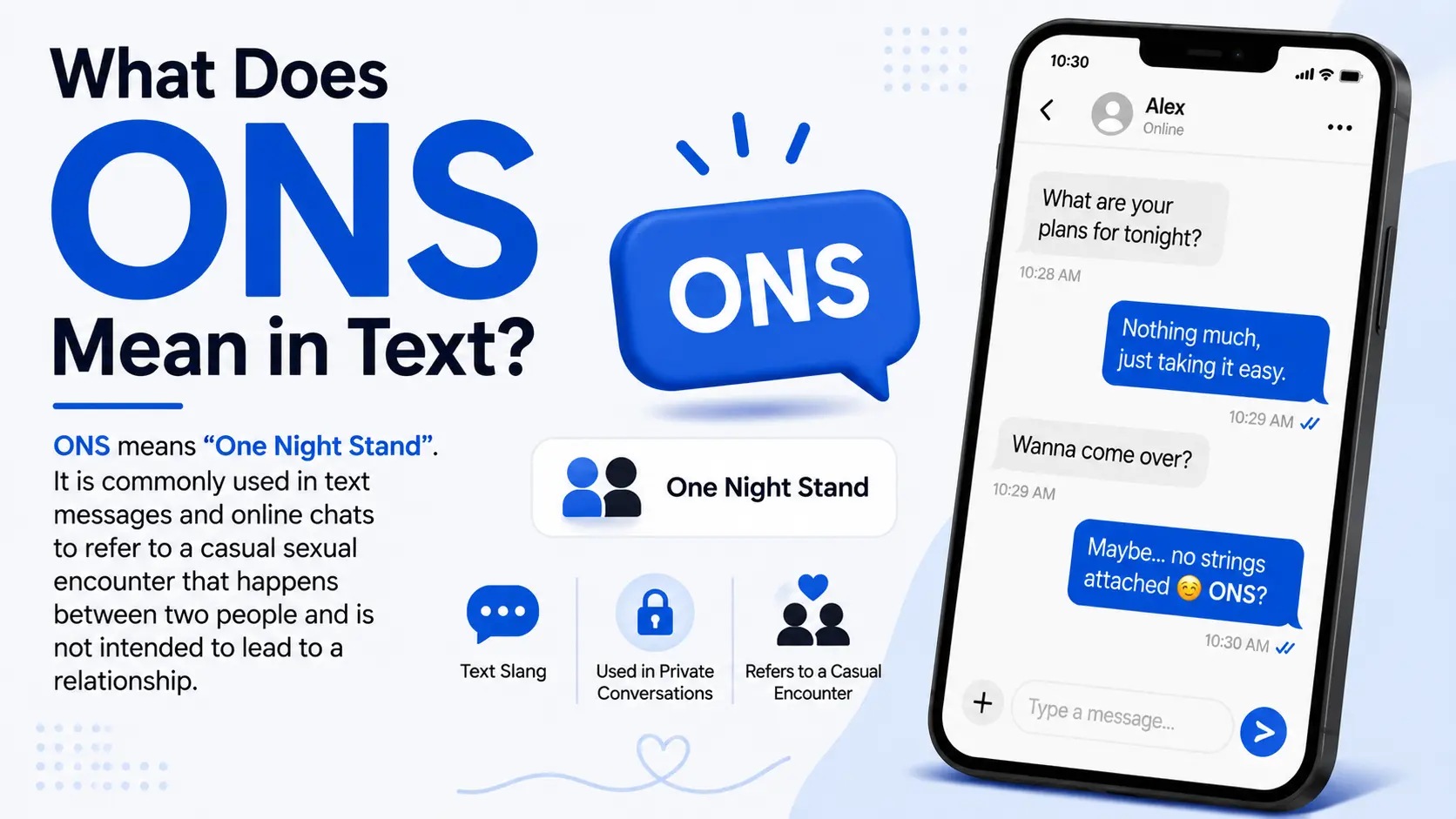
In text messaging and online slang, ONS usually stands for “One Night Stand.”
It refers to a brief romantic or physical encounter that happens only once, without expectations of a long-term relationship.
People often use ONS in:
- Dating app conversations
- Casual texting
- Relationship discussions
- Social media comments
- Private chats
The meaning depends heavily on context.
Quick Examples
“He said he only wanted an ONS, nothing serious.”
“I’m not into ONS situations anymore.”
“Some people are fine with ONS, others want deeper connections.”
In most cases, ONS is used in conversations related to dating, attraction, or relationship boundaries.
Origin and Background of ONS
The abbreviation ONS did not begin as internet slang. The phrase “one night stand” existed long before texting culture became mainstream.
Historically, “one night stand” described a brief romantic encounter between two people who did not plan to continue seeing each other. The phrase became common in casual conversation, movies, magazines, and relationship discussions.
As texting culture evolved, people began shortening longer phrases into quick abbreviations.
Words like:
- LOL for laughing
- BRB for be right back
- IMO for in my opinion
followed the same pattern.
ONS entered digital communication because it saved time and felt less direct than writing out the full phrase.
Social media platforms accelerated its popularity.
Dating culture online created a space where relationship intentions became important to communicate quickly. Apps and messaging platforms encouraged shorter language, especially when discussing boundaries or expectations.
Many users adopted ONS as a simple label rather than writing an entire explanation.
Today, ONS appears in:
- Dating profiles
- Reddit discussions
- TikTok comments
- Instagram captions
- Messaging apps
Its meaning remains consistent, but the emotional interpretation changes depending on who uses it and why.
Real-Life Conversations Using ONS
Understanding slang becomes easier when you see it used naturally.
Below are realistic examples showing how ONS appears in real conversations.
WhatsApp Conversation
Person A: Are you talking to that guy from the party again?
Person B: No, it was just an ONS. Nothing serious.
Person A: Got it. I thought you two were still texting.
Instagram DM Conversation
Person A: You two looked close in your story.
Person B: Honestly, it was more of an ONS situation.
Person A: That explains why you never posted them again.
TikTok Comment Section
Person A: Why do people always catch feelings after casual situations?
Person B: Because sometimes one person thinks it is an ONS and the other wants more.
Text Message Conversation
Person A: Do you think he actually likes me?
Person B: Depends. Did he say he wanted something serious or just an ONS?
Person A: He avoided the topic completely.
These examples show that ONS often appears in conversations about expectations, emotional clarity, and relationship intentions.
Emotional and Psychological Meaning of ONS
Although ONS sounds simple, the emotional meaning behind it can be complex.
For some people, it represents freedom and casual connection.
For others, it can create confusion, disappointment, or mixed expectations.
The emotional weight depends on personal values, dating goals, and communication style.
What ONS Often Expresses Emotionally
- Casual attraction
- Temporary connection
- Lack of long-term commitment
- Desire for independence
- Exploration without emotional pressure
Psychologically, people use abbreviations like ONS because they create distance.
Writing “ONS” feels less intense than spelling out “one night stand.”
Shortened language often softens uncomfortable topics.
Many people use shorthand terms to avoid awkwardness or emotional vulnerability.
Personal-Style Scenario
Imagine someone who recently ended a serious relationship.
They may not feel ready for emotional attachment yet.
In conversation, they might say they only want an ONS because they want companionship without commitment.
That does not always mean they are emotionally unavailable.
Sometimes it simply reflects where they are in life.
Modern communication allows people to define relationship expectations quickly, and ONS has become one of those labels.
How ONS Is Used in Different Contexts
The meaning of ONS stays fairly consistent, but the tone changes depending on the setting.
Social Media Usage
On social media, ONS often appears in discussions about dating culture.
People use it when sharing opinions, relationship stories, or dating experiences.
Examples include:
- TikTok relationship debates
- Instagram captions
- Dating advice posts
- Comment sections discussing casual relationships
In these spaces, ONS is usually understood by younger audiences familiar with internet slang.
Friends and Relationships
Among friends, ONS is often used casually.
People may discuss dating experiences without going into detailed explanations.
Example:
“It was just an ONS. I’m not emotionally attached.”
The abbreviation makes the conversation feel lighter.
Professional or Work Settings
ONS is generally not suitable in professional communication.
Work emails, business messages, or formal discussions are not appropriate places for slang tied to personal relationships.
Using ONS at work may create confusion or appear unprofessional.
Casual vs Serious Tone
In casual settings, ONS may sound neutral.
In serious conversations, it can carry emotional weight.
Someone discussing boundaries or heartbreak may use ONS to explain why expectations did not align.
Tone matters just as much as definition.
When Not to Use ONS
Not every situation is appropriate for slang like ONS.
Even though it is common online, there are moments when using it can create discomfort or misunderstanding.
Avoid Using ONS In:
- Professional communication
- Conversations with older relatives unfamiliar with slang
- Formal writing
- Sensitive emotional discussions without context
- Situations where meaning may be misunderstood
Because ONS relates to dating or intimacy, some audiences may find it too personal.
You should also avoid using it sarcastically if the other person may not understand the tone.
Miscommunication often happens when abbreviations assume shared understanding.
Common Misunderstandings About ONS
ONS is straightforward once you know the meaning, but confusion still happens.
1. People Think It Means “Online Status”
Some users assume ONS refers to online activity or availability.
This misunderstanding happens because abbreviations often have multiple meanings.
2. Tone Can Feel Harsh
Using ONS can sound emotionally distant.
Someone may interpret it as cold or dismissive, especially in relationship discussions.
3. Not Everyone Understands Dating Slang
Older generations or people unfamiliar with internet culture may not recognize the abbreviation.
4. Assumptions Create Problems
One person may see ONS as casual and harmless.
Another may feel uncomfortable discussing it.
Context matters more than the letters themselves.
Comparison Table: ONS vs Similar Expressions
| Expression | Meaning | Tone | Relationship Context |
|---|---|---|---|
| ONS | One night stand | Casual | Temporary encounter |
| Hookup | Casual physical connection | Informal | Short-term |
| Situationship | Undefined relationship | Emotional | Ongoing but unclear |
| Casual Dating | Relaxed dating without commitment | Neutral | Repeated interaction |
| Serious Relationship | Long-term commitment | Deep | Emotional investment |
| Friends with Benefits | Friendship plus intimacy | Comfortable | Recurring connection |
Key Insight
ONS usually implies a single encounter, while other expressions often involve ongoing interaction. The biggest difference is duration and emotional expectation.
Variations and Related Terms
Here are common expressions related to ONS that appear in texting and online conversations.
1. Hookup
A casual romantic or physical interaction.
2. FWB
Short for friends with benefits.
3. Situationship
A relationship without clear labels.
4. Casual Dating
Seeing someone without exclusivity.
5. No Strings Attached
Connection without emotional commitment.
6. Talking Stage
Early phase of getting to know someone.
7. Sneaky Link
A secret romantic meeting.
8. Rebound
Dating shortly after a breakup.
9. Crush
Strong attraction to someone.
10. Soft Launch
Introducing a relationship subtly online.
These variations help explain modern dating language and how communication continues evolving.
How to Respond When Someone Uses ONS
Your response depends on tone, comfort level, and relationship context.
Casual Replies
- “That makes sense.”
- “Thanks for being honest.”
- “Got it, no pressure.”
Funny Replies
- “At least you kept it honest.”
- “Modern dating really comes with labels.”
- “That definitely explains the mixed signals.”
Mature Replies
- “I appreciate the clarity.”
- “It is good to know what you are looking for.”
- “Honesty helps avoid confusion.”
Respectful Replies
- “Thanks for being upfront.”
- “Everyone has different preferences.”
- “I respect your honesty.”
A calm response creates healthier communication.
The goal is understanding, not judgment.
Regional and Cultural Usage of ONS
The interpretation of ONS changes slightly depending on culture and age group.
Western Culture
In Western countries, ONS is widely recognized in dating culture.
It often appears openly in apps, conversations, and relationship discussions.
Younger generations usually understand it immediately.
Asian Culture
In many Asian cultures, discussions around dating slang may feel more private.
ONS may still be understood online, but people may avoid discussing it openly.
Social expectations around relationships often shape how comfortable people feel using the term.
Middle Eastern Culture
In Middle Eastern settings, ONS may be less openly discussed due to cultural values surrounding dating and relationships.
People may understand the abbreviation but avoid public use.
Global Internet Culture
Internet culture removes geographical boundaries.
People across countries encounter the same slang through memes, videos, and social platforms.
ONS has become globally recognized because digital communication spreads trends quickly.
Generational Differences
Gen Z
Gen Z often understands ONS instantly because they grew up with texting culture.
Millennials
Millennials also recognize the term but may use it less frequently in everyday conversation.
Older generations may need explanation before understanding the abbreviation.
Is ONS Safe for Kids?
ONS is not harmful as a word itself, but it relates to mature dating concepts.
Parents should understand that children and teenagers may encounter the term online.
Context matters.
If younger users see ONS in social media comments or conversations, it may be helpful to explain it in age-appropriate language.
Open communication is often more effective than avoiding the topic entirely.
Frequently Asked Questions
What does ONS mean in texting?
ONS usually means “one night stand,” referring to a single casual romantic or physical encounter.
Is ONS a bad term?
No. ONS is not inherently negative. Its meaning depends on context and personal values.
Is ONS only used on dating apps?
No. It appears in texting, social media, forums, and casual conversations.
Can ONS have another meaning?
Yes. In rare cases, ONS can stand for other phrases depending on industry or context. In texting, it most commonly means one night stand.
Why do people use ONS instead of writing it fully?
Abbreviations save time and feel less direct in casual conversation.
Is ONS common among Gen Z?
Yes. Younger users often understand the abbreviation because of social media and texting culture.
Can ONS create misunderstandings?
Yes. If context is unclear, someone may misinterpret the tone or meaning.
Final Thoughts on What ONS Mean in Text
Understanding what ONS means in text helps you navigate modern communication with more confidence.
It is a short abbreviation, but it carries emotional meaning, cultural influence, and social context.
Whether you encounter it in a text message, dating conversation, or online comment, recognizing its meaning allows you to respond thoughtfully.
Digital communication moves quickly.
The more familiar you become with slang terms like ONS, the easier it becomes to understand tone, intention, and emotional nuance.
Language changes constantly, but clarity always matters.
Knowing what ONS means helps you avoid confusion and communicate with greater awareness.