
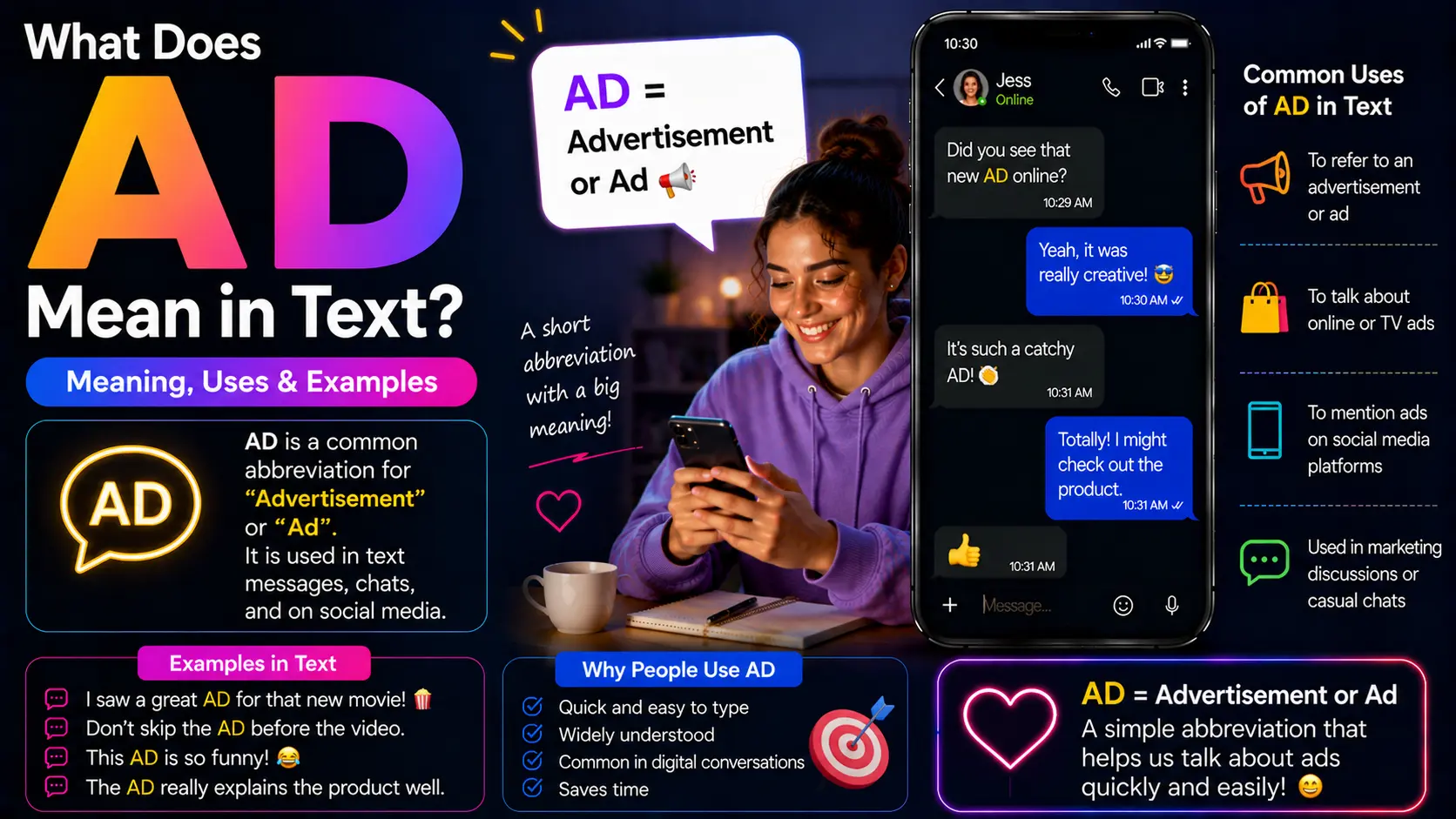
If you’ve received a message containing “AD” and found yourself wondering what it means, you’re not alone. Text abbreviations often have multiple meanings, and their interpretation depends entirely on the conversation.
In texting, social media, online gaming, and professional chats, AD can represent different ideas. Sometimes it refers to an advertisement, sometimes it means Attack Damage in gaming, and in certain conversations it can even stand for Active Directory or other topic-specific terms.
This variety is exactly why people search for what does AD mean in text. Understanding the context helps you avoid confusion and respond naturally.
In this guide, you’ll learn the most common meanings of AD, where it came from, how people use it in everyday conversations, and when you should or should not use it.
AD Meaning in Text: Quick Meaning
The abbreviation AD has several common meanings depending on the situation.
Most common meanings include:
- Advertisement
- Attack Damage (gaming)
- Active Directory (technology)
- Assistant Director (workplace)
- Anno Domini (historical dates)
When people ask about texting or social media, Advertisement is usually the intended meaning.
Quick Examples
“That post is clearly an AD.”
“She tagged the brand because it’s an AD.”
“This creator always says #AD when promoting products.”
The surrounding conversation almost always tells you which meaning is being used.
Origin & Background
Unlike many internet slang terms, AD wasn’t invented by young texters. It has existed as an abbreviation for decades.
One of its oldest uses is Advertisement, appearing in newspapers, magazines, and classified listings long before smartphones existed.
As social media grew, influencers and content creators began using AD to indicate sponsored content. Platforms encouraged transparency, making labels like #AD common on Instagram, TikTok, YouTube, and other networks.
At the same time, online gaming communities adopted AD to mean Attack Damage, while workplaces often used it for Assistant Director or Active Directory.
Today, the abbreviation is widely recognized across many online communities, but its meaning always depends on context.
Real-Life Conversations
Person A:
Did you actually buy that skincare product?
Person B:
Yes, but the video recommending it was an AD.
Person A:
At least they were honest about it.
Instagram DM
Person A:
Your favorite creator keeps posting beauty brands.
Person B:
Most of those are paid AD collaborations.
TikTok Comments
Person A:
Is this review real?
Person B:
It says #AD, so it’s a sponsored partnership.
Text Messages
Person A:
Why did everyone suddenly start talking about that app?
Person B:
Probably because a huge AD campaign just launched.
Emotional & Psychological Meaning
Although AD itself doesn’t express emotion, it often signals transparency, promotion, or commercial intent.
When someone labels a post as an AD, they’re telling their audience that they’re promoting a product or service. This honesty can increase trust because viewers know the recommendation is sponsored.
On the other hand, some readers become skeptical when they see AD, wondering whether the opinion is completely genuine.
I’ve noticed that many people immediately judge online recommendations differently once they see the AD label. Instead of accepting the message at face value, they naturally become more thoughtful and ask whether the recommendation matches their own needs.
This reflects a broader shift in digital communication. People value authenticity and appreciate knowing when marketing is involved.
Usage in Different Contexts
Social Media
AD most commonly means Advertisement.
Examples include:
- #AD
- Paid AD
- Sponsored AD
- Brand AD
Creators use it to disclose promotional partnerships.
Friends and Relationships
Friends may casually mention AD when talking about sponsored posts.
Example:
“Everything she posts feels like an AD now.”
The tone is usually playful or observational.
Work and Professional Settings
At work, AD may mean:
- Advertisement
- Assistant Director
- Active Directory
Because multiple meanings exist, professional communication should always provide context.
Casual vs Serious Tone
Casually, AD often refers to marketing content.
Professionally, it usually relates to business, technology, or organizational roles.
When NOT to Use It
Avoid using AD when your audience may not understand the abbreviation.
Examples include:
- Formal academic writing
- Legal documents
- Important client communication
- International conversations where abbreviations may differ
- Conversations that require complete clarity
Instead, write the full word when precision matters.
Common Misunderstandings
Many people assume AD always means Advertisement, but that’s not true.
Here are common mistakes:
- Confusing Advertisement with Attack Damage.
- Assuming every influencer post is an AD.
- Thinking AD automatically means the recommendation is dishonest.
- Misreading gaming discussions.
- Misunderstanding workplace conversations.
Remember that context always determines the correct interpretation.
Comparison Table
| Expression | Meaning | Typical Use |
|---|---|---|
| AD | Advertisement | Sponsored content |
| Promo | Promotional content | Marketing |
| Sponsored | Paid partnership | Influencers |
| Organic Post | Non-paid content | Social media |
| Attack Damage (AD) | Offensive game statistic | Gaming |
| PR Package | Free product sent by brands | Influencer marketing |
Key Insight
The letters AD are simple, but their meaning changes dramatically depending on the conversation. Looking at who is speaking and what they’re discussing makes interpretation much easier.
Variations and Types of AD
1. #AD
Used to disclose sponsored content.
2. Paid AD
Indicates a paid advertisement.
3. Sponsored AD
A promotional partnership with a company.
4. Brand AD
Advertising created for a specific brand.
5. Video AD
A promotional video.
6. Display AD
An online banner advertisement.
7. Mobile AD
Advertising shown inside mobile apps.
8. Search AD
Advertisements appearing in search engine results.
9. Gaming AD
Usually refers to Attack Damage depending on the game.
10. Social Media AD
Advertising distributed across social platforms.
How to Respond When Someone Uses AD
Casual Replies
- Oh, that makes sense.
- I figured it was sponsored.
- Thanks for letting me know.
Funny Replies
- My wallet saw that AD before I did.
- Another AD trying to convince me.
- Mission accomplished. Now I want it too.
Mature Replies
- I appreciate the transparency.
- Thanks for being honest about the sponsorship.
- That’s helpful information.
Respectful Replies
- Thanks for clarifying.
- Good to know it was a paid partnership.
- I appreciate the disclosure.
Regional & Cultural Usage
Western Culture
AD is strongly associated with influencer marketing and sponsored posts. Many creators openly label partnerships to build audience trust.
Asian Culture
Social commerce is rapidly growing, and AD disclosures are becoming more common. Some platforms rely more on local language labels, while English abbreviations are increasingly understood among younger users.
Middle Eastern Culture
Many creators use AD when working with international brands. However, local audiences may also see disclosures written in their native language alongside English hashtags.
Global Internet Usage
Across the internet, AD is widely recognized as a shorthand for advertising. Gaming communities continue using it to mean Attack Damage, so context remains important.
Gen Z vs Millennials
Gen Z is highly familiar with #AD through TikTok, Instagram, and creator culture. Millennials also recognize it, especially from blogs, YouTube, and social media marketing, but may be more accustomed to seeing the full word “sponsored.”
Is It Safe for Kids?
Yes, the abbreviation AD is generally safe for children because it is not offensive or inappropriate.
However, parents and educators can use it as an opportunity to teach media literacy. Helping young people recognize when content is promotional encourages thoughtful decision-making rather than accepting every recommendation at face value.
Frequently Asked Questions
What does AD mean in text?
Most commonly, it means Advertisement, although it can have other meanings depending on the conversation.
Is AD the same as sponsored?
Usually yes. Both indicate promotional or paid content.
What does #AD mean on Instagram?
It tells viewers that the post contains a paid partnership or sponsored promotion.
Can AD mean something in gaming?
Yes. In many games, AD stands for Attack Damage.
Is AD considered internet slang?
Not exactly. It is an abbreviation used across advertising, technology, gaming, and online communication.
Why do influencers write AD?
They use it to disclose sponsored partnerships and help audiences understand that the content includes advertising.
Should I use AD in professional emails?
Only if your audience clearly understands the abbreviation. Otherwise, writing the full term is usually better.
Conclusion
Understanding what does AD mean in text becomes much easier once you pay attention to context. While it most often refers to Advertisement on social media, it can also represent gaming terms, workplace roles, or technical concepts.
Instead of assuming a single meaning, look at the conversation, the platform, and the people involved. That simple habit helps you interpret messages accurately and communicate with greater confidence.
As digital communication continues to evolve, abbreviations like AD will remain part of everyday conversations. Knowing how and when to use them allows you to navigate online interactions naturally while avoiding unnecessary misunderstandings.