

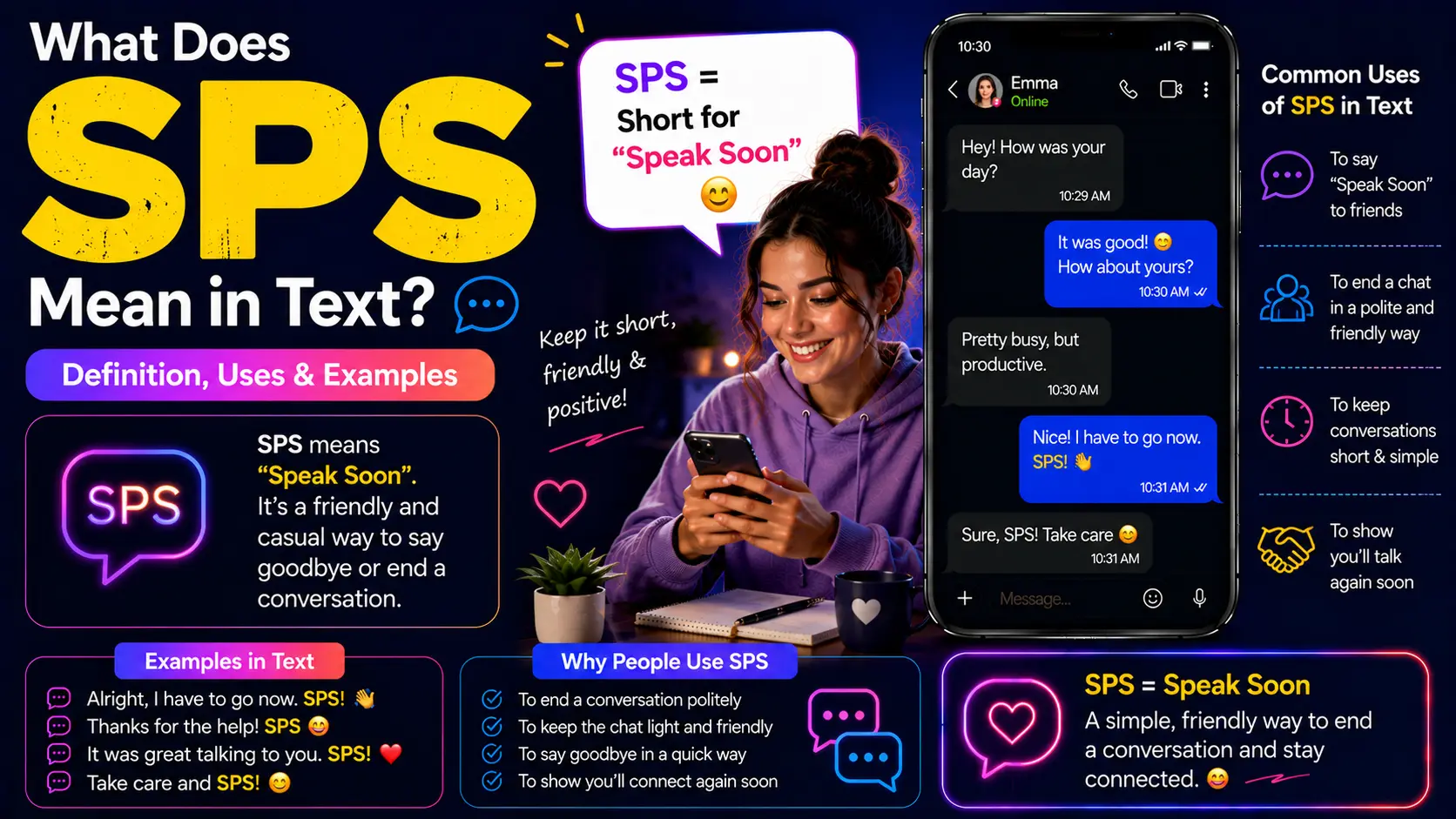
If you’ve received a message that simply says “SPS”, you’re not alone in wondering what it means. Text messaging and social media have created thousands of abbreviations, and many of them can have more than one meaning depending on the conversation. That can make even a simple three-letter message surprisingly confusing.
In most online conversations, SPS commonly stands for “Share for Share.” It’s a popular phrase on social media where one person agrees to promote another person’s account, post, or content in exchange for receiving the same support in return. However, in different situations, SPS can also represent other meanings, making context incredibly important.
People search for “what does SPS mean in text” because they want to avoid misunderstanding a message, reply appropriately, or better understand the language used on platforms like Instagram, Snapchat, TikTok, and WhatsApp.
In this guide, you’ll learn the most common meaning of SPS, where it came from, how people actually use it in everyday conversations, and when you should or shouldn’t use it yourself.
What Does SPS Mean in Text? Quick Meaning
The most common meaning of SPS in texting and social media is:
SPS = Share for Share
It refers to an agreement where two people promote each other’s content, profile, or account.
Quick definition
- Full form: Share for Share
- Common platforms: Instagram, Snapchat, TikTok, Facebook, WhatsApp
- Tone: Friendly, promotional, casual
- Purpose: Mutual support and audience growth
Here are a few simple examples:
“Can we do an SPS later today?”
“Thanks for the SPS. I got several new followers!”
“Anyone interested in an SPS?”
Although “Share for Share” is the meaning most people recognize, SPS can occasionally stand for different things in professional or technical conversations. That’s why reading the surrounding messages always helps you understand the intended meaning.
Origin & Background
The phrase Share for Share became popular during the rapid growth of visual social media platforms in the early 2010s. As users searched for ways to gain more followers, they began exchanging promotions with friends, creators, and influencers.
Instagram played one of the biggest roles in popularizing SPS. Before advanced recommendation algorithms became dominant, creators relied heavily on community engagement. Sharing another person’s profile in Stories or posts often introduced them to hundreds or even thousands of potential followers.
Soon, the trend expanded to:
- Snapchat Stories
- TikTok videos
- Facebook groups
- Pinterest communities
- Smaller creator networks
Over time, SPS became more than just a marketing shortcut. It also represented friendship, collaboration, and community support.
For many small creators, an SPS wasn’t simply about numbers. It was a way of saying:
“I appreciate your content, and I’d like my audience to discover you too.”
As influencer culture evolved, SPS also became more selective. Larger creators often reserved Share for Share collaborations for accounts with similar audiences or high-quality content. Even today, the abbreviation remains widely understood across many social platforms.
Real-Life Conversations
Below are realistic examples showing how SPS naturally appears in everyday conversations.
1. WhatsApp Conversation
Person A:
Hey! I really like your photography page.
Person B:
Thanks! That means a lot.
Person A:
Want to do an SPS tonight?
Person B:
Sure! I’ll share your latest post if you share mine.
2. Instagram DMs
Person A:
Your reels have been amazing lately.
Person B:
Thank you!
Person A:
Would you be interested in an SPS? I think our audiences would enjoy each other’s content.
Person B:
Absolutely. Send me the post you’d like me to feature.
3. TikTok Comments
Person A:
Love your videos!
Person B:
Thanks so much!
Person A:
SPS?
Person B:
Definitely! I’ll follow and share your newest upload.
4. Text Messages
Person A:
I’m trying to grow my small business page.
Person B:
Same here.
Person A:
Let’s do an SPS this weekend.
Person B:
Sounds good. We’ll both get some extra exposure.
These conversations highlight an important point. SPS is usually not about asking for a favor without giving anything back. Instead, it reflects a mutual exchange where both people benefit.
Because of that, the abbreviation often carries a positive, cooperative tone. It encourages networking, supports small creators, and helps people discover new accounts through trusted recommendations.
Whether you’re chatting with friends, connecting with fellow creators, or promoting a small business online, understanding what SPS means allows you to participate confidently in today’s fast-moving digital conversations.
Emotional & Psychological Meaning
At first glance, SPS (Share for Share) seems like a simple request for mutual promotion. But underneath that short abbreviation is something much more human. It reflects the desire to connect, support others, and grow together.
Social media can sometimes feel competitive, with everyone trying to gain attention. An SPS changes that dynamic by encouraging collaboration instead of competition. Rather than saying, “Look at me,” it says, “Let’s help each other.”
People often use SPS because they:
- Want to build a supportive community.
- Appreciate another person’s content.
- Hope to reach new audiences fairly.
- Feel more comfortable asking for mutual support than asking for a one-sided favor.
Psychologically, SPS creates a sense of reciprocity. When both people contribute equally, the interaction feels balanced and respectful. This is one reason the phrase has remained popular despite constant changes in social media trends.
Imagine you’ve spent weeks creating helpful content, but very few people see it. A fellow creator messages you asking for an SPS. After you both share each other’s work, new followers arrive, conversations begin, and your motivation returns. The biggest reward is not always the increase in numbers. Sometimes it is simply knowing someone believes your work deserves to be seen.
That feeling of shared encouragement is what gives SPS its lasting appeal.
Usage in Different Contexts
Although SPS usually means Share for Share, the way people use it depends on the platform and the relationship between the people involved.
Social Media
This is where SPS appears most frequently.
Creators use it to exchange visibility by sharing each other’s:
- Stories
- Posts
- Reels
- Videos
- Profiles
Example:
“Anyone interested in an SPS? I’m looking for creators in the fitness niche.”
Here, the request is public and invites collaboration.
Friends & Relationships
Friends often use SPS casually to support each other’s hobbies, businesses, or creative projects.
Example:
“Can you do an SPS for my art page?”
Rather than feeling like advertising, it feels like helping a friend succeed.
Work or Professional Settings
In professional environments, the abbreviation is far less common.
Instead of writing “Let’s do an SPS,” people usually say:
- “Let’s cross-promote.”
- “Would you like to collaborate?”
- “We can feature each other’s brands.”
These phrases sound more polished and appropriate for business communication.
Casual vs. Serious Tone
SPS almost always has a casual tone.
Among friends or creators, it sounds natural.
In formal emails, job applications, client meetings, or academic writing, using SPS may confuse readers or appear unprofessional.
Knowing your audience is more important than knowing the abbreviation itself.
When NOT to Use It
Even though SPS is friendly, there are situations where using it is not the best choice.
During Serious Conversations
If someone is discussing a personal problem, illness, or emotional struggle, asking for an SPS can seem insensitive.
For example:
❌ “Sorry you’re having a hard week. Anyway, SPS?”
The timing feels inappropriate.
Professional Business Emails
Many professionals are unfamiliar with internet slang.
Instead of writing SPS, explain your collaboration clearly.
For example:
✔ “Would you be interested in promoting each other’s content?”
This removes any chance of misunderstanding.
With People Who Rarely Use Social Media
Parents, grandparents, or colleagues may interpret SPS differently or have no idea what it means.
Using plain language is often the better choice.
When You Only Want Promotion
An SPS should be a mutual exchange.
If someone expects the other person to promote them without offering anything in return, calling it an SPS becomes misleading.
Common Misunderstandings
Although SPS usually means Share for Share, many people misunderstand it because the same abbreviation has other meanings in different fields.
Here are some common sources of confusion.
Assuming It Always Means the Same Thing
Someone working in technology, medicine, education, or engineering may recognize SPS as a completely different abbreviation.
Always consider the topic of the conversation.
Thinking It’s the Same as “Shoutout”
A shoutout is usually one person promoting another.
An SPS is an agreement where both people share each other’s content.
That difference matters.
Believing It Guarantees Followers
An SPS increases visibility, but it does not guarantee engagement or long-term followers.
People still decide whether your content interests them.
Misreading the Tone
Some people view SPS requests as genuine networking.
Others see frequent SPS requests as overly promotional.
The tone depends on how politely and naturally the request is made.
Comparison Table
| Expression | Meaning | Typical Use | Tone |
|---|---|---|---|
| SPS | Share for Share | Mutual promotion | Friendly, collaborative |
| SFS | Shoutout for Shoutout or Share for Share | Mutual promotion | Casual |
| SO | Shoutout | Promoting another person | Supportive |
| Collab | Collaboration | Working together on content | Professional and creative |
| Repost | Sharing someone else’s content | One-way promotion | Neutral |
| Support | Helping another creator | General encouragement | Positive |
| Ignore | Choosing not to engage | Opposite of SPS | Neutral or negative |
| Cross-promotion | Business partnership | Marketing and branding | Professional |
Key Insight
Although SPS and similar expressions all involve promotion, SPS stands out because it is based on mutual exchange. Both people contribute, making the interaction feel more balanced and community-driven rather than one-sided.
Variations and Related Types of SPS
Internet slang changes constantly, and several expressions are closely connected to SPS. Here are some of the most common ones.
1. SFS (Shoutout for Shoutout)
Two creators give each other public shoutouts to reach new audiences.
2. L4L (Like for Like)
Users agree to like each other’s posts to increase engagement.
3. F4F (Follow for Follow)
Each person follows the other’s account.
4. C4C (Comment for Comment)
Participants leave meaningful comments on each other’s content.
5. T4T (Tag for Tag)
Users tag one another in posts or stories for greater visibility.
6. Share Back
A less abbreviated way of requesting mutual sharing.
Example:
“I’ll share yours if you share mine.”
7. Cross-Promotion
A more professional version of SPS often used by businesses, brands, and content creators.
8. Story Swap
Two users exchange Instagram or Snapchat Story mentions.
9. Creator Collaboration
Instead of simply sharing content, both creators work together on videos, live sessions, or projects.
10. Community Support Post
Some online communities organize scheduled posts where members voluntarily share each other’s work to help everyone grow.
How to Respond When Someone Uses SPS
If someone sends you “SPS?”, your reply depends on whether you’re interested.
Casual Replies
- “Sure, let’s do it!”
- “Sounds good to me.”
- “I’m in!”
- “Absolutely!”
Funny Replies
- “Only if your followers promise to like my terrible jokes.”
- “Deal, but my cat deserves most of the credit.”
- “Let’s make each other internet famous.”
Mature Replies
- “I’d be happy to support your content.”
- “Let’s choose posts that fit both of our audiences.”
- “Thanks for asking. I think that could work well.”
Respectful Replies
- “I appreciate the invitation, but I’ll pass this time.”
- “Thanks for thinking of me.”
- “Maybe another day.”
- “I’m focusing on different collaborations right now.”
A thoughtful response helps maintain a positive relationship, whether you accept the invitation or politely decline.
Regional & Cultural Usage
Although SPS most commonly means “Share for Share,” the way people use and interpret it can vary across cultures and online communities. Understanding these differences helps you communicate more naturally and avoid confusion.
Western Culture
In countries like the United States, Canada, the United Kingdom, and Australia, SPS is widely recognized among content creators and active social media users.
Creators often use it to:
- Grow their audience.
- Build networking relationships.
- Support friends and fellow creators.
- Promote small businesses.
Because influencer culture is well established, SPS is generally viewed as a normal way to collaborate, especially among smaller accounts.
Asian Culture
Across many Asian countries, the idea behind SPS is familiar, even if the abbreviation itself is not always used.
Some creators prefer writing out phrases like:
- “Let’s support each other.”
- “Please share my post.”
- “Mutual promotion?”
In countries where online communities emphasize respect and group harmony, people may phrase these requests more politely instead of using internet shorthand.
Middle Eastern Culture
In many Middle Eastern online communities, mutual support is highly valued, particularly among small businesses, artists, and educational creators.
However, users may avoid abbreviations like SPS when speaking with broader audiences because not everyone recognizes English internet slang.
Writing a complete sentence often feels more welcoming and inclusive.
Global Internet Usage
On international platforms like Instagram, TikTok, Snapchat, and X, SPS has become part of the shared vocabulary of many creators.
Even when users speak different native languages, abbreviations such as SPS, F4F, and L4L are often understood because they have spread through global social media culture.
Still, context remains important. Someone outside the creator community may never have encountered the abbreviation before.
Generational Differences
Gen Z
Gen Z generally recognizes SPS quickly, especially if they spend time on social media. They often use abbreviations naturally in conversations and understand the collaborative nature of the phrase.
Millennials
Many Millennials also understand SPS, particularly those who actively use Instagram, TikTok, or run personal brands.
However, Millennials are slightly more likely to write the full phrase “Share for Share” instead of relying only on the abbreviation.
Older Generations
People who use social media less frequently may not recognize SPS at all. They may assume it has a technical or workplace meaning instead of a social media one.
For that reason, spelling out the phrase is often the clearest option when talking to a mixed audience.
Is It Safe for Kids?
In most cases, yes.
SPS is generally a harmless abbreviation that encourages people to share and support one another’s content. It does not contain offensive language or inappropriate meaning.
However, parents and young users should still understand the context.
Children should avoid accepting SPS requests from strangers without guidance, especially if those interactions encourage sharing personal information or connecting with unknown accounts.
When used among friends, classmates, or trusted creators, SPS is simply a form of mutual online support.
Like many internet abbreviations, it is safe when paired with good digital habits and sensible privacy choices.
Frequently Asked Questions
What does SPS mean in text messages?
In most text conversations and social media chats, SPS means “Share for Share.” It refers to two people agreeing to promote each other’s content.
Does SPS always mean Share for Share?
No. While Share for Share is the most common meaning online, SPS can represent different phrases in technical, educational, or professional fields. The surrounding conversation usually makes the intended meaning clear.
Is SPS the same as SFS?
They are very similar.
SFS often means “Shoutout for Shoutout” or sometimes “Share for Share.” Both involve mutual promotion, though wording may differ slightly between platforms.
Where is SPS used the most?
SPS is most commonly found on:
- TikTok
- Snapchat
- Creator communities
It appears wherever users want to help each other reach larger audiences.
Is asking for an SPS considered rude?
Not usually.
A polite SPS request is generally accepted as a friendly invitation to collaborate. However, repeatedly asking people for promotion without building genuine relationships can feel overly promotional.
Should businesses use the term SPS?
Small businesses that communicate casually on social media may use it with other creators.
For formal partnerships, phrases such as “cross-promotion” or “content collaboration” sound more professional and are easier for everyone to understand.
Can SPS help grow social media accounts?
It can increase visibility by introducing your content to new audiences.
However, lasting growth still depends on creating valuable, engaging content that people genuinely want to follow.
Conclusion
If you’ve been wondering what does SPS mean in text, the answer is usually straightforward. In most online conversations, SPS stands for “Share for Share,” a friendly agreement where two people support each other by sharing content or promoting each other’s profiles.
Beyond its literal definition, SPS reflects something important about modern digital communication. It encourages cooperation, community, and mutual encouragement in spaces that can often feel competitive. Whether you’re a new creator, a small business owner, or simply helping a friend, an SPS can be a simple way to build connections while reaching new audiences.
Like any piece of internet slang, context is everything. Before assuming its meaning, consider where the conversation is happening and who you’re talking to. A quick look at the surrounding messages usually reveals whether SPS refers to social media promotion or something entirely different.
Now that you know what SPS means, you’ll be able to recognize it instantly, respond with confidence, and decide whether joining an SPS is the right choice for you.