
If you’ve spent time on TikTok, Instagram, X, Snapchat, or in group chats, you’ve probably seen someone reply with GTFOH and wondered what they actually meant. At first glance, it looks like just another internet abbreviation, but its meaning depends heavily on the conversation and the tone behind it.
Sometimes GTFOH is used as a playful reaction between close friends. Other times, it expresses disbelief, frustration, or complete rejection of what someone has said. Because it can carry different emotions, many people worry about using it incorrectly or misunderstanding someone else’s message.
In this guide, you’ll learn exactly what GTFOH means in text, where it came from, how people use it today, when it is appropriate, and when you should avoid it. You’ll also see realistic conversations that show how the expression sounds in everyday digital communication.
What Does GTFOH Mean in Text? Quick Meaning
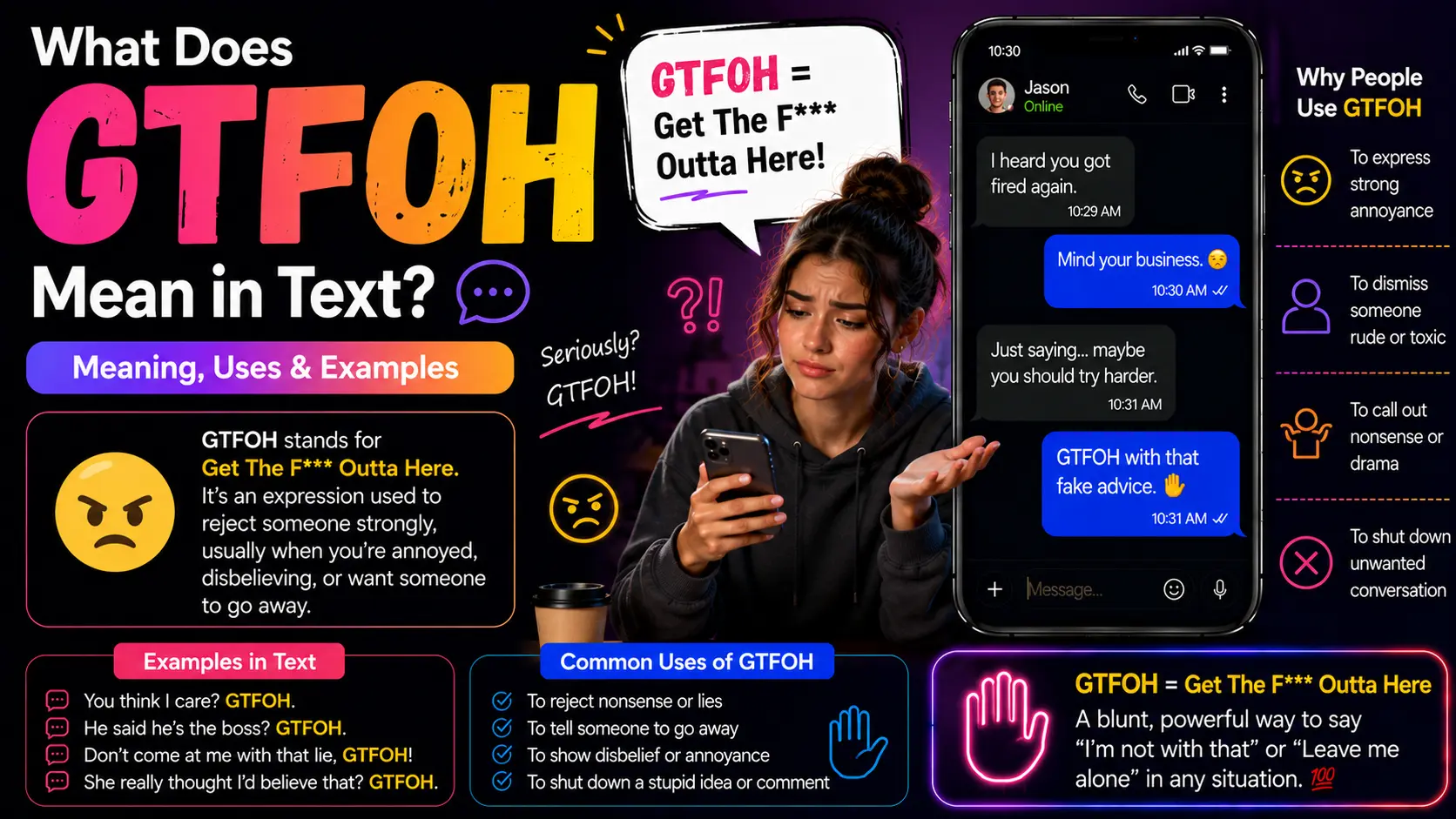
GTFOH stands for “Get the F* Out of Here.”**
Although the phrase contains profanity, its actual meaning changes depending on the situation. It may express:
- Surprise
- Disbelief
- Excitement
- Frustration
- Dismissal
- Strong disagreement
In many conversations, people are not literally telling someone to leave. Instead, they’re reacting emotionally to something they just read or heard.
Simple Definition
GTFOH means:
“I can’t believe what you just said.”
or
“You’re joking, right?”
or
“Leave me alone with that nonsense.”
Everything depends on the relationship between the people involved and the tone of the conversation.
Quick Examples
“You won free concert tickets?”
“GTFOH! That’s amazing.”
“You’re saying pineapple belongs on every pizza?”
“GTFOH 😂”
“Stop making excuses. GTFOH.”
Notice how the first two examples are playful and surprised, while the last one sounds much harsher.
Origin and Background of GTFOH
Like many internet abbreviations, GTFOH existed as a spoken expression long before it became a texting shortcut.
The full phrase, “Get the f*** out of here,” has been part of American English slang for decades. Originally, people used it during face-to-face conversations to show disbelief or tell someone they strongly disagreed.
As texting became more common in the late 1990s and early 2000s, long phrases were shortened into acronyms to save time. GTFOH became one of many abbreviations that spread through online forums, chat rooms, and instant messaging services.
Influence of Urban Culture
GTFOH gained popularity through urban slang, hip-hop culture, comedy, and everyday street conversations. Movies, stand-up comedians, and musicians often used the phrase to create dramatic or humorous reactions.
Because it sounded expressive and memorable, internet users quickly adopted the abbreviation.
Rise on Social Media
Today’s social media platforms helped GTFOH reach an even wider audience.
You’ll regularly find it in:
- TikTok comment sections
- Instagram replies
- X conversations
- Snapchat chats
- Reddit discussions
- Discord servers
- Gaming communities
People often type GTFOH instead of writing the full phrase because it’s shorter and slightly less explicit while still conveying strong emotion.
How the Meaning Has Evolved
Years ago, GTFOH usually sounded aggressive.
Today, many people also use it humorously.
Among close friends, it can simply mean:
- “No way!”
- “You’re kidding!”
- “That’s unbelievable!”
This shift reflects how internet language constantly adapts to become more playful and expressive.
Real-Life Conversations
Below are realistic examples showing how GTFOH appears in different digital conversations.
1. WhatsApp Chat
Person A: I finally passed my driving test!
Person B: GTFOH! Seriously?
Person A: Yep! First attempt too.
Person B: That’s awesome. Congratulations!
Meaning: Person B is expressing happy disbelief, not anger.
2. Instagram DMs
Person A: I just met my favorite actor at the airport.
Person B: GTFOH 😭
Person A: I even got a selfie.
Person B: I’m so jealous!
Meaning: The phrase shows excitement mixed with disbelief.
3. TikTok Comments
Creator: I finished this painting in only two hours.
Commenter 1: GTFOH…that’s incredible.
Commenter 2: I couldn’t even draw a stick figure 😂
Meaning: The commenter is amazed by the creator’s talent.
4. Text Messages
Person A: You forgot my birthday again.
Person B: It slipped my mind.
Person A: GTFOH. You remembered everyone else’s.
Meaning: Here, GTFOH expresses disappointment and frustration.
These examples show why context matters so much. The same four letters can communicate admiration, shock, humor, or irritation depending on the conversation.
Emotional and Psychological Meaning
GTFOH is more than just an internet abbreviation. It’s an emotional shortcut.
Instead of typing several sentences to explain a reaction, people use GTFOH to instantly communicate how strongly they feel.
It Can Express Strong Surprise
One of the most common uses is genuine disbelief.
When someone hears unbelievable news, GTFOH becomes an immediate emotional response.
For example:
“I got promoted after only three months.”
“GTFOH! That’s incredible.”
The speaker isn’t rejecting the news. They’re showing excitement because the information feels almost too good to believe.
It Can Show Frustration
GTFOH also appears when someone feels annoyed or tired of hearing excuses.
Rather than arguing for several messages, they use one short expression to signal they’ve had enough.
This creates a quick emotional boundary in digital conversations.
It Can Build Friendship
Among close friends, GTFOH often functions as playful teasing.
Friends exaggerate their reactions because both people understand there’s no real hostility behind the words.
The stronger language actually makes the exchange feel funnier and more energetic.
It Reflects Modern Digital Communication
Online conversations move quickly.
People want reactions that are short but emotionally powerful.
Expressions like GTFOH allow users to communicate surprise, humor, disbelief, or irritation in just four letters.
This efficiency explains why slang abbreviations continue to thrive across social media platforms.
A Personal-Style Scenario
Imagine you’re scrolling through your messages after a long day. A close friend texts that they unexpectedly won VIP tickets to a sold-out concert you’ve both wanted to attend for months.
Without even thinking, your first reply is:
“GTFOH! No way!”
You’re not being rude. You’re reacting with genuine excitement because the news feels almost impossible. Moments like these show how internet slang often captures emotion faster than a full sentence ever could.
Usage in Different Contexts
GTFOH is flexible, but it is not universal. The same abbreviation can sound funny in one conversation and offensive in another. Understanding the setting helps you decide whether it fits.
On Social Media
Social media is where GTFOH appears most often. People use it to react quickly to surprising videos, unbelievable stories, or controversial opinions.
Examples include:
- “GTFOH, that transformation is amazing!”
- “GTFOH, I did not expect that ending.”
- “GTFOH 😂 You’re hilarious.”
In these cases, emojis often soften the tone and make the message feel playful rather than aggressive.
Between Friends and in Relationships
Among close friends, GTFOH usually signals comfort and familiarity. Friends know each other’s personalities, so the phrase often feels like harmless banter.
For example:
Friend 1: “I ate the whole pizza by myself.”
Friend 2: “GTFOH. No chance.”
In romantic relationships, however, context matters more. Used jokingly, it can create laughter. Used during an argument, it may sound dismissive or hurtful.
At Work or in Professional Settings
GTFOH is generally not appropriate in professional communication.
Whether you’re emailing a client, messaging your manager, or participating in a workplace chat, the abbreviation contains implied profanity. Even if you intend it as a joke, others may see it as disrespectful.
Instead, choose alternatives such as:
- “Really?”
- “That’s surprising.”
- “I can’t believe it.”
- “Are you serious?”
Professional environments usually reward clear and respectful communication.
Casual vs. Serious Conversations
In casual chats, GTFOH often adds humor and personality.
In serious discussions involving emotions, family issues, health, or conflict, it can make you seem insensitive.
For example:
Casual:
Friend: “I accidentally wore two different shoes.”
You: “GTFOH 😂”
Serious:
Friend: “I lost my job today.”
Responding with GTFOH here could easily be misunderstood, even if you meant, “I can’t believe that happened.”
When emotions are involved, empathy is always the better choice.
When NOT to Use It
Although GTFOH is common online, there are situations where avoiding it is the smarter decision.
During Professional Communication
Avoid using GTFOH in:
- Business emails
- Job interviews
- Workplace chats
- Academic discussions
- Customer service conversations
It may damage your professional image.
When Speaking to Someone You Don’t Know Well
Humor depends on trust.
If someone isn’t familiar with your personality, they may interpret GTFOH as a direct insult rather than playful disbelief.
During Emotional Conversations
Avoid using it when someone is sharing:
- Bad news
- Personal struggles
- Mental health concerns
- Family problems
- Relationship issues
A caring response will always communicate more effectively.
Around Younger Children
Even though GTFOH is abbreviated, many adults recognize what it stands for.
Using it around children may unintentionally expose them to language you would rather they not repeat.
In Cross-Cultural Conversations
Not every culture treats slang and profanity the same way.
Some people may find GTFOH far more offensive than native English speakers do, especially if English is their second language.
Taking cultural differences into account helps prevent misunderstandings.
Common Misunderstandings
GTFOH is one of those abbreviations that people often misread because they focus only on the words instead of the intention.
Here are the most common misconceptions.
Mistaking It for a Literal Command
Many beginners assume GTFOH always means:
“Leave right now.”
In reality, it often means:
“I don’t believe you.”
The phrase is frequently figurative rather than literal.
Assuming It’s Always Angry
Because of the strong wording, many people think GTFOH always expresses anger.
In fact, it often communicates excitement, amusement, or pleasant surprise.
Adding laughing emojis or playful punctuation completely changes the feeling.
Compare these:
“GTFOH 😂”
versus
“GTFOH.”
The first feels friendly.
The second sounds much more confrontational.
Ignoring Relationship Context
The same message can have opposite meanings depending on who sends it.
Between lifelong friends, GTFOH might strengthen the conversation through shared humor.
Between strangers, it may sound unnecessarily hostile.
Forgetting That Tone Doesn’t Exist in Text
Text messages remove facial expressions and vocal cues.
Without context, readers may misunderstand your intention.
If you’re unsure how someone will interpret GTFOH, using clearer language is often the safer option.
GTFOH Compared with Similar Expressions
| Expression | Meaning | Tone | Typical Use |
|---|---|---|---|
| GTFOH | I don’t believe you or that’s ridiculous | Strong, playful, or dismissive | Surprise, disbelief, frustration |
| No way! | Genuine surprise | Friendly | Positive reactions |
| Seriously? | Asking for confirmation | Neutral | Curiosity or disbelief |
| You’re kidding! | Shock or surprise | Lighthearted | Exciting news |
| Give me a break | Stop exaggerating | Annoyed | Mild frustration |
| Come on | Doubt or encouragement | Flexible | Everyday conversations |
| LOL | Something is funny | Positive | Humor |
| Whatever | I don’t care | Dismissive | Ending an argument |
Key Insight
GTFOH is stronger than most expressions used to show surprise or disbelief. While phrases like “No way!” or “Seriously?” are widely acceptable, GTFOH carries an edge because of its implied profanity. Choosing between them depends on your audience, your relationship with the other person, and the mood of the conversation.
Variations and Types of GTFOH
Internet slang constantly evolves, and GTFOH has inspired several related expressions. Here are some of the most common variations you’ll encounter.
1. GTFO
Meaning: Get the F*** Out.
Usually a direct command telling someone to leave or expressing disbelief.
2. GTFOH
Meaning: Get the F*** Out of Here.
The most complete and widely recognized version.
3. GTFH
Meaning: Get the F*** Here.
A less common abbreviation that asks someone to come over quickly.
4. STFU
Meaning: Shut the F*** Up.
Used to tell someone to stop talking. It can be humorous among close friends but is often offensive.
5. IDC
Meaning: I Don’t Care.
Shows indifference rather than disbelief.
6. SMH
Meaning: Shaking My Head.
Expresses disappointment, disbelief, or frustration without using profanity.
7. WTF
Meaning: What the F***.
Communicates confusion, shock, or surprise.
8. LMFAO
Meaning: Laughing My F***ing Ass Off.
Used to show intense laughter or amusement.
9. BRUH
Meaning: A reaction to something ridiculous or surprising.
Popular among younger internet users and often paired with memes.
10. CAP / NO CAP
Meaning: “Cap” means a lie, while “No Cap” means someone is telling the truth.
Frequently used when responding to unbelievable claims.
How to Respond When Someone Uses GTFOH
The best response depends on why the person used it. Were they joking, expressing surprise, or showing frustration? Reading the tone before replying helps keep the conversation smooth.
Casual Replies
If the other person is simply shocked or amused, keep your response light.
- “I’m serious!”
- “I know, right?”
- “Believe it or not, it’s true.”
- “I couldn’t believe it either.”
- “Yep, it actually happened.”
Funny Replies
When you’re chatting with close friends, humor usually works well.
- “Want me to send the proof?”
- “I promise I’m not making this up.”
- “You sound more shocked than I was!”
- “I had the same reaction.”
- “Plot twist… it gets even obsessed.”
Mature Replies
If the conversation is more serious, respond calmly instead of matching strong language.
- “I understand why you’re surprised.”
- “It does sound unbelievable.”
- “I wasn’t expecting it either.”
- “Let me explain what happened.”
Respectful Replies
If GTFOH feels a little harsh, staying respectful can prevent the discussion from becoming an argument.
- “I see why you feel that way.”
- “Let’s hear each other out.”
- “I wasn’t trying to upset you.”
- “We can disagree without arguing.”
A thoughtful response often changes the direction of a conversation more effectively than reacting with equal intensity.
Regional and Cultural Usage
Although GTFOH is widely recognized online, its interpretation can vary across cultures and generations.
Western Culture
In countries like the United States and Canada, GTFOH is a familiar piece of internet slang.
People often use it jokingly among friends to express surprise, excitement, or disbelief. Because casual language is common in many online spaces, the abbreviation is usually understood without much explanation.
Asian Culture
Across many Asian countries, English internet slang is popular among younger users, especially those active on global social media.
However, not everyone recognizes GTFOH immediately. Since the abbreviation contains implied profanity, some people may consider it stronger or ruder than native English speakers intend.
Middle Eastern Culture
In many Middle Eastern communities, respectful communication is highly valued, particularly with older family members and in formal settings.
While younger internet users may understand GTFOH through movies, music, and social media, using it outside close friendships can be viewed as inappropriate.
Global Internet Usage
Thanks to platforms like TikTok, Instagram, Reddit, Discord, and X, GTFOH has become part of global internet culture.
Many users recognize it even if English is not their first language. Still, because slang evolves quickly, some people may understand the emotion without knowing the exact words behind the abbreviation.
Gen Z vs. Millennials
Gen Z tends to use GTFOH more casually. For many, it simply signals surprise, humor, or playful disbelief.
Millennials often recognize the expression as well but may associate it more closely with its original, stronger meaning.
These differences highlight how internet language evolves over time. What once sounded aggressive can become playful as younger generations reshape its use.
Is GTFOH Safe for Kids?
GTFOH is not generally considered kid-friendly because it represents a phrase containing profanity.
Although only the initials appear in text, many children eventually learn what the letters stand for through social media or online gaming.
Parents and educators should encourage young people to understand the meaning without feeling pressured to use it themselves. Teaching context is just as important as teaching vocabulary. Knowing when a word is appropriate is a valuable communication skill.
Frequently Asked Questions
What does GTFOH stand for in text?
GTFOH stands for “Get the F* Out of Here.”** It usually expresses disbelief, surprise, excitement, or frustration rather than literally telling someone to leave.
Is GTFOH offensive?
It can be. Since it contains implied profanity, some people may find it offensive, especially in formal settings or when used with strangers.
Does GTFOH always mean “go away”?
No. Most of the time, it simply means “I can’t believe that” or “You’re kidding!” The exact meaning depends on the context and tone.
Can GTFOH be used as a joke?
Yes. Among close friends, GTFOH is often used playfully to react to surprising or funny news. Shared understanding makes a big difference.
Is GTFOH popular on social media?
Yes. You’ll frequently see it on TikTok, Instagram, X, Reddit, Discord, and in private text messages because it’s a quick way to express a strong reaction.
Should I use GTFOH at work?
No. Professional communication is usually better served by polite alternatives such as “Really?” or “That’s surprising.” Avoid slang with implied profanity in workplace settings.
What’s the difference between GTFO and GTFOH?
GTFO is a shorter version meaning “Get the F*** Out.” GTFOH expands it to “Get the F*** Out of Here,” which is more commonly used to express disbelief rather than giving a literal command.
Conclusion
Understanding what does GTFOH mean in text is about more than memorizing an abbreviation. It’s about recognizing the emotion behind the words.
In today’s digital conversations, GTFOH can express shock, excitement, disbelief, humor, or frustration in just four letters. While it often sounds playful among friends, it also carries implied profanity, making it unsuitable for professional settings and conversations where respect and sensitivity are especially important.
The key to using GTFOH confidently is reading the context. Consider who you’re talking to, the relationship you share, and the mood of the conversation. When used thoughtfully, it can make online chats feel lively and expressive. When used carelessly, it can create confusion or come across as unnecessarily rude.
Internet slang changes quickly, but good communication never goes out of style. Understanding both the language and the people you’re speaking with will always help you connect more effectively