
If you’ve recently received a message that says “diddo”, you’re probably wondering what it means. It may have appeared in a text message, a WhatsApp chat, an Instagram DM, or even a TikTok comment. At first glance, the word can seem confusing because it isn’t found in most dictionaries.
In everyday digital conversations, “diddo” is usually an informal misspelling or alternate spelling of “ditto.” People use it to express agreement, show they feel the same way, or repeat the same opinion without writing it all over again. In many cases, the sender doesn’t even realize they’ve spelled it differently.
The confusion comes from the fact that some people intentionally write “diddo”, while others simply type it by mistake. Either way, the intended meaning is often the same, and understanding the context makes it much easier to interpret.
This guide explains what diddo means in text, where it comes from, how people use it in online conversations, and why it has become a familiar part of casual digital communication.
What Does Diddo Mean in Text? Quick Meaning
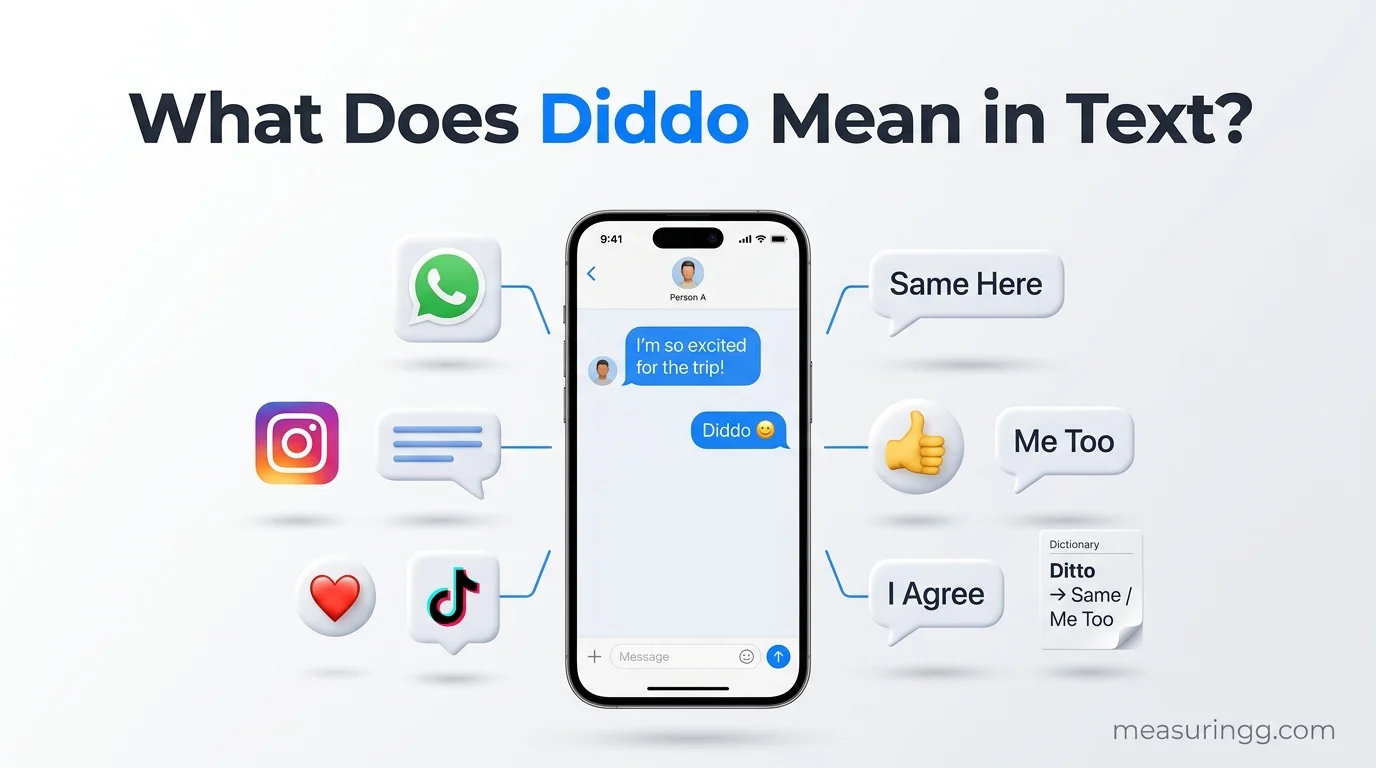
In texting, diddo generally means:
- “Same here.”
- “I agree with you.”
- “Me too.”
- “I feel exactly the same.”
Most of the time, it replaces a longer response and keeps the conversation flowing naturally.
Quick examples
“I can’t wait for the weekend.”
“Diddo!”
“That movie was amazing.”
“Diddo. I’d watch it again.”
“I’m exhausted after today.”
“Diddo.”
Although diddo isn’t the standard spelling, people reading the conversation usually understand that the sender means ditto, especially in casual chats.
At a glance
- Meaning: Same, me too, I agree
- Tone: Friendly and informal
- Common places: Text messages, social media, group chats
- Formal writing: Not recommended
- Most likely origin: A misspelling or phonetic spelling of ditto
Origin & Background
To understand diddo, it helps to know the history behind the word people usually intend to write.
The expression ditto has existed for centuries. It comes from the Italian word detto, meaning “said.” English speakers eventually adopted it to avoid repeating words or phrases that had already been written.
For many years, people used ditto in handwritten lists and business records. Instead of writing the same information twice, they simply wrote ditto or used quotation marks to indicate repetition.
As communication shifted online, the meaning became much more conversational.
Instead of meaning “repeat the same words,” it began to mean:
- I agree.
- I think the same.
- That’s exactly how I feel.
- Same here.
Why “diddo” appears today
Typing on smartphones has changed the way people spell words.
There are several reasons someone may write diddo instead of ditto:
- Fast typing
- Autocorrect mistakes
- Phonetic spelling
- Habit
- Seeing others use the spelling online
Because the pronunciation is similar, many people never notice the spelling difference.
Social media influence
Modern platforms encourage quick, casual communication.
Whether someone is replying to an Instagram Story, reacting to a TikTok video, or chatting in a gaming community, short responses often replace longer messages.
Instead of writing:
“I completely agree with everything you said.”
Many people simply reply:
“Diddo.”
The internet has always allowed informal spellings to spread quickly. Just as words like “gonna,” “wanna,” and “lemme” became common in casual writing, alternate spellings such as diddo continue to appear across online conversations.
Even though dictionaries still recognize ditto as the standard form, many internet users immediately understand what diddo is trying to communicate.
Real-Life Conversations
Below are realistic examples showing how people commonly use diddo in everyday conversations.
1. WhatsApp Chat
Person A: I’m seriously thinking about taking a break from social media for a while.
Person B: Diddo. It’s starting to feel overwhelming.
Person A: Maybe we’ll actually have more free time.
Person B: I honestly think we will.
2. Instagram DM
Person A: That sunset looked unreal. I wish I had been there.
Person B: Diddo. Those photos made me want to book a trip immediately.
Person A: We should plan one before summer ends.
Person B: I’m definitely in.
3. TikTok Comments
Person A: This song has been stuck in my head all week.
Person B: Diddo!
Person A: I can’t stop playing it.
Person B: Same playlist every day.
4. Text Messages
Person A: I’m nervous about tomorrow’s interview.
Person B: Diddo. Mine is in the afternoon.
Person A: Good luck. We’ve prepared for this.
Person B: Thanks. You’ve got this too.
Why These Conversations Feel Natural
One interesting thing about diddo is that it often replaces a much longer emotional response.
Instead of saying:
- I completely understand.
- I agree with everything you just said.
- I feel exactly the same way.
People simply type:
“Diddo.”
That single word can communicate agreement, empathy, encouragement, or shared excitement, depending on the conversation.
Because texting favors speed and simplicity, expressions like diddo help people respond quickly without losing the emotional connection behind the message.
It is also worth remembering that context matters. If someone writes diddo after a happy message, it usually expresses shared excitement. After a frustrating message, it often shows empathy or solidarity. Understanding the surrounding conversation is the key to interpreting the intended meaning accurately.
Emotional & Psychological Meaning
Words like diddo may seem small, but they often carry more emotion than a longer reply. In digital conversations, people look for quick ways to show they are listening and that they relate to what someone else is saying. That is where diddo fits naturally.
When someone replies with diddo, they are usually saying:
- “I understand how you feel.”
- “I’m on the same page.”
- “I agree with you.”
- “You’re not the only one.”
Instead of repeating an entire sentence, the word creates an instant feeling of connection.
Why People Use It
People choose short expressions because texting is designed for speed. A simple word can communicate agreement without interrupting the flow of the conversation.
Some common reasons include:
- To save time while texting.
- To sound friendly and relaxed.
- To show emotional support.
- To strengthen a sense of connection.
- To avoid repeating the same sentence.
In many conversations, the emotional value of diddo is more important than the word itself. It tells the other person, “I feel the same.”
What It Reveals About Modern Communication
Digital communication has changed how people express emotions. Instead of writing long paragraphs, many rely on short words, emojis, and reactions to express understanding.
Expressions like diddo work because they are simple and easy to recognize within the conversation.
They also create a feeling of shared experience. Whether friends are talking about work, school, relationships, or hobbies, saying “diddo” immediately signals agreement.
A Personal-Style Scenario
A friend once messaged me after a long week and said, “I’m completely drained.”
Instead of writing a detailed response, I simply replied, “Diddo.”
That single word was enough for both of us to know we were feeling exactly the same. The conversation naturally continued from there without needing lengthy explanations.
Moments like this show why short expressions remain popular in texting.
Usage in Different Contexts
Although diddo is informal, its meaning changes slightly depending on where it is used.
Social Media
On platforms like Instagram, TikTok, Facebook, and X, people often reply with diddo to show agreement with a post or comment.
Example:
Post: Coffee is the only reason I survive Mondays.
Comment: Diddo.
The reply is short, friendly, and relatable.
Friends and Relationships
Friends frequently use diddo during casual conversations.
Example:
Friend: I miss our weekend road trips.
You: Diddo. We need another one soon.
Between close friends, it sounds warm and conversational.
In relationships, it can also express affection.
Partner: I miss you already.
Reply: Diddo ❤️
Here, it simply means “I miss you too.”
Work and Professional Settings
Using diddo at work is generally not recommended.
Professional communication usually benefits from complete sentences that leave no room for confusion.
Instead of writing:
“Diddo.”
It is better to say:
- I agree with your suggestion.
- I share the same opinion.
- I completely agree.
- That matches my thoughts as well.
Clear language is more appropriate in emails, reports, and business discussions.
Casual vs Serious Tone
The tone of diddo depends on the conversation.
Casual
Friend: Pizza tonight?
You: Diddo!
This feels cheerful and natural.
Serious
Friend: I’m worried about my health.
You: Diddo.
Although understandable, it may sound too brief for an emotional conversation.
In situations involving grief, stress, or important life events, adding a few supportive words creates a more caring response.
For example:
“I feel the same. I hope everything gets better soon.”
When NOT to Use It
While diddo works well in casual conversations, there are situations where it may not be the best choice.
Formal Communication
Avoid using it in:
- Job applications
- Business emails
- Academic writing
- Professional reports
- Official documents
Many readers may assume it is simply a spelling mistake.
Serious Personal Conversations
If someone shares deeply emotional news, replying with only diddo may appear dismissive.
Example:
“I’m really struggling after losing my job.”
Instead of:
“Diddo.”
Try:
“I understand how you feel. I’m here if you want to talk.”
A thoughtful response shows greater empathy.
Cross-Cultural Communication
Not everyone is familiar with internet slang or alternate spellings.
If the person speaks English as a second language, they may not recognize what diddo means.
Using a clear phrase such as “I agree” or “Same here” avoids unnecessary confusion.
Situations That Require Precision
During legal, financial, medical, or educational discussions, clarity is more important than casual language.
Using direct wording prevents misunderstandings.
Common Misunderstandings
Because diddo is not the standard dictionary spelling, people often misunderstand it.
Here are some common misconceptions.
Mistaking It for a Separate Word
Some people assume diddo has a completely different meaning from ditto.
In reality, it is most often an alternate spelling or simple typo used with the same intention.
Thinking It Is Always Incorrect
While dictionaries recognize ditto, internet users frequently write diddo in informal conversations.
Although it is not standard English, many people immediately understand its intended meaning from the context.
Confusing the Tone
Some readers interpret diddo as playful.
Others see it as lazy.
Neither interpretation is always correct.
The tone depends on:
- Who is speaking
- Their relationship
- The conversation itself
- The platform being used
Taking It Literally
People sometimes search for a hidden definition because they believe diddo is internet slang with a unique meaning.
In most cases, it simply expresses agreement.
The surrounding conversation usually provides all the context needed.
Comparison Table
| Expression | Meaning | Tone | Best Used For |
|---|---|---|---|
| Diddo | Same here, I agree | Casual | Texts, chats, social media |
| Ditto | Standard spelling of “same” | Casual to neutral | Everyday conversation |
| Same | I feel the same | Informal | Friends and comments |
| Me too | I also feel or think that | Friendly | Daily conversations |
| Absolutely | Strong agreement | Positive | Casual and professional settings |
| I agree | Direct agreement | Neutral | Work and formal communication |
| Exactly | Complete agreement | Confident | Discussions and debates |
| No way | Strong disagreement or surprise | Informal | Casual conversations |
Key Insight
Although diddo and ditto are often used with the same intention, ditto remains the accepted spelling in standard English. If your goal is clear and professional communication, use ditto. If you’re chatting casually and someone types diddo, the intended message is almost always “same here” or “I agree.”
Variations and Related Expressions
Below are common alternatives that express a similar idea.
1. Ditto
The standard English spelling that means “the same” or “I agree.”
2. Same
A quick way to show you share the same feeling or opinion.
3. Same Here
Adds a little more warmth than simply saying “same.”
4. Me Too
Shows that you have had the same experience or feeling.
5. Likewise
A polite way to express mutual feelings or agreement.
6. Exactly
Shows complete agreement with someone’s statement.
7. Totally
A modern, enthusiastic way to agree.
8. Absolutely
Expresses strong support for an idea or opinion.
9. Couldn’t Agree More
Shows complete agreement in a slightly more expressive way.
10. I Feel the Same
A thoughtful alternative that works well in emotional conversations.
How to Respond When Someone Uses “Diddo”
If someone replies with “diddo”, they are usually expressing agreement or saying they feel the same way. Your response can match the tone of the conversation.
Casual Replies
These responses work well with friends and family.
- “I knew you’d agree!”
- “Glad we’re on the same page.”
- “Exactly what I was thinking.”
- “Same vibe!”
- “That’s why we get along.”
Funny Replies
If the conversation is lighthearted, a humorous response can keep it fun.
- “Copycat!”
- “Looks like great minds think alike.”
- “You’re reading my mind again.”
- “I was waiting for you to say that.”
- “Now we have no excuse not to do it.”
Mature Replies
For more thoughtful conversations, a sincere response is often best.
- “I’m glad we see it the same way.”
- “Thanks for sharing your perspective.”
- “It’s good to know we’re in agreement.”
- “I appreciate your honesty.”
Respectful Replies
These are suitable when speaking with someone you don’t know well or in semi-professional settings.
- “I understand.”
- “I appreciate your agreement.”
- “Thank you for sharing.”
- “That’s helpful to know.”
The best response always depends on the relationship you have with the other person and the overall tone of the conversation.
Regional & Cultural Usage
Language evolves differently around the world, and expressions like diddo can be interpreted in different ways depending on culture, age, and online experience.
Western Culture
In countries such as the United States, Canada, the United Kingdom, and Australia, people are generally familiar with ditto. When they see diddo, most assume it is simply a typo or an informal variation.
Because texting often favors speed over perfect spelling, many readers barely notice the difference.
Asian Culture
In many Asian countries where English is used as a second language, diddo may be unfamiliar. People who spend time on international social media are more likely to recognize that it means “same” or “I agree.”
Outside those online communities, the spelling may cause confusion.
Middle Eastern Culture
English is widely used across many professional and educational settings in the Middle East. Younger internet users usually understand expressions like diddo through exposure to social media, while older generations may expect the standard spelling ditto.
Global Internet Usage
Online communities often create their own writing styles. Alternate spellings, abbreviations, and slang spread quickly through memes, gaming, and social platforms.
As a result, diddo is understood by many internet users even though it is not considered standard English.
Gen Z vs. Millennials
Gen Z
Gen Z tends to embrace creative spelling and internet slang. They are less likely to question alternate spellings if the meaning is clear from context.
Millennials
Millennials often recognize both diddo and ditto, but many still prefer the standard spelling in everyday writing.
Both generations generally understand the intended meaning, although Gen Z is more comfortable with informal variations.
Is It Safe for Kids?
Yes, diddo is generally safe for kids because it is not offensive, harmful, or inappropriate. It simply expresses agreement or shared feelings in casual conversation.
That said, children should also learn that ditto is the standard spelling. Understanding the difference between informal texting and proper written English helps them communicate effectively in both personal and academic settings.
Teaching context is just as important as teaching vocabulary. Casual expressions are perfectly acceptable among friends, but formal situations require clearer and more conventional language.
Frequently Asked Questions
What does diddo mean in text?
In most text conversations, diddo means “same,” “me too,” or “I agree.” It is commonly used as an informal variation or misspelling of ditto.
Is diddo a real English word?
No. Diddo is not recognized as a standard English word in major dictionaries. Most people use it as an alternate spelling of ditto.
Is diddo the same as ditto?
In casual texting, yes. Both are usually intended to express agreement or indicate that someone feels the same way.
Why do people type diddo instead of ditto?
Common reasons include fast typing, autocorrect, phonetic spelling, or simply copying the way others write online.
Can I use diddo in professional emails?
It is better not to. In formal communication, use clear expressions such as “I agree,” “Likewise,” or “I share the same opinion.”
Is diddo considered slang?
Not exactly. It is more accurately described as an informal alternate spelling that appears in casual digital conversations rather than a distinct slang term.
Will people understand what diddo means?
Most active social media users and frequent texters will understand it from the context. However, some people may assume it is a spelling mistake, so ditto is the safer choice when clarity matters.
Conclusion
If you’ve ever wondered what does diddo mean in text, the answer is usually straightforward. In most conversations, diddo expresses agreement, shared feelings, or the idea of saying “same here.” It is most often used as an informal variation or misspelling of the standard word ditto.
Although it appears regularly in text messages, social media comments, and online chats, it is still best to use ditto in formal writing or professional communication. Choosing the right expression for the right situation helps avoid confusion and makes your message clearer.
Language on the internet continues to evolve, and small expressions like diddo show how people value quick, relatable, and emotionally meaningful communication. Whether you see it in a WhatsApp conversation, an Instagram reply, or a TikTok comment, understanding the context will help you interpret it with confidence.