
If you’ve searched “what does its mean in text,” you’re probably trying to figure out whether someone intentionally wrote “its” in a message or accidentally left out an apostrophe. It is one of the most common points of confusion in English, especially in texting, social media, and casual online conversations.
In some cases, its is used correctly. In others, people actually mean it’s, but skip the apostrophe because they are typing quickly. Understanding the difference can help you avoid misunderstandings and improve your own communication.
This guide explains what its means in text messages, where it comes from, how people use it across different platforms, common mistakes, and how context changes its meaning. By the end, you’ll know exactly when “its” is correct and when it isn’t.
What Does Its Mean in Text? Quick Meaning
In texting, its usually has one of two meanings:
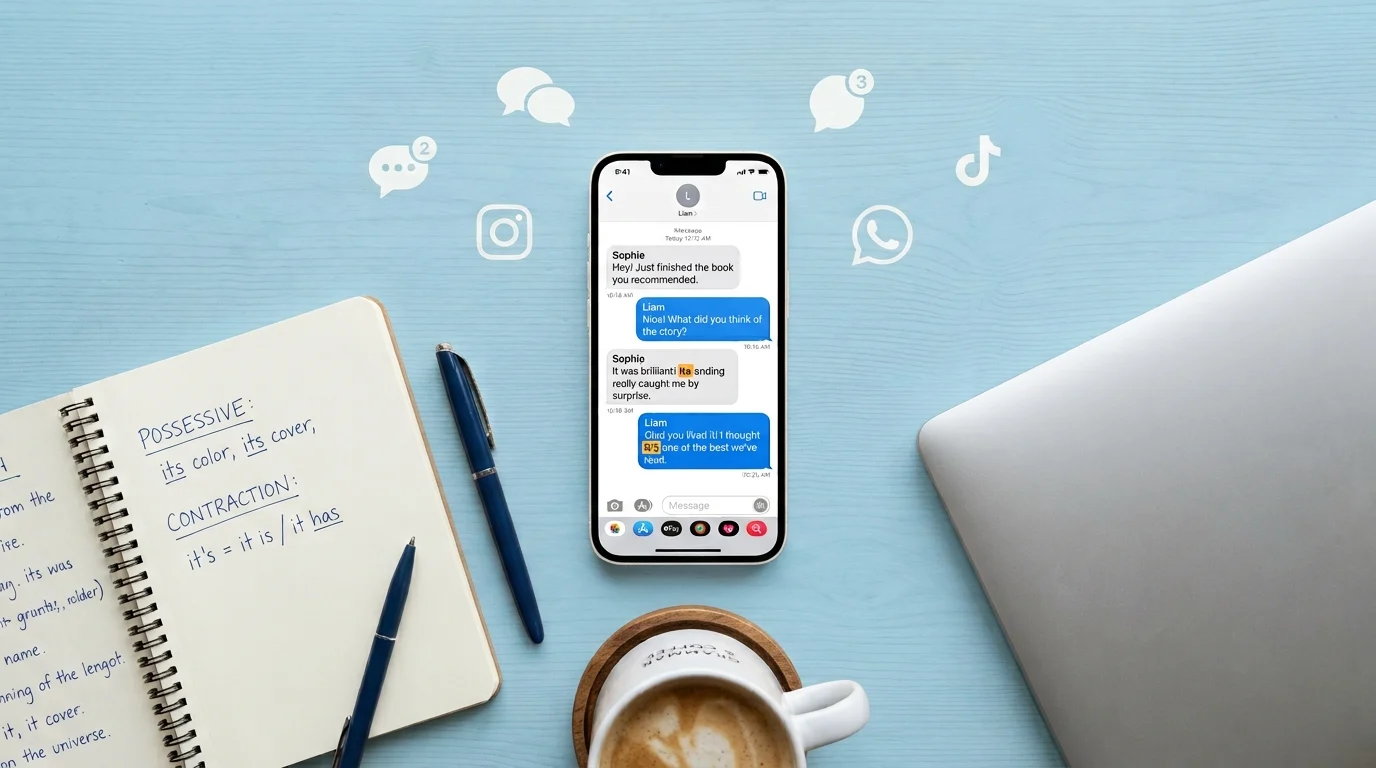
- It is the possessive form of it, meaning something belongs to or is associated with something.
- Sometimes people accidentally type its when they actually mean it’s, the contraction for it is or it has.
Simple definition
Its = belonging to it
Examples
“The dog wagged its tail.”
“The company changed its logo.”
“The phone lost its signal.”
If someone texts:
“Its raining.”
They almost certainly mean:
“It’s raining.”
The intended meaning depends on the context.
Origin and Background
The word its has existed in English for centuries as the possessive form of the pronoun it. Unlike most possessive nouns that use an apostrophe, English personal pronouns follow different rules.
For example:
- His
- Hers
- Yours
- Ours
- Its
Notice that none of these possessive pronouns use an apostrophe.
The confusion grew with the rise of texting and social media. People began typing faster, relying on autocorrect, and paying less attention to punctuation. As a result, its and it’s became one of the most frequently mixed-up word pairs online.
Platforms such as Instagram, TikTok, WhatsApp, and X have made short-form communication more common, where speed often matters more than perfect grammar. Even so, understanding the correct usage helps you communicate more clearly.
Real-Life Conversations
Person A: Did you see the puppy?
Person B: Yes! Its little ears are adorable.
Instagram DM
Person A: This café has changed its menu again.
Person B: I actually like the new options better.
TikTok Comments
Person A: Its amazing how fast this recipe became popular.
Person B: I think you meant “It’s amazing,” but the video is great!
Text Messages
Person A: My laptop won’t charge.
Person B: Check if its cable is damaged.
Emotional and Psychological Meaning
Although its itself does not carry emotional meaning, the way people use it reflects how modern communication has evolved.
Many people prioritize speed over grammar when texting. They assume the reader will understand the intended message without perfect punctuation.
Imagine messaging a close friend after a long day.
You quickly type:
“Its been exhausting.”
Your friend immediately understands you mean:
“It’s been exhausting.”
The emotional message comes through because your relationship and the conversation provide enough context. This shows that human communication often relies on shared understanding rather than grammatical perfection.
However, in professional conversations or formal writing, using the correct form demonstrates attention to detail and credibility.
Usage in Different Contexts
Social Media
People often confuse its and it’s because they are posting quickly.
Example:
“Its finally summer!”
Although technically incorrect, many readers understand the intended meaning.
Friends and Relationships
Friends rarely focus on grammar unless the mistake changes the meaning.
Example:
“I love how the cat protects its kittens.”
Here, its is perfectly correct.
Work and Professional Settings
Professional writing benefits from proper grammar.
Correct:
“The software updated its security settings.”
Incorrect:
“Its important to submit the report today.”
The second sentence should be:
“It’s important to submit the report today.”
Casual vs Serious Tone
In casual chats, minor mistakes are usually ignored.
In academic, business, or professional communication, using the correct word helps establish trust and professionalism.
When Not to Use It
Avoid using its when you actually mean it is or it has.
Examples:
Incorrect:
- Its nice to meet you.
- Its been a long week.
- Its going to rain.
Correct:
- It’s nice to meet you.
- It’s been a long week.
- It’s going to rain.
Also avoid assuming readers will always know what you meant. In formal writing, grammatical accuracy matters.
Common Misunderstandings
One of the biggest misunderstandings is believing that every possessive word requires an apostrophe.
Many people compare:
“The company’s office.”
and assume:
“Its” should become “it’s.”
However, pronouns follow different grammar rules.
Another common misunderstanding is thinking it’s always sounds more natural. In reality, the sentence determines which form is correct.
Literal meaning:
“The tree lost its leaves.”
Contraction:
“It’s getting colder.”
Understanding the sentence structure removes the confusion.
Comparison Table
| Expression | Meaning | Example |
|---|---|---|
| its | Possessive form of it | The phone lost its battery. |
| it’s | It is or it has | It’s raining today. |
| his | Belonging to him | His car is new. |
| her | Belonging to her | Her book is missing. |
| their | Belonging to them | Their house is beautiful. |
| one’s | Belonging to one person | One should know one’s limits. |
Key Insight
The easiest way to remember the difference is to replace it’s with it is. If the sentence still makes sense, use it’s. If not, its is probably the correct choice.
Variations and Related Forms
1. Its
Shows possession.
2. It’s
Means “it is” or “it has.”
3. It is
The fully written version of “it’s.”
4. It has
Another expanded form of “it’s.”
5. Its own
Emphasizes exclusive ownership.
6. In its entirety
Refers to something being complete.
7. At its best
Describes the highest quality or performance.
8. At its worst
Describes the lowest quality or most difficult state.
9. Its value
Focuses on importance or worth.
10. Its purpose
Refers to the intended function or role of something.
How to Respond When Someone Uses It
Casual Replies
- Got it.
- That makes sense.
- I understand what you mean.
Funny Replies
- Your keyboard is working overtime today.
- Autocorrect strikes again!
Mature Replies
- I think you meant “it’s,” but I understood your message.
- Thanks for explaining. I get your point.
Respectful Replies
- No worries. I knew what you meant.
- Thanks for clarifying.
Regional and Cultural Usage
Western Culture
Grammar discussions are common in schools, but casual texting often overlooks small punctuation mistakes.
Asian Culture
Many English learners study grammar carefully, so understanding the difference between its and it’s is often emphasized in education.
Middle Eastern Culture
English is widely used in education and business. Correct grammar is generally appreciated in professional settings, while casual messaging is often more relaxed.
Global Internet Usage
Across the internet, millions of people type quickly. Minor grammar mistakes are common, especially on social media, where speed often takes priority.
Generational Differences
Gen Z
Often values fast communication over perfect grammar in casual conversations.
Millennials
May pay slightly more attention to punctuation, especially in work-related communication, while still being relaxed in personal chats.
Is It Safe for Kids?
Yes.
The word its is simply a standard English possessive pronoun. Learning the difference between its and it’s helps children build stronger writing skills and communicate more clearly. The word itself has no inappropriate or harmful meaning.
Frequently Asked Questions
What does “its” mean in text?
It usually means something belongs to an object, animal, organization, or idea.
Is “its” the same as “it’s”?
No. Its shows possession, while it’s means it is or it has.
Why do people confuse them?
Because they sound identical when spoken but have different grammatical functions.
Can I use “its” in professional writing?
Yes, when you are expressing possession correctly.
Is “its” considered slang?
No. It is a standard English word.
Does texting change its meaning?
Not usually. Texting mainly increases the chances that people accidentally type its instead of it’s.
How can I remember the difference?
Replace it’s with it is. If the sentence still works, use it’s. Otherwise, use its.
Conclusion
Understanding what does its mean in text is simpler than it first appears. The word its is the possessive form of it, showing ownership or association, while it’s is a contraction meaning it is or it has. Because both words sound the same, they are frequently confused in text messages, social media posts, and everyday conversations.
Context is the key. In casual chats, people often overlook missing apostrophes because the intended meaning is still clear. In professional, academic, or formal writing, however, using the correct form improves clarity and shows attention to detail.
Once you remember that its shows possession and it’s can be expanded to it is or it has, you’ll be able to use both confidently in any situation.