
If you’ve spent time on TikTok, Instagram, or YouTube lately, you’ve probably come across the abbreviation DITL. Someone might caption a video “DITL as a college student” or “DITL working from home,” leaving you wondering what those four letters actually mean.
The good news is that the meaning is simple, but the way people use it has grown beyond a basic abbreviation. Today, DITL is more than internet slang. It has become a popular way for people to share authentic moments from their everyday lives, connect with others, and tell personal stories online.
In this guide, you’ll learn exactly what DITL means in text, where it came from, how it became popular, when to use it, and how to understand it confidently whenever you see it online.
What Does DITL Mean in Text? Quick Meaning
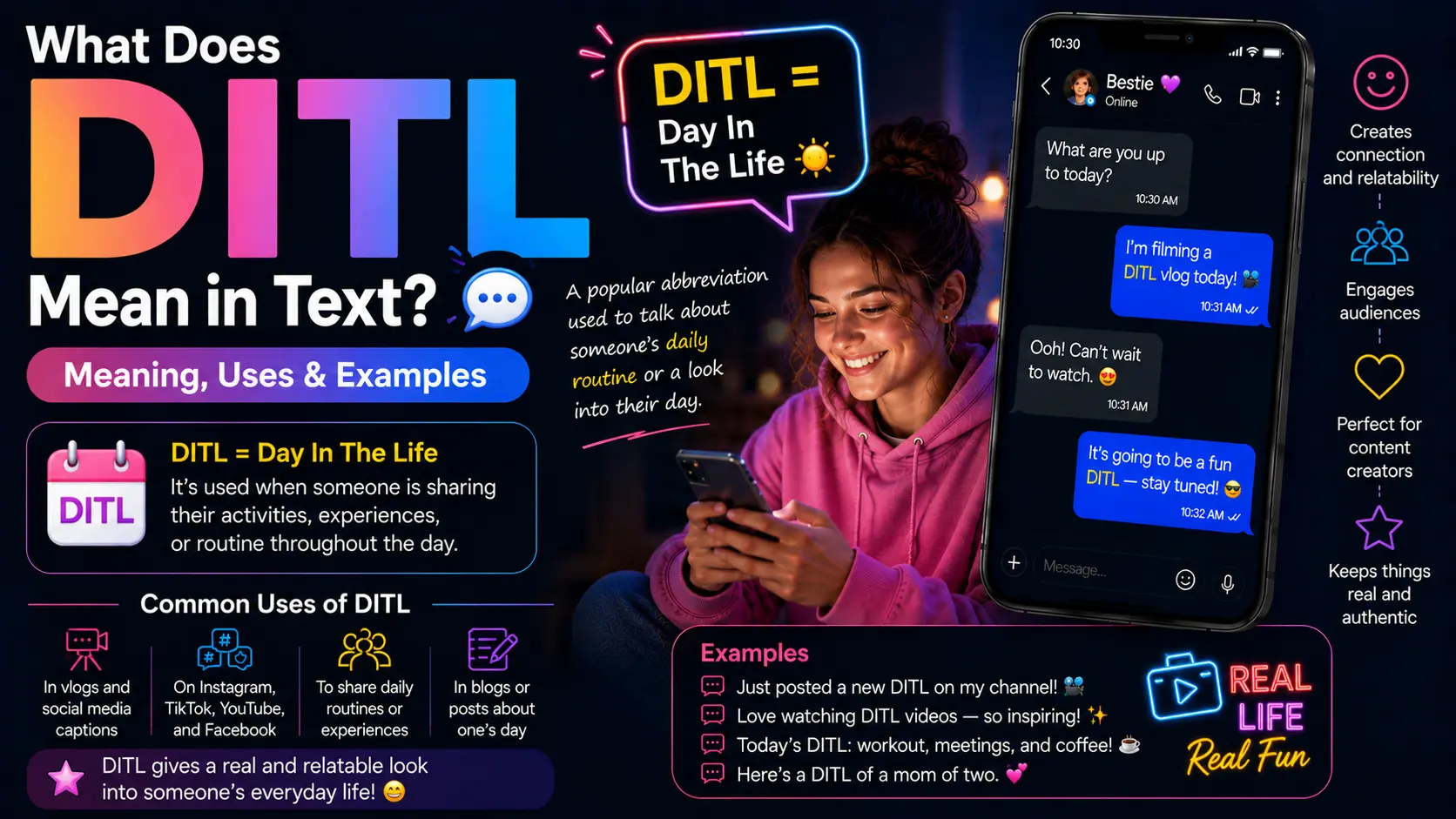
DITL stands for “Day In The Life.”
People use it to introduce content that shows what happens during a typical day. Instead of explaining everything in one sentence, DITL signals that someone is about to share a glimpse into their daily routine.
Quick Definition
- Full form: Day In The Life
- Commonly used on TikTok, Instagram, YouTube, and Snapchat
- Often appears in captions, hashtags, and text messages
- Usually introduces videos, photos, or stories about everyday experiences
Examples
“Uploading a DITL as a nursing student.”
“Today’s DITL was surprisingly productive.”
“Can you post another DITL tomorrow?”
These examples all refer to content showing someone’s ordinary daily activities.
Origin and Background
Although “day in the life” has existed as an English phrase for decades, the abbreviation DITL became widely recognized during the rise of short-form video platforms.
Content creators wanted quick, catchy titles that immediately told viewers what to expect. Instead of writing “Day in the Life,” many began shortening it to DITL.
As TikTok’s popularity exploded, viewers became familiar with the abbreviation. Soon, Instagram Reels, YouTube Shorts, Pinterest, and even LinkedIn creators adopted it.
Today, DITL content covers almost every lifestyle imaginable, including:
- Students
- Teachers
- Doctors
- Office workers
- Parents
- Travelers
- Entrepreneurs
- Athletes
- Artists
Rather than highlighting perfect moments, many creators now use DITL videos to show realistic routines, making the content feel more relatable and trustworthy.
Real-Life Conversations
Person A: Did you see Sarah’s new DITL?
Person B: Yes! I didn’t realize nursing school was that busy.
Instagram DMs
Person A: Your morning routine looked so peaceful.
Person B: Thanks! I’m thinking about posting another DITL next week.
TikTok Comments
Person A: I love these DITLs. They actually motivate me.
Person B: Same. They make normal life feel interesting.
Text Messages
Person A: What are you filming today?
Person B: Just a DITL while I work from home.
Emotional and Psychological Meaning
At first glance, DITL simply describes someone’s daily routine. Emotionally, though, it serves a much deeper purpose.
People naturally enjoy seeing how others live. Watching someone’s ordinary day creates curiosity while also building familiarity.
For creators, sharing a DITL often feels less pressured than producing highly polished content. Instead of trying to impress everyone, they simply document their everyday experiences.
For viewers, these videos often provide:
- Inspiration
- Comfort
- Motivation
- Curiosity
- A sense of connection
Imagine starting a new job in a different city. You search for “DITL of a software engineer” because you’re hoping to understand what your future routine might look like. Watching someone else’s day can reduce uncertainty and help you feel more prepared.
That emotional connection is one reason DITL content continues growing across social media.
Usage in Different Contexts
Social Media
This is where DITL appears most frequently.
Examples include:
- DITL as a college student
- DITL working night shifts
- Weekend DITL
- Summer DITL
The abbreviation immediately tells followers they’re about to watch someone’s daily routine.
Friends and Relationships
Friends often use DITL casually when discussing content.
Example:
“I watched your DITL. Your new apartment looks amazing.”
Some people also joke about filming their ordinary day for friends.
Work and Professional Settings
Professionals increasingly use DITL to showcase their careers.
Examples include:
- DITL as a teacher
- DITL in corporate finance
- DITL running a small business
These posts help educate audiences while making careers feel more approachable.
Casual vs. Serious Tone
DITL is almost always casual.
It works well in conversations with friends, online communities, and social media audiences.
However, it is usually inappropriate for formal reports, academic writing, legal documents, or official business communication. In those settings, writing “day in the life” in full is clearer and more professional.
When NOT to Use DITL
Although DITL is widely recognized across social media, it is not suitable for every situation. Knowing when to avoid it helps you communicate more clearly and professionally.
1. Formal Business Communication
Avoid using DITL in business emails, reports, proposals, or presentations unless you’re specifically discussing social media content.
Instead of:
“Here’s my DITL at the company.”
Write:
“Here’s an overview of my typical workday.”
2. Academic Writing
School assignments, research papers, and formal essays should use complete phrases rather than internet abbreviations.
For example, write “a day in the life of a medical student” instead of “DITL of a medical student.”
3. Professional Interviews
If you’re describing your experience during an interview, saying “DITL” may sound too informal. Explaining your daily responsibilities in full creates a stronger impression.
4. When Your Audience May Not Understand It
Not everyone spends time on TikTok or Instagram. Older family members, clients, or international audiences may not recognize the abbreviation.
Using the complete phrase avoids unnecessary confusion.
Common Misunderstandings
Like many internet abbreviations, DITL is sometimes misunderstood.
People think it’s texting slang.
While DITL appears in text messages, it usually refers to content, not an emotion or reaction.
People assume it always means videos.
Although videos are the most common format, DITL can also describe:
- Photo collections
- Blog posts
- Instagram Stories
- YouTube vlogs
- Written journal entries
People expect exciting content.
One misconception is that a DITL must be filled with adventures.
In reality, audiences often enjoy ordinary routines because they feel authentic and relatable.
People confuse it with a schedule.
A schedule lists planned activities.
A DITL documents what actually happened during the day.
Comparison Table
| Expression | Meaning | When It’s Used |
|---|---|---|
| DITL | Day In The Life | Showing someone’s daily routine |
| Vlog | Video blog | Covers almost any topic or experience |
| GRWM | Get Ready With Me | Focuses on preparing for an event or the day |
| POV | Point of View | Shows content from a specific perspective |
| Routine | Regular habits | Explains repeated daily activities |
| Highlights | Best moments | Focuses only on memorable events |
Key Insight
A DITL usually captures an entire day’s journey, including ordinary moments that people often overlook. Unlike highlights, which focus only on exciting experiences, DITL content celebrates real life and everyday routines, making it feel more genuine and relatable.
Variations and Types of DITL
Here are some of the most common variations you’ll see online.
1. Student DITL
Shows lectures, studying, meals, and campus life.
2. Work DITL
Documents a typical workday in a specific profession.
3. Weekend DITL
Focuses on relaxing, hobbies, family time, or outings.
4. Travel DITL
Follows someone’s daily experiences while exploring a new destination.
5. Morning DITL
Highlights the first few hours of the day and morning habits.
6. Night Shift DITL
Shows what life is like working overnight.
7. Fitness DITL
Includes workouts, meals, recovery, and healthy routines.
8. Mom DITL
Shares parenting responsibilities and family life throughout the day.
9. Entrepreneur DITL
Documents meetings, planning, client work, and business tasks.
10. Remote Work DITL
Shows how people balance work, home life, and productivity while working remotely.
How to Respond When Someone Uses DITL
Casual Replies
- “That was really interesting.”
- “I enjoyed watching your day.”
- “You should post another one.”
Funny Replies
- “Your DITL made my day look boring.”
- “Now I need to organize my life.”
- “Can I borrow your productivity?”
Mature Replies
- “Thanks for sharing your daily experience.”
- “It was insightful to see how your routine works.”
- “I appreciate how authentic your video felt.”
Respectful Replies
- “Great job documenting your day.”
- “Your routine was inspiring.”
- “Thank you for giving everyone a realistic look into your daily life.”
Regional and Cultural Usage
Western Culture
DITL has become a mainstream content format. Creators often use it to document careers, fitness journeys, travel, and personal development.
Asian Culture
Many creators focus on study routines, productivity, food, fashion, and daily habits. The content is often carefully organized while still feeling personal.
Middle Eastern Culture
DITL videos frequently highlight family traditions, hospitality, local culture, education, and everyday life, while respecting cultural values and privacy.
Global Internet Usage
Across the world, DITL has become a universal storytelling style. Even when creators speak different languages, viewers immediately recognize the format through the abbreviation or translated title.
Gen Z vs. Millennials
Gen Z commonly uses DITL as both an abbreviation and a hashtag. They expect quick, authentic, and visually engaging content.
Millennials are also familiar with DITL but often connect it with longer YouTube vlogs and lifestyle blogging rather than short-form videos.
Is DITL Safe for Kids?
Yes. DITL itself is a harmless abbreviation meaning “Day In The Life.” It simply describes content about someone’s daily routine.
However, parents should remember that the quality of DITL content depends on the creator. Some videos are educational and inspiring, while others may include themes or language intended for older audiences. As with any online content, age-appropriate supervision is helpful.
Frequently Asked Questions
What does DITL stand for in text?
DITL stands for Day In The Life, describing content that shows someone’s daily routine.
Is DITL only used on TikTok?
No. It’s also widely used on Instagram, YouTube, Snapchat, Pinterest, Facebook, and other social media platforms.
Is DITL considered slang?
Not exactly. It’s better described as a social media abbreviation rather than traditional slang.
Can DITL refer to photos as well as videos?
Yes. A DITL can be shared through photos, written posts, blogs, stories, or videos.
Why do people enjoy DITL content?
People enjoy seeing authentic routines, learning about different lifestyles, finding inspiration, and feeling connected to others.
Is DITL appropriate in professional settings?
It’s appropriate when discussing social media or content creation. For formal communication, writing “day in the life” in full is usually the better choice.
Conclusion
Understanding what DITL means in text makes navigating today’s digital conversations much easier. While it simply stands for “Day In The Life,” the abbreviation represents something much bigger: a way for people to share authentic experiences, build connections, and tell everyday stories.
Whether you’re watching a student’s busy schedule, following an entrepreneur’s workday, or documenting your own routine, DITL content reminds us that ordinary moments can be meaningful. It offers a window into different lifestyles and encourages genuine communication in a world that often celebrates only the highlights.
The next time you see “DITL” in a caption, comment, or text message, you’ll know exactly what it means and how to use it naturally with confidence.