
If you’ve spent any time on TikTok, Snapchat, Instagram, or messaging apps, you’ve probably come across someone replying with “init” at the end of a sentence. Maybe a friend texted, “That movie was amazing, init?” or you spotted a comment saying, “He’s funny, init.” If you weren’t sure what it meant, you’re definitely not alone.
Many people search for what does init mean in text because the word looks unusual. Some assume it’s a typing mistake, while others think it’s a new internet abbreviation. In reality, “init” is a long-standing slang expression that has become even more popular through social media and online conversations.
Understanding this expression helps you recognize the tone behind a message. It often adds agreement, seeks confirmation, or creates a more relaxed and friendly conversation. Once you know how it’s used, you’ll start noticing it everywhere, from casual text messages to viral TikTok comments.
In this guide, you’ll learn exactly what “init” means, where it came from, how people use it in everyday conversations, and when it sounds natural or awkward.
What Does Init Mean in Text? Quick Meaning
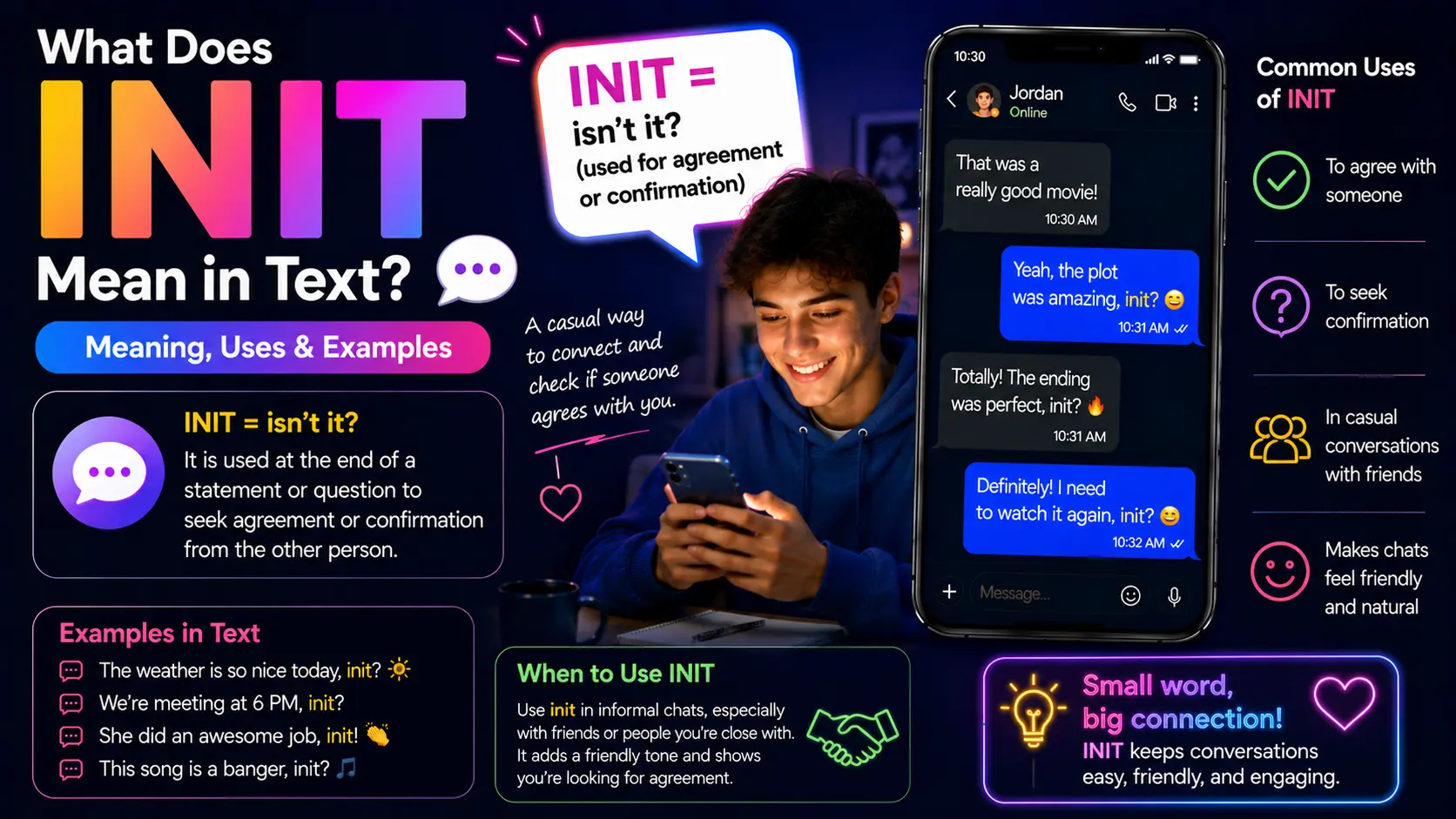
Init is an informal slang spelling of “isn’t it?” It is commonly used at the end of a sentence to ask for agreement or confirm that someone feels the same way.
Rather than asking a serious question, it usually invites the other person to agree.
Quick definition
- Means “isn’t it?”
- Used to seek agreement or confirmation
- Common in casual texting and online conversations
- Often expresses friendliness or shared opinion
- Best suited for informal situations
Examples
“This weather is perfect, init?”
“That song is stuck in everyone’s head, init?”
“Life feels easier after exams, init?”
In each example, the speaker isn’t looking for new information. They’re simply encouraging the other person to agree.
Origin and Background of “Init”
The word init didn’t begin on social media. It has much older roots in spoken English, especially in the United Kingdom.
Originally, people casually shortened the phrase “isn’t it?” during everyday conversations. Over time, the pronunciation became quicker until it sounded like a single word: init.
As texting became more popular, people started spelling it exactly as they said it. This transformed a spoken habit into an internet slang term.
British influence
Init has been widely used in British street slang for decades. Young people often added it to the end of sentences regardless of the original grammar.
For example:
- “You’re coming later, init?”
- “They’re really good, init?”
- “We had fun yesterday, init?”
Although traditional English grammar would normally change the question tag, informal speech often keeps “init” the same.
Influence of social media
Platforms such as TikTok, Instagram, Snapchat, and YouTube helped spread the expression beyond the UK.
People watching British creators began copying their speech patterns because they sounded casual, confident, and relatable.
Soon, users from different countries started including “init” in comments, captions, memes, and private chats.
How the meaning evolved
Originally, “isn’t it?” simply asked for confirmation.
Today, init can also express:
- Shared excitement
- Surprise
- Humor
- Frustration
- Sarcasm
- Strong agreement
Sometimes it doesn’t even expect a reply. Instead, it simply emphasizes the speaker’s opinion.
For example:
“This game is impossible, init.”
Here, the speaker is expressing frustration more than asking a question.
Real-Life Conversations
The easiest way to understand init is by seeing how real people naturally use it.
WhatsApp Conversation
Person A: I finally finished all my assignments.
Person B: Best feeling ever, init?
Person A: Honestly, I can finally relax.
Instagram DMs
Person A: That sunset picture looks unreal.
Person B: The colors are beautiful, init?
Person A: I couldn’t stop staring at it.
TikTok Comments
Person A: This creator always makes the funniest videos.
Person B: Literally never disappoints, init?
Person A: Every upload is worth watching.
Text Messages
Person A: I can’t believe summer is almost over.
Person B: Time flies so fast, init?
Person A: It feels like the holidays just started.
These conversations show that “init” usually creates a sense of connection. Instead of making a formal statement, it gently invites the other person to share the same feeling or opinion.
Emotional and Psychological Meaning
At first glance, init may seem like nothing more than casual slang. However, it often carries an emotional purpose that goes beyond the literal words. People use it because they want to feel understood, build rapport, or make a conversation sound warmer.
In many cases, adding init softens a statement. Instead of sounding like someone is forcing an opinion, it turns the sentence into an invitation for agreement.
For example:
“That was such a stressful week, init?”
The speaker is not only describing their experience. They are also hoping the other person relates to it.
What emotion does “init” express?
Depending on the situation, init can communicate different emotions, including:
- Agreement
- Excitement
- Relief
- Frustration
- Surprise
- Amusement
- Sympathy
- Shared understanding
The exact feeling comes from the rest of the sentence and the relationship between the people talking.
Why do people use it?
Modern digital communication is often short and fast. People want messages that feel natural rather than overly formal.
Adding init helps achieve that by making conversations sound:
- More friendly
- Less confrontational
- More conversational
- More relatable
- More emotionally connected
It also encourages the other person to respond instead of simply reading the message.
What it reveals about modern communication
Expressions like init show how people value connection over perfect grammar in casual conversations.
Instead of writing long explanations, they use small words that signal shared experiences and mutual understanding.
Social media has accelerated this habit. Short expressions travel quickly across cultures because they are easy to remember and instantly recognizable.
A personal-style scenario
Imagine you’ve been preparing for an important presentation all week. After finishing, you text your best friend:
“I’m so glad that’s over, init?”
Your friend immediately replies,
“Definitely. You worked so hard for it.”
That single word helped transform a simple update into a shared emotional moment.
Usage in Different Contexts
Although init is widely used online, it does not fit every situation equally well. Understanding where it sounds natural can help you communicate more confidently.
Social media
Social media is one of the most common places to see init.
People use it in:
- TikTok comments
- Instagram captions
- Snapchat messages
- YouTube comments
- Facebook posts
- X replies
Examples:
“This trend is everywhere, init?”
“Best concert ever, init?”
It creates a casual tone that encourages interaction.
Friends and relationships
Among friends, init often strengthens conversations because it feels relaxed and familiar.
Examples:
“We’ve known each other forever, init?”
“Pizza always fixes everything, init?”
It also appears in playful conversations between siblings, classmates, and close relatives.
Work and professional settings
Using init at work depends on the environment.
In relaxed conversations with close coworkers, it might occasionally sound natural.
Example:
“That meeting was longer than expected, init?”
However, it is usually better to avoid it in:
- Business emails
- Job interviews
- Formal presentations
- Client communication
- Professional reports
Standard English creates a more polished impression in these situations.
Casual versus serious tone
Init belongs firmly in casual communication.
It works well when talking with:
- Friends
- Family
- Classmates
- Gaming communities
- Social media followers
It becomes less appropriate during serious discussions involving:
- Legal matters
- Medical issues
- Academic writing
- Official announcements
- Workplace policies
Choosing the right tone helps ensure your message is understood as intended.
When Not to Use It
Even popular slang has limits. Knowing when not to use init can prevent misunderstandings and help you communicate respectfully.
Formal communication
Avoid using init in:
- Business emails
- College assignments
- Research papers
- Official letters
- Government documents
Formal writing values clear grammar over conversational slang.
Speaking with people unfamiliar with the expression
Not everyone recognizes British slang.
Someone from another country may mistake init for:
- A typo
- A technical abbreviation
- A random internet word
If you’re unsure whether someone understands it, writing “isn’t it?” is often the safer choice.
Sensitive conversations
During emotional or serious discussions, slang can sometimes make you sound less sincere.
For example:
Instead of writing,
“Everything will be okay, init?”
A more thoughtful message might be,
“Everything will be okay. I’m here if you need me.”
The second version feels more supportive.
Cultural differences
Because init is strongly associated with British English, people in other regions may not naturally use it.
Overusing it can sound forced if it isn’t part of your normal speaking style.
Using language that matches your audience is usually the best approach.
Common Misunderstandings
Although init is simple once you know it, newcomers often misunderstand its purpose.
Mistaking it for an abbreviation
Some people think each letter stands for separate words.
In reality, init is simply a phonetic spelling of “isn’t it?”
Assuming it always asks a question
Not every sentence ending with init expects an answer.
Sometimes it simply emphasizes a feeling.
Example:
“That’s absolutely brilliant, init.”
The speaker is expressing enthusiasm more than requesting confirmation.
Confusing the tone
Tone depends on context.
The same phrase can sound:
- Friendly
- Funny
- Sarcastic
- Frustrated
- Supportive
Reading the surrounding conversation helps reveal the intended meaning.
Taking it literally
Traditional English grammar uses different question tags.
For example:
- You’re coming, aren’t you?
- She’s ready, isn’t she?
- They won, didn’t they?
In everyday slang, many speakers simply use init regardless of grammar because it has become a fixed informal expression.
Comparison Table
| Expression | Meaning | Tone | Common Usage |
|---|---|---|---|
| Init | Isn’t it? Used to seek agreement | Casual | Texts, social media, conversations |
| Right? | Asking someone to agree | Friendly | Everyday speech and messaging |
| You know? | Checking understanding | Conversational | Casual discussions |
| Exactly | Strong agreement | Positive | Chats and online comments |
| True | Agreeing with a statement | Relaxed | Text messages and social apps |
| For real | Expressing genuine agreement or surprise | Informal | Gen Z conversations |
| Seriously? | Showing disbelief or emphasis | Emotional | Casual conversations |
| No way | Expressing surprise or disbelief | Informal | Friends and social media |
Key Insight
While init, right?, and you know? all encourage agreement, init has a distinctly conversational style that reflects British slang and modern internet culture. It often feels more playful and informal, making it a natural fit for friendly chats rather than formal communication.
Variations and Related Types of “Init”
Like many internet expressions, init appears alongside several related words and phrases. While they are not always identical in meaning, they serve a similar purpose by making conversations feel more natural and interactive.
1. Isn’t it?
Meaning: The standard English version of “init.”
Example: “It’s a beautiful day, isn’t it?”
2. Innit
Meaning: The most common alternative spelling of init.
Explanation: “Innit” is especially popular in British English and is widely seen on social media.
3. Right?
Meaning: Used to invite agreement.
Example: “That was the best episode, right?”
4. You know?
Meaning: Checks whether the listener understands or relates.
Example: “It was awkward, you know?”
5. True
Meaning: A quick way to show agreement.
Example: “True, I was thinking the same thing.”
6. Exactly
Meaning: Strong agreement with someone’s opinion.
Example: “Exactly. That’s what I meant.”
7. For real
Meaning: Shows genuine agreement or emphasizes sincerity.
Example: “For real, that movie was incredible.”
8. Facts
Meaning: Modern slang that means a statement is completely true.
Example: “Facts. Everyone knows that.”
9. No cap
Meaning: Means someone is being completely honest.
Example: “No cap, that restaurant is amazing.”
10. Literally
Meaning: Adds emphasis to a statement, even when used informally.
Example: “I literally laughed the whole time.”
These expressions all help conversations sound more engaging, but each carries its own style and level of emphasis.
How to Respond When Someone Uses “Init”
When someone ends a sentence with init, they are often looking for agreement or a friendly reaction. Your response can match the mood of the conversation.
Casual replies
- “Yeah, definitely.”
- “I know.”
- “You’re right.”
- “Absolutely.”
- “Same here.”
Funny replies
- “Only on Mondays.”
- “Don’t expose me like that.”
- “You read my mind.”
- “Now you’re just stating facts.”
- “I can’t even argue with that.”
Mature replies
- “I completely understand your point.”
- “That’s a fair observation.”
- “I agree with you.”
- “That makes perfect sense.”
- “I can see why you feel that way.”
Respectful replies
- “Yes, I agree.”
- “Thanks for pointing that out.”
- “That’s a good perspective.”
- “I appreciate your opinion.”
- “You’re absolutely right.”
The best response depends on your relationship with the other person and the overall tone of the conversation.
Regional and Cultural Usage
Although init originated in British English, its popularity has expanded far beyond the United Kingdom.
Western culture
In the UK, init is part of everyday informal speech for many people, particularly among younger generations.
In countries like the United States and Canada, it is less common in daily conversation. However, many people recognize it through online videos, music, gaming communities, and social media.
Asian culture
Many young people across Asia encounter init through English-language content on TikTok, Instagram, YouTube, and streaming platforms.
It is usually understood as internet slang rather than a phrase used in everyday local speech.
Middle Eastern culture
English-speaking young adults in the Middle East may use init while chatting online with international friends.
In most cases, it appears in digital conversations rather than face-to-face communication.
Global internet usage
The internet has blurred regional language boundaries.
Today, someone in London, Dubai, Karachi, Singapore, or Sydney may recognize init simply because they spend time on the same social platforms.
This shared online culture has helped many regional expressions become part of global digital language.
Gen Z vs. Millennials
Gen Z
Gen Z tends to embrace evolving internet slang quickly.
Many use init naturally in comments, captions, gaming chats, and group conversations.
Millennials
Millennials are generally more familiar with traditional English forms such as “isn’t it?” or “right?”
Those who actively use social media are more likely to understand init, even if they don’t use it themselves.
Is “Init” Safe for Kids?
Yes. Init is generally considered safe for children and teenagers.
It does not contain offensive language, inappropriate content, or hidden meanings.
However, parents and educators should encourage young people to understand the difference between informal slang and standard English.
Using init while chatting with friends is perfectly acceptable, but school assignments, exams, and formal writing should use proper grammar instead.
Learning when to switch between casual and formal language is an important communication skill.
Frequently Asked Questions
What does “init” mean in text?
It means “isn’t it?” and is used to ask for agreement or confirmation in casual conversations.
Is “init” the same as “innit”?
Yes. They have the same meaning. Innit is simply the more common spelling in British slang.
Is “init” rude?
No. It is generally friendly and informal. The tone depends on the rest of the conversation.
Can I use “init” in professional emails?
No. It is best to avoid slang in professional or formal communication.
Why do people say “init” instead of “isn’t it”?
It reflects natural spoken language and makes conversations feel quicker, more relaxed, and conversational.
Is “init” only used in the UK?
No. While it began in British English, social media has introduced it to people around the world.
Does “init” always require an answer?
Not always. Sometimes it simply emphasizes a shared feeling or opinion rather than asking a genuine question.
Conclusion
If you’ve ever wondered what does init mean in text, the answer is surprisingly simple. It is an informal way of saying “isn’t it?” and is used to invite agreement, express shared feelings, or make conversations sound more relaxed.
What makes init interesting is not just its meaning but the role it plays in modern communication. It reflects how language adapts to faster conversations, online communities, and changing cultural influences. A single word can make a message feel warmer, friendlier, and more personal.
Like any slang expression, context matters. It works best in conversations with friends, family, classmates, and social media communities. In formal situations, standard English remains the better choice.
The more you understand expressions like init, the easier it becomes to follow online conversations and connect with people from different backgrounds. Instead of feeling confused the next time you see it in a text or comment, you’ll know exactly what the speaker is trying to say and how to respond naturally.