
If you have ever received a message that simply says “JP” and paused for a second wondering what it meant, you are not alone.
Modern texting culture moves quickly. New abbreviations appear across social media, messaging apps, and online communities every day. Some are obvious, while others leave people confused because they can carry different meanings depending on context.
The phrase “JP” is one of those abbreviations that often causes uncertainty. One person may use it casually in a joke, while another may use it in a completely different way during conversation. That is why many people search for what does JP mean in text before replying.
Understanding slang matters because digital communication removes tone, facial expressions, and body language. A small abbreviation can completely change how a message feels.
In this guide, you will learn what JP means in texting, where it comes from, how people use it in real conversations, emotional meaning, cultural differences, and how to respond naturally.
What Does JP Mean in Text? Quick Meaning
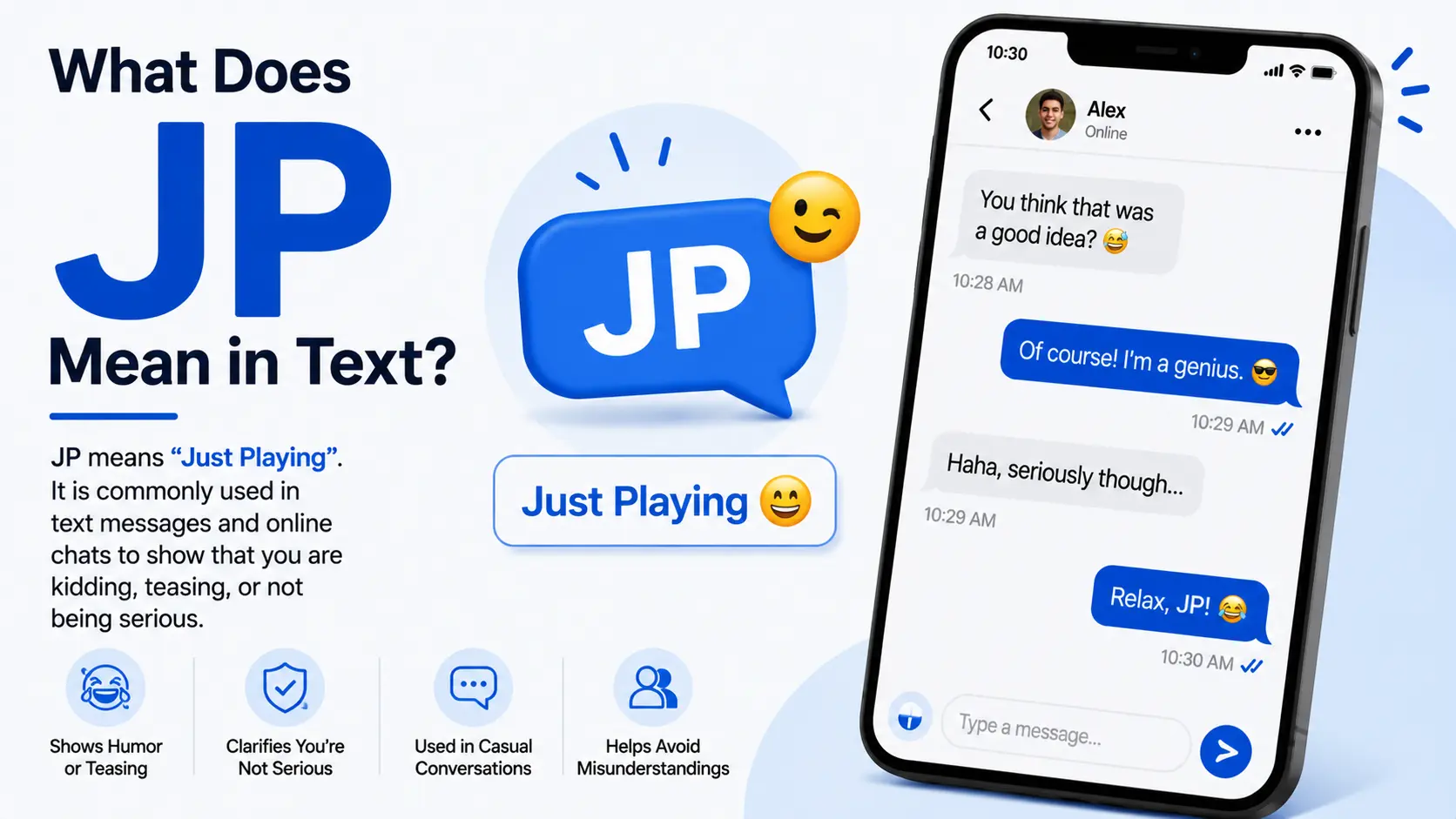
In texting, JP usually means “Just Playing.”
People use it to show that something they said was a joke, teasing comment, or playful remark.
It helps soften a message and lets the other person know not to take the statement seriously.
Quick Definition
- JP = Just Playing
- Used after jokes or teasing comments
- Often appears in casual conversations
- Common in texting, social media, and chats
- Helps prevent misunderstandings
Simple Examples
“You better stop ignoring me. JP 😂”
“I was gonna block you for that. JP.”
“You owe me lunch forever. JP lol.”
In these examples, “JP” acts as emotional clarification. It signals humor and removes tension.
Origin & Background of JP in Texting
Text abbreviations became popular during the early era of mobile phones.
When texting had character limits and slow typing, people shortened phrases to save time.
Abbreviations like LOL, BRB, TBH, and IMO became part of online language. JP followed a similar path.
“Just Playing” grew naturally from spoken conversation.
In face-to-face interaction, people often say things like:
- “I’m kidding.”
- “Just joking.”
- “I’m only playing.”
Digital communication lacked vocal tone, so users began shortening playful clarifications into abbreviations.
JP became especially popular among younger users on:
- Text messaging apps
- Online gaming chats
- Social media captions
- Comment sections
- Teen and Gen Z conversations
As internet culture expanded, short emotional markers became necessary.
Without facial expressions, people needed ways to show sarcasm, friendliness, or humor.
JP became a quick emotional signal that reduced conflict and helped conversations stay lighthearted.
Social platforms such as entity[“mobile_app”,”Instagram”,”social media app”], entity[“mobile_app”,”Snapchat”,”messaging and social media app”], and entity[“mobile_app”,”TikTok”,”short-form video platform”] accelerated the spread of slang because trends moved quickly across communities.
Today, JP remains part of texting culture, though usage varies by age group and online environment.
Real-Life Conversations Using JP
Understanding slang becomes easier when you see it used naturally.
Here are realistic examples showing how JP appears in everyday digital communication.
WhatsApp Conversation
Person A: You seriously forgot my birthday?
Person B: No way, I could never forget.
Person A: I was about to get mad 😂 JP.
This example shows playful teasing rather than real anger.
Instagram DM Example
Person A: You looked too confident in those photos.
Person B: Too confident?
Person A: JP, you actually looked amazing.
Here, JP softens what might otherwise sound critical.
TikTok Comment Section
Person A: This dance challenge is impossible.
Person B: Only impossible for people with no rhythm 😅
Person A: Wow okay… JP haha.
The phrase avoids tension and keeps the interaction playful.
Text Message Example
Person A: You take forever to reply.
Person B: I was working.
Person A: I know, JP.
This creates emotional balance.
The sender avoids sounding demanding or upset.
Emotional & Psychological Meaning of JP
Text slang is rarely just about efficiency.
People use abbreviations because they communicate emotion.
JP often carries emotional intent beyond the literal words.
What Emotion Does JP Express?
- Playfulness
- Light teasing
- Humor
- Social comfort
- Emotional reassurance
JP tells someone:
“I am not trying to hurt you.”
This matters because text messages can easily feel harsher than intended.
Without tone of voice, even a simple joke can sound serious.
JP works as a social safety net.
It helps people joke without creating conflict.
Why People Use It
People often use JP because they want to:
- Keep conversations fun
- Avoid awkward misunderstandings
- Sound relaxed
- Reduce emotional tension
- Make teasing feel friendly
A Personal-Style Scenario
Imagine texting a close friend after they cancel plans.
You write:
“Wow, guess I’m not important anymore. JP.”
Without JP, the message might sound passive-aggressive.
With JP, it feels more playful and emotionally safe.
This tiny abbreviation changes the emotional direction of the conversation.
Usage in Different Contexts
JP does not work the same way everywhere.
Context matters.
Social Media
On social media, JP appears in comments, captions, and replies.
People use it to soften sarcasm or exaggeration.
Example:
“Best singer alive. JP 😂”
This makes the statement feel humorous rather than literal.
Friends & Relationships
Among friends, JP is very common.
It creates closeness.
People often tease those they feel comfortable around.
Example:
“You always steal my snacks. JP.”
In relationships, JP can lighten emotional conversations.
It allows playful flirting.
Example:
“You forgot our anniversary… JP, don’t panic.”
Work or Professional Settings
JP is less common in professional communication.
Business conversations rely on clarity.
Using slang can feel too casual.
Example of poor use:
“Your presentation was terrible. JP.”
Even with JP, this may feel inappropriate.
Professional settings often require direct communication without slang.
Casual vs Serious Tone
JP belongs in casual communication.
It works best when:
- Talking with friends
- Messaging someone close
- Commenting casually online
- Adding humor to conversation
It may not fit serious discussions involving:
- Emotional conflict
- Professional feedback
- Sensitive topics
- Important decisions
When NOT to Use JP
Like most slang, JP has limits.
Using it at the wrong moment can create confusion.
During Serious Conversations
If someone is upset or emotional, JP may seem dismissive.
Example:
“I guess your feelings don’t matter. JP.”
This can feel emotionally confusing.
In Professional Emails
Professional communication values clarity.
Slang may appear immature or unclear.
When Tone Is Already Misunderstood
If a conversation already feels tense, JP may not repair the situation.
Some people may think you are hiding behind humor.
With People Who Do Not Know Slang
Older family members or non-native English speakers may not understand the abbreviation.
They might assume it means something entirely different.
During Sensitive Topics
Avoid JP when discussing:
- Grief
- Mental health struggles
- Relationship conflict
- Serious apologies
- Workplace disagreements
Humor is not always appropriate.
Common Misunderstandings About JP
Many people assume JP always has one meaning.
That is not true.
Context matters.
Misunderstanding #1: Thinking It Means a Name
Some people believe JP refers to someone’s initials.
For example:
“JP said he’s coming.”
In this case, JP may simply be a person’s nickname.
Misunderstanding #2: Confusing It With “Just Pretending”
Some users interpret JP as “Just Pretending.”
Although possible in rare cases, “Just Playing” is much more common in texting.
Misunderstanding #3: Taking the Joke Seriously
Some people miss the emotional signal.
Without understanding JP, a playful comment may feel rude.
Misunderstanding #4: Assuming It Is Always Positive
JP softens tone, but context still matters.
A harsh comment followed by JP can still hurt.
Comparison Table
| Expression | Meaning | Tone | Common Usage |
|---|---|---|---|
| JP | Just Playing | Playful | Teasing or joking |
| JK | Just Kidding | Lighthearted | Clarifying humor |
| LOL | Laughing Out Loud | Positive | Humor or reaction |
| TBH | To Be Honest | Honest | Personal opinion |
| IDC | I Don’t Care | Neutral or cold | Disinterest |
| SRSLY | Seriously | Direct | Emphasis |
| No Cap | No Lie | Confident | Truthful statement |
| FR | For Real | Genuine | Agreement or honesty |
Key Insight
JP and JK are very similar, but JP often feels slightly more playful and casual. JK is more widely recognized, while JP may appear more personal or niche depending on the social group.
Variations and Related Types of JP
Text culture constantly evolves.
Here are related expressions and variations connected to playful texting.
1. JK
Meaning: Just Kidding
Used to clarify a joke.
2. JKS
Meaning: Jokes
A short way to say something was not serious.
3. LOL JK
Meaning: Laughing plus joking
Used for extra humor.
4. JP LOL
Meaning: Just Playing plus laughter
Makes teasing sound lighter.
5. Kidding
Meaning: Informal playful correction
A full-word version of JP.
6. Messing With You
Meaning: Teasing someone casually
Common among close friends.
7. Just Messing
Meaning: Friendly sarcasm
Softens comments.
8. I’m Playing
Meaning: Spoken version of JP
Often heard in casual speech.
9. No Offense
Meaning: Attempt to soften criticism
Different tone but similar purpose.
10. Relax, I’m Joking
Meaning: Clarifies humor directly
Used when misunderstanding happens.
How to Respond When Someone Uses JP
You do not always need a complicated reply.
Response depends on mood and relationship.
Casual Replies
- “Haha okay.”
- “You almost got me.”
- “I figured you were joking.”
- “Good one.”
Funny Replies
- “Too late, I already got offended 😂”
- “That almost started drama.”
- “I was ready to argue.”
- “You scared me for a second.”
Mature Replies
- “Glad you clarified.”
- “Text tone can be hard to read.”
- “I understand what you meant.”
Respectful Replies
- “Thanks for explaining.”
- “Got it.”
- “Makes sense now.”
The best response depends on your relationship and the emotional tone.
Regional & Cultural Usage
Text slang changes across cultures.
JP may be common in one region and unfamiliar in another.
Western Culture
In Western texting culture, JP is often used casually among teenagers and young adults.
Humor-driven communication is common.
People use slang to keep conversations relaxed.
Asian Culture
In many Asian countries, texting culture blends English abbreviations with local slang.
JP may appear among English-speaking online communities.
However, users may prefer emojis instead of abbreviation-based clarification.
Middle Eastern Culture
Texting slang varies widely.
English abbreviations are common among younger internet users.
JP may appear in bilingual conversations.
Global Internet Usage
Platforms like entity[“mobile_app”,”WhatsApp”,”messaging platform”], entity[“mobile_app”,”Facebook Messenger”,”messaging application”], and entity[“mobile_app”,”Discord”,”voice and messaging platform”] help slang spread internationally.
A phrase popular in one country can quickly appear worldwide.
Generational Differences
Gen Z
- Uses abbreviations frequently
- Comfortable with slang
- Understands shorthand quickly
Millennials
- Recognize common slang
- Use abbreviations selectively
- Prefer clarity over excessive shorthand
Older generations may not recognize JP immediately.
Is JP Safe for Kids?
Yes, JP is generally considered safe.
It usually means “Just Playing” and carries no harmful or inappropriate meaning.
However, context matters.
Children may misunderstand tone or use sarcasm without realizing emotional impact.
Parents and educators can encourage healthy communication by helping kids understand when playful language is appropriate.
Teaching tone awareness matters more than banning harmless slang.
Frequently Asked Questions
What does JP stand for in text?
JP usually stands for “Just Playing.” It shows that a message was meant as a joke.
Is JP the same as JK?
They are similar.
JP means “Just Playing,” while JK means “Just Kidding.” Both soften humor.
Is JP rude?
Not usually.
JP is often friendly and playful. Tone and context determine whether it feels positive.
Can JP mean something else?
Yes.
In some situations, JP may refer to initials, names, or niche meanings.
Do adults use JP?
Yes.
Although more common among younger users, adults also use JP in casual texting.
Is JP popular on social media?
Yes.
JP appears in comments, captions, memes, and conversations across social platforms.
Should I use JP in professional messages?
Generally no.
Professional communication works better with clear wording instead of slang abbreviations.
Conclusion
Understanding what does JP mean in text helps you avoid confusion in modern communication.
Most commonly, JP means “Just Playing.”
It adds humor, reduces tension, and makes playful comments feel safer.
Small abbreviations often carry emotional meaning.
They help people communicate tone in a world where facial expressions and voice are missing.
JP may seem like a tiny piece of slang, but it reveals something important about digital language.
People want connection, humor, and emotional clarity.
The next time you see JP in a message, you will know it is usually a sign that the sender wants to keep things lighthearted.
Understanding slang is not just about definitions.
It is about understanding people.