
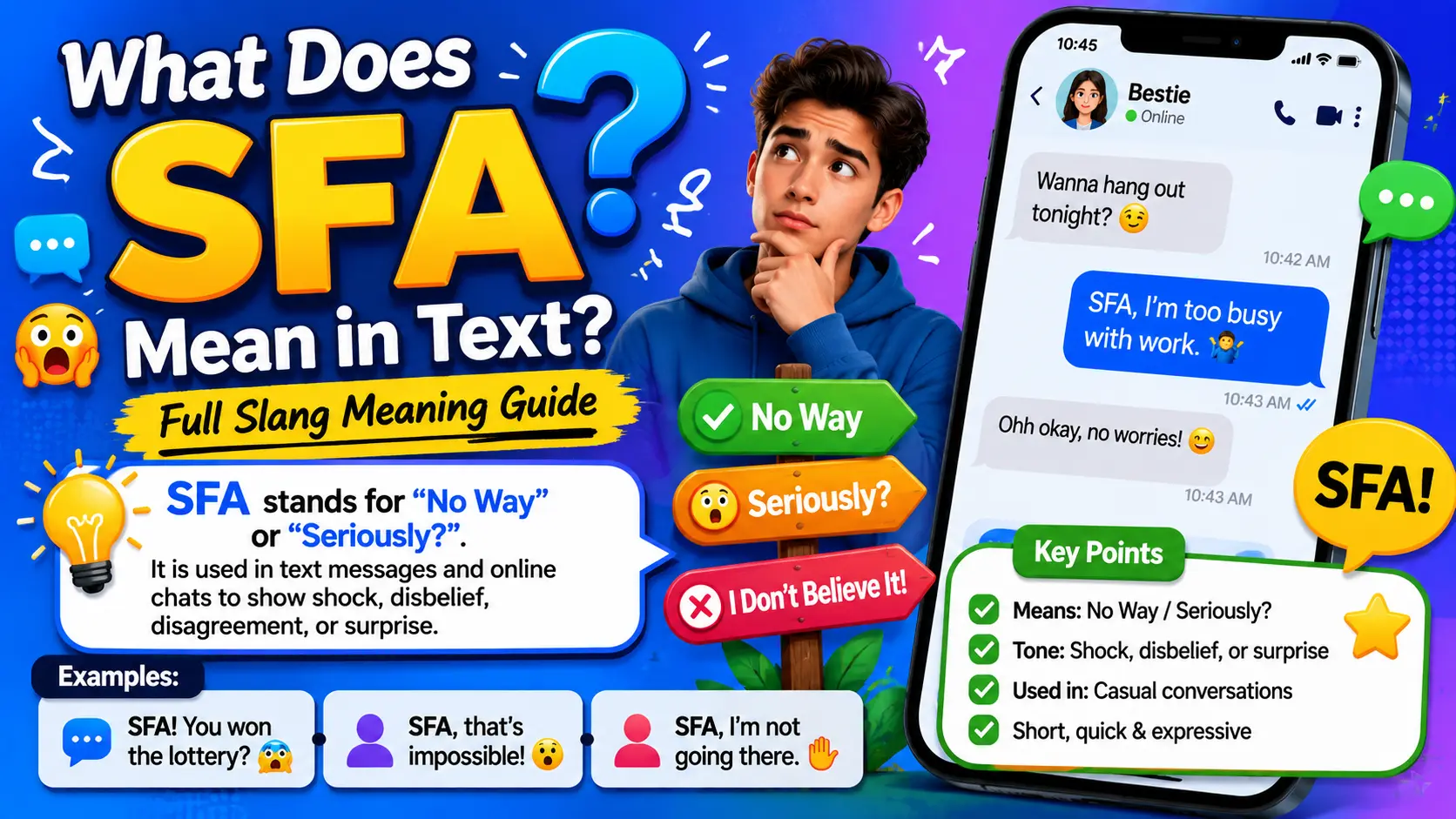
If you have ever received a message saying “SFA” and instantly felt confused, you are definitely not alone. Internet slang changes fast, and abbreviations like this often carry meanings that depend heavily on tone, context, and relationship dynamics.
The phrase “what does SFA mean in text” has become increasingly searched because people see it in TikTok comments, Snapchat conversations, gaming chats, and private messages without fully understanding what the sender actually means.
In most cases, SFA is used casually, but depending on the situation, it can sound humorous, dismissive, sarcastic, or even slightly aggressive. That uncertainty is exactly why many people look it up before replying.
This guide breaks down the true meaning of SFA, where it came from, how people actually use it in real conversations, and when you should avoid using it altogether.
SFA Meaning in Text – Quick Meaning
SFA usually stands for:
“Sweet F* All”**
It is a slang phrase used to mean:
- Nothing
- Very little
- Absolutely zero
- No meaningful result
People often use it when they are frustrated, disappointed, sarcastic, or joking about getting nothing from a situation.
Simple Examples
“I studied all night and learned SFA.”
“He promised to help but did SFA.”
“My paycheck covered SFA after bills.”
In texting culture, SFA is often used to exaggerate disappointment in a funny or relatable way.
Origin & Background of SFA
SFA has roots in British and Irish slang culture. Long before social media existed, people in everyday conversation used the phrase “sweet f*** all” to describe situations where something produced no real outcome.
The word “sweet” in this expression is ironic. Instead of meaning pleasant or nice, it intensifies the emptiness of the result.
Over time, the phrase spread through:
- Online gaming communities
- British comedy culture
- Internet forums
- Twitter and Reddit conversations
- TikTok captions and memes
As texting culture became shorter and faster, people reduced the phrase to simply “SFA.”
Today, many younger users encounter it online without knowing its original cultural background.
Social media helped transform SFA from regional slang into a globally recognized internet abbreviation.
Real-Life Conversations Using SFA
WhatsApp Conversation
Person A:
Did your manager approve the raise?
Person B:
Nope. After three meetings, I got SFA.
Instagram DM
Person A:
How was the party last night?
Person B:
Honestly? SFA happened. Everyone just sat around on their phones.
TikTok Comments
Person A:
This tutorial helped me achieve SFA 😂
Person B:
Same. I’m still confused.
Text Message
Person A:
Did the delivery guy bring your package?
Person B:
Nah. Waited all day for SFA.
Group Chat Example
Person A:
How much sleep did everyone get before exams?
Person B:
About SFA hours.
These examples show how flexible the phrase can be. Sometimes it sounds funny. Other times it reflects genuine annoyance or exhaustion.
Emotional & Psychological Meaning of SFA
SFA is more than just slang for “nothing.” It often carries emotional weight.
People use it when they want to express:
- Frustration
- Disappointment
- Sarcasm
- Emotional burnout
- Cynical humor
- Resignation
In modern digital communication, exaggeration helps people bond emotionally. Saying “I got nothing” feels flat. Saying “I got SFA” sounds more expressive, dramatic, and relatable.
It also reflects how internet culture values emotional shorthand. One abbreviation can instantly communicate mood, attitude, and personality.
A Realistic Scenario
Imagine spending weeks preparing for a big opportunity, only to receive no response at all. Instead of typing a long emotional paragraph, many people simply text:
“All that effort for SFA.”
That short phrase communicates disappointment, fatigue, and sarcasm at the same time.
This is why slang like SFA survives. It condenses emotional experience into a quick, socially recognizable expression.
Usage of SFA in Different Contexts
Social Media
On platforms like TikTok, Reddit, Instagram, and X, SFA is often used humorously.
Examples include:
- “I cleaned my room for SFA because it got messy again.”
- “Downloaded the update and it changed SFA.”
People use it to make frustration feel entertaining.
Friends & Relationships
Among friends, SFA usually sounds casual and playful.
Example:
“He texted me all day and said SFA important.”
In relationships, though, tone matters. Used carelessly, it can sound dismissive or emotionally cold.
Work or Professional Settings
SFA is generally inappropriate in professional communication because it contains implied profanity.
Avoid using it in:
- Emails
- Workplace chats
- Client communication
- Academic writing
Even if abbreviated, many people still recognize the original phrase behind it.
Casual vs Serious Tone
Casual Tone
“I learned SFA from that class.”
Sounds humorous or sarcastic.
Serious Tone
“The investigation uncovered SFA.”
Could sound harsh or disrespectful depending on the context.
Tone depends heavily on audience familiarity and emotional atmosphere.
When NOT to Use SFA
There are situations where using SFA can create confusion or offense.
Around Older Audiences
Many older users may not understand the abbreviation or may find it vulgar once explained.
In Professional Communication
Even abbreviated profanity can damage professionalism.
Avoid it in:
- Job interviews
- Business emails
- Customer support
- School assignments
During Emotional Conversations
If someone is upset or vulnerable, replying with SFA may appear insensitive.
Example:
Bad response:
“Your apology meant SFA.”
This can escalate conflict quickly.
Cross-Cultural Communication
Not every culture interprets sarcasm the same way. In some places, direct slang expressions can sound more offensive than intended.
Common Misunderstandings About SFA
People Think It Means Something Positive
Because of the word “sweet,” some users assume SFA has a positive meaning.
In reality, it usually means the opposite.
Confusion With Financial or Technical Terms
In some industries, SFA can also stand for:
- Sales Force Automation
- Single Factor Authentication
- Software Functional Analysis
This is why context matters heavily.
Tone Misreading
Text messages remove facial expressions and vocal tone. What feels funny to one person may sound rude to another.
Example:
“That helped SFA.”
Could sound playful or insulting depending on the relationship.
Comparison Table
| Expression | Meaning | Tone | Similarity to SFA |
|---|---|---|---|
| SFA | Absolutely nothing | Sarcastic | Direct meaning |
| Nada | Nothing | Lighthearted | Softer version |
| Zilch | Zero | Playful | Less aggressive |
| Nothing at all | Complete absence | Neutral | Formal equivalent |
| NFA | No further action | Professional | Different context |
| IDC | I don’t care | Detached | Emotionally different |
| Barely anything | Very little | Mild | Less dramatic |
| Jack squat | Nothing | Informal | Very similar |
Key Insight
SFA stands out because it mixes humor with emotional intensity. Unlike softer phrases such as “nothing much” or “barely anything,” SFA usually emphasizes frustration or disappointment.
Variations and Types of SFA Usage
1. “Got SFA”
Means receiving nothing.
Example:
“Worked overtime and got SFA.”
2. “Learned SFA”
Means learning very little.
Example:
“That lecture taught me SFA.”
3. “Did SFA”
Means someone contributed nothing.
Example:
“My teammate did SFA during the project.”
4. “Absolutely SFA”
Adds stronger emphasis.
Example:
“There was absolutely SFA in the fridge.”
5. “Pretty Much SFA”
Softer version meaning almost nothing.
Example:
“I slept pretty much SFA last night.”
6. “Know SFA”
Means having no knowledge about something.
Example:
“I know SFA about cars.”
7. “Worth SFA”
Means something has little value.
Example:
“This old phone is worth SFA now.”
8. “Achieved SFA”
Means effort produced no result.
Example:
“Spent months training and achieved SFA.”
9. “Found SFA”
Means discovering nothing useful.
Example:
“Searched the whole house and found SFA.”
10. “SFA Energy”
A modern meme-style expression implying laziness or lack of motivation.
Example:
“I woke up with SFA energy today.”
How to Respond When Someone Uses SFA
Casual Replies
- “That’s rough 😂”
- “Classic.”
- “Sounds about right.”
Funny Replies
- “At least you got experience.”
- “SFA is basically my life story.”
- “Achievement unlocked: absolutely nothing.”
Mature Replies
- “That must feel frustrating.”
- “Hopefully the next attempt goes better.”
- “I understand why you’re annoyed.”
Respectful Replies
- “Sorry things didn’t work out.”
- “That sounds disappointing.”
- “I hope things improve soon.”
Choosing the right response depends on emotional tone, friendship level, and context.
Regional & Cultural Usage of SFA
Western Culture
SFA is most common in the UK, Ireland, Australia, and parts of online American culture.
British humor especially embraces sarcastic slang expressions like this.
Asian Culture
In many Asian countries, younger internet users understand SFA through gaming, memes, and social media exposure.
However, older generations may not recognize it at all.
Middle Eastern Culture
Usage is less common offline but increasingly visible among English-speaking online communities.
Tone sensitivity matters more in conservative environments.
Global Internet Usage
Online gaming and meme culture helped standardize SFA globally.
Platforms spreading the term include:
- Discord
- TikTok
- Twitch
Gen Z vs Millennials
Gen Z
Uses SFA more casually and humorously.
Often paired with memes, emojis, and exaggerated storytelling.
Millennials
More likely to use it sarcastically in reaction to work stress, adult responsibilities, or disappointment.
Generational context shapes emotional delivery.
Is SFA Safe for Kids?
SFA contains implied profanity, even though abbreviated.
Older teens may encounter it frequently online, especially in gaming and meme communities.
Parents and educators should understand that while it is not the harshest slang term online, it still carries adult language undertones.
Context matters greatly.
A casual meme usage is different from aggressive or disrespectful communication.
Frequently Asked Questions
What does SFA stand for in texting?
SFA usually stands for “Sweet F*** All,” meaning absolutely nothing or very little.
Is SFA rude?
It can be mildly vulgar because it references profanity indirectly. Tone and context determine how offensive it sounds.
Do Americans use SFA?
It is more common in British and Australian slang, but internet culture has spread it globally, including the United States.
Can SFA mean something else?
Yes. In business or technology, SFA may also stand for terms like Sales Force Automation or Single Factor Authentication.
Is SFA popular on TikTok?
Yes. TikTok users often use SFA in captions, comments, and memes to express disappointment humorously.
Should I use SFA at work?
Generally no. Even abbreviated slang with implied profanity can appear unprofessional.
Why do people use abbreviations like SFA?
People use shorthand slang to communicate emotion quickly, add humor, and feel socially connected in digital conversations.
Conclusion
Understanding what SFA means in text helps decode a common piece of modern internet slang that carries much more emotion than the word “nothing” alone.
At its core, SFA expresses frustration, disappointment, sarcasm, or humorous resignation. Its popularity comes from how efficiently it captures modern emotional communication in just three letters.
Like many internet expressions, context matters. Used among friends, it can feel funny and relatable. Used in the wrong setting, it may sound rude or insensitive.
The key is understanding tone, audience, and intention.
Once you recognize how people use SFA in real conversations, you will start noticing it everywhere across social media, texting culture, gaming chats, and meme communities. And the next time someone messages “I got SFA,” you will immediately understand exactly what they mean.