

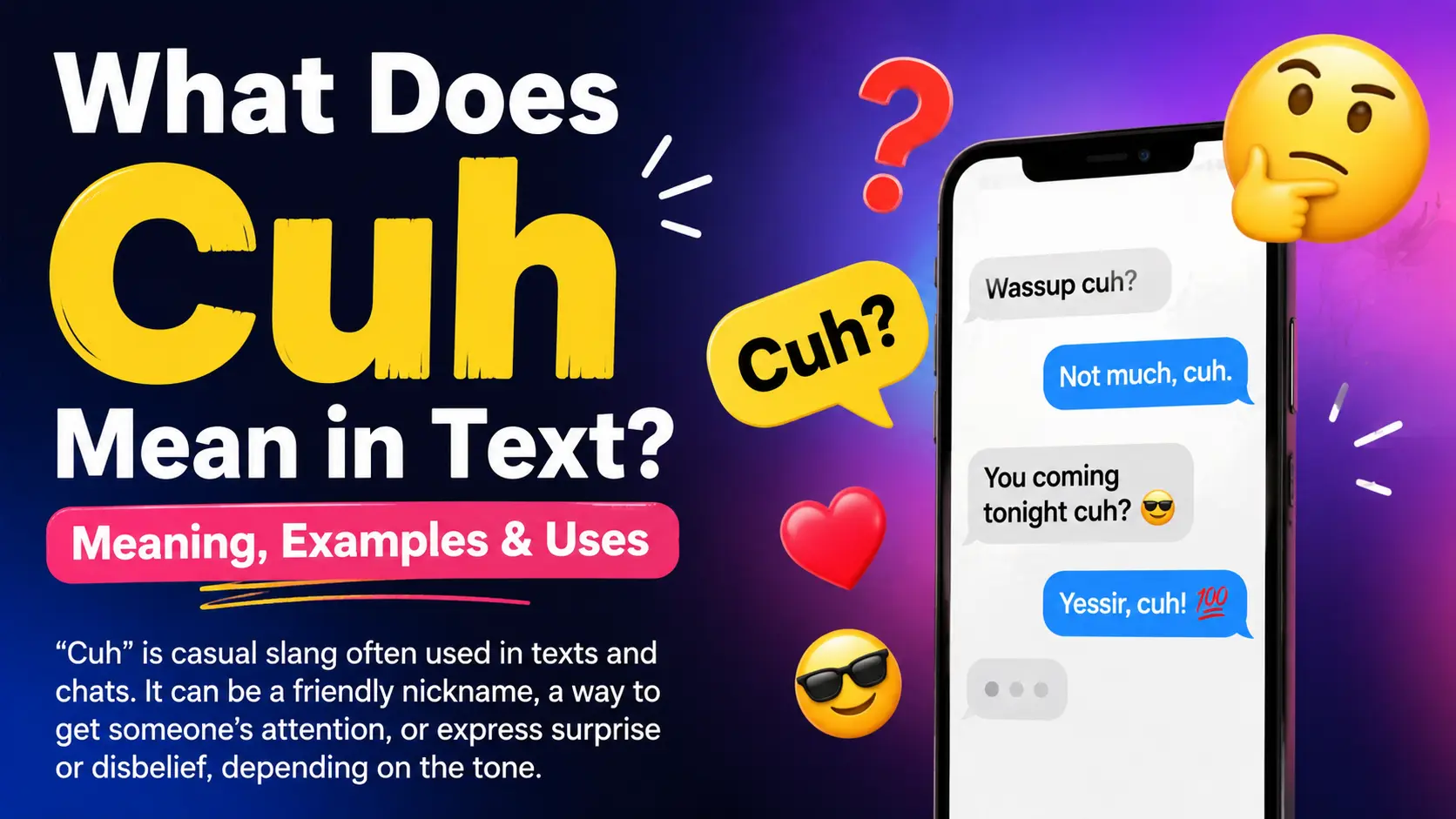
If you’ve spent any time on TikTok, Snapchat, Instagram, or texting with younger friends, you’ve probably seen someone write “cuh.” At first glance, it can be confusing. Is it someone’s name? A typo? Or does it actually mean something?
The truth is that “cuh” is a popular internet slang term used as a casual way to address someone. Depending on the conversation, it can express friendship, excitement, surprise, or even mild frustration. Like many modern slang words, its meaning changes slightly based on the relationship between the people talking and the tone of the message.
People search for “what does cuh mean in text” because the word appears everywhere online. From funny TikTok videos to gaming chats and Instagram comments, it has become part of everyday digital conversations. If you’re unfamiliar with the slang, it’s easy to misunderstand what someone is trying to say.
In this guide, you’ll learn exactly what cuh means, where it came from, how people use it in real conversations, and when it’s appropriate to use. You’ll also discover why this simple three-letter word has become such a recognizable part of online communication.
Cuh Meaning in Text: Quick Definition
In text messages and social media, cuh is an informal way of saying “cousin,” “bro,” “friend,” or “buddy.” Most people use it as a friendly nickname rather than referring to an actual family member.
Its meaning depends on the conversation, but it almost always signals familiarity and closeness.
Quick facts
- Meaning: Friend, bro, buddy, cousin
- Tone: Casual, friendly, playful
- Common on: TikTok, Instagram, Snapchat, Discord, gaming chats, text messages
- Best used with: Close friends and people who understand internet slang
Examples
“What’s good, cuh?”
“You coming tonight, cuh?”
“Relax, cuh. It was just a joke.”
In each example, cuh replaces words like bro, dude, or my friend, making the conversation sound more relaxed and personal.
Origin and Background of “Cuh”
Like many popular slang terms, cuh did not begin on social media. Its roots can be traced back to spoken language within communities where “cousin” was shortened into a casual nickname.
Over time, the pronunciation evolved into “cuh.” Friends began using it even when they weren’t actually related. Calling someone “cuh” became another way of saying that the person belonged to your circle.
As hip-hop culture grew in popularity, many regional slang expressions reached a wider audience. Music, street culture, online gaming, and viral videos all helped spread the word beyond its original communities.
Then came social media.
Platforms like TikTok, Instagram Reels, YouTube Shorts, and Snapchat introduced millions of users to slang that previously stayed within specific regions. Content creators used cuh naturally in jokes, reaction videos, and conversations, encouraging viewers to adopt the term in their own messages.
Today, many teenagers and young adults use cuh without even knowing where it originally came from. For them, it simply feels like another friendly way to greet someone online.
Cultural influence
Modern internet culture constantly creates and reshapes language. Words become popular because they sound natural, entertaining, or relatable.
“Cuh” fits perfectly into this pattern because it is:
- Short and easy to type
- Friendly without sounding overly formal
- Flexible enough to fit many conversations
- Common in memes and viral content
Its popularity shows how online communities can transform local expressions into global slang within just a few years.
How the meaning evolved
Originally, the word referred more directly to “cousin.”
Today, it has expanded to include meanings such as:
- Close friend
- Trusted buddy
- Someone you’re comfortable talking to
- Playful way of getting someone’s attention
This evolution reflects how digital communication often values connection over literal definitions.
Real-Life Conversations Using “Cuh”
One of the easiest ways to understand slang is by seeing it in realistic conversations. Here are examples based on everyday texting and social media interactions.
WhatsApp Conversation
Person A: Yo, cuh, where you at?
Person B: Five minutes away. Save me a seat.
Person A: Bet. Don’t be late this time.
Instagram DM
Person A: Cuh, your vacation pictures are amazing.
Person B: Thanks! I finally got a chance to travel.
Person A: You definitely picked the perfect spot.
TikTok Comments
Person A: Cuh really finished that challenge in one try.
Person B: I watched it three times. That’s impressive.
Person A: He’s making it look way easier than it is.
Text Message
Person A: Cuh, thanks for checking on me yesterday.
Person B: Of course. I knew you were having a rough day.
Person A: I really appreciate it.
These conversations highlight something important. “Cuh” is rarely the main point of the message. Instead, it helps create a relaxed, friendly atmosphere. It tells the other person, “We’re comfortable with each other.”
That emotional connection is one reason the slang continues to thrive across texting, gaming communities, and social media platforms.
Emotional and Psychological Meaning of “Cuh”
Slang is about more than shortening words. It often carries emotion that standard language cannot express as naturally. That is exactly why cuh has become so popular.
When someone says “cuh,” they usually are not trying to sound formal. They are signaling comfort, trust, or a sense of belonging. The word creates an instant feeling of familiarity.
Depending on the situation, it can communicate different emotions.
Friendship
The most common emotion behind cuh is friendship. It tells the other person they are part of your circle.
Example:
“Good to see you again, cuh.”
The message feels warmer than simply saying “Good to see you.”
Excitement
People also use it when they are excited or impressed.
Example:
“Cuh, you actually won!”
The slang adds energy and makes the reaction sound genuine.
Encouragement
Sometimes it helps comfort a friend.
Example:
“You got this, cuh.”
The message feels supportive without sounding overly serious.
Playful Frustration
Friends often tease each other using the word.
Example:
“Cuh, why are you always late?”
Although it points out a problem, the tone usually stays lighthearted.
A Personal-Style Scenario
A few years ago, I noticed how younger relatives greeted each other online. Instead of saying “hello” or using each other’s names, they simply wrote, “Yo, cuh.”
At first, it sounded unusual. After watching their conversations, it became clear that the word wasn’t replacing a name. It was replacing emotional distance. It made conversations feel relaxed before they even began.
That is one reason slang like cuh continues to spread. It helps people feel connected with very little effort.
Using “Cuh” in Different Contexts
Although cuh usually means the same thing, the way people use it changes depending on the setting.
On Social Media
TikTok, Instagram, Snapchat, and X are filled with casual conversations where cuh feels completely natural.
Examples include:
- “That’s crazy, cuh.”
- “You nailed it, cuh.”
- “Come back with Part 2, cuh.”
Here, the word helps create a friendly community atmosphere.
Between Friends
This is where cuh appears most often.
Close friends use it instead of:
- Bro
- Dude
- Buddy
- Homie
It makes conversations feel casual and relaxed.
In Relationships
Some couples jokingly call each other cuh, especially if both enjoy internet humor or Gen Z slang.
For example:
“Cuh, you forgot our movie night.”
In this situation, the word feels playful rather than romantic.
However, every relationship is different. Some people enjoy slang, while others prefer more personal nicknames.
Gaming Communities
Gamers frequently use cuh during multiplayer matches.
Examples include:
- “Nice play, cuh.”
- “Cover me, cuh.”
- “GG, cuh.”
The fast pace of gaming encourages short, recognizable expressions.
Professional Settings
This is one place where you should avoid using cuh.
Sending messages like these is usually inappropriate:
- “Morning, cuh.”
- “Thanks, cuh.”
- “Can you review this report, cuh?”
Most workplaces expect respectful and professional language.
Instead, use:
- Hi
- Hello
- Thanks
- Appreciate it
- Good morning
Professional communication should always match the environment.
Casual Versus Serious Conversations
Casual
“Cuh, let’s grab burgers tonight.”
This sounds friendly and natural.
Serious
“I appreciate your support during this difficult time.”
Using cuh here might make an emotional conversation feel less sincere unless you know the other person well.
Always think about the mood before using slang.
When Not to Use “Cuh”
Although cuh is harmless in many situations, it is not suitable everywhere.
Understanding when to avoid it can help prevent awkward moments.
During Job Interviews
Professional conversations require respectful language.
Calling an interviewer “cuh” may seem immature or disrespectful.
Formal Emails
Business emails should avoid internet slang.
Instead of:
“Thanks, cuh.”
Write:
“Thank you for your assistance.”
Speaking With Teachers or Professors
Unless they specifically encourage casual language, use respectful forms of address.
Good communication also means understanding your audience.
When Talking to Someone You Don’t Know
Some people may not recognize the slang.
Others could misunderstand your tone or think you are being overly familiar.
If you are unsure, choose more neutral language.
During Serious Discussions
Topics involving grief, illness, conflict, or important decisions usually require a more thoughtful tone.
Slang can accidentally reduce the seriousness of the conversation.
Around Different Cultural Groups
Not every country or generation uses internet slang in the same way.
Using cuh with someone unfamiliar with the expression could create confusion instead of connection.
Common Misunderstandings About “Cuh”
Internet slang often changes meaning depending on context, and cuh is no exception.
Here are some misunderstandings people commonly have.
Mistake 1: Thinking It Always Means “Cousin”
Although the word originally came from cousin, most people today use it for close friends.
Actual family relationships usually have nothing to do with it.
Mistake 2: Assuming It’s Offensive
Some people hear unfamiliar slang and assume it is an insult.
In most conversations, cuh is completely friendly.
Only the surrounding words determine whether the tone is positive or negative.
Mistake 3: Using It With Everyone
Not everyone enjoys internet slang.
Older relatives, teachers, managers, or clients may find it confusing.
Knowing your audience is an important communication skill.
Mistake 4: Believing It Is Only a TikTok Word
TikTok helped make cuh more popular, but the expression existed long before short-form videos became popular.
Social media accelerated its growth rather than creating it.
Mistake 5: Ignoring Tone
Consider these two examples:
“Cuh, you’re the best.”
“Cuh, what were you thinking?”
The same word appears in both messages, but the emotions are completely different.
That is why context always matters more than the slang itself.
Comparison Table
| Expression | Meaning | Typical Tone | Best Used With |
|---|---|---|---|
| Cuh | Friend, bro, buddy | Casual, friendly | Close friends |
| Bro | Brother or close friend | Friendly | Friends and siblings |
| Dude | Casual way to address someone | Relaxed | Friends and acquaintances |
| Homie | Trusted friend | Loyal, supportive | Close friends |
| Fam | Close friend or group | Warm, inclusive | Friends and online communities |
| Bestie | Best friend | Affectionate | Close friends |
| Buddy | Friend or companion | Friendly, neutral | Casual conversations |
| Sir/Ma’am | Respectful form of address | Formal | Professional or polite settings |
Key Insight
While cuh, bro, dude, and homie all express familiarity, cuh often reflects modern internet culture and close-knit friendships. The best choice depends on your relationship with the other person and the setting. In casual conversations, it can make interactions feel more relaxed, but in professional or serious situations, standard language is usually the better option.
Variations and Similar Forms of “Cuh”
Like many slang terms, cuh has inspired several variations. Some are regional, while others simply reflect different texting styles.
1. Cuhh
A stretched version of cuh used to add emphasis or excitement.
Example: “Cuhh, that game was insane!”
2. Cuz
A shortened form of cousin or because, depending on context. When used as a nickname, it has a similar friendly feel to cuh.
3. Cuzzo
A playful variation that means close friend or cousin.
Example: “What’s up, cuzzo?”
4. Bro
One of the most common alternatives. It refers to a friend rather than an actual brother.
5. Bruh
A popular internet expression that often shows surprise, disbelief, or mild frustration.
Example: “Bruh, did that really happen?”
6. Homie
A term for a loyal and trusted friend.
It often suggests a long-lasting friendship.
7. Fam
Originally meaning family, it is now widely used for close friends or a trusted group.
8. Dawg
A casual nickname that expresses friendship and respect.
It appears frequently in sports, music, and gaming communities.
9. Twin
A newer Gen Z expression for someone you feel especially close to, even if you are not related.
Example: “That’s my twin.”
10. Gang
Often used as a friendly way to address one person or a group of friends.
Example: “What’s good, gang?”
These variations all serve a similar purpose. They create a sense of closeness and make conversations feel more relaxed.
How to Respond When Someone Says “Cuh”
The best response depends on the tone of the conversation and your relationship with the person.
Casual Replies
- “What’s up?”
- “Not much. You?”
- “Hey! How’s it going?”
- “Good to see you.”
Funny Replies
- “Only if snacks are included.”
- “You finally remembered me?”
- “What’s the mission today?”
- “You always show up with something interesting.”
Mature Replies
- “I’m doing well. Hope you are too.”
- “Thanks for checking in.”
- “I appreciate the message.”
- “Let’s catch up soon.”
Respectful Replies
- “Hello! Hope everything is going well.”
- “Nice hearing from you.”
- “Thanks for reaching out.”
- “Have a great day.”
There is no perfect response. Matching the other person’s energy usually makes conversations feel more natural.
Regional and Cultural Usage
Although cuh is widely recognized online, its popularity and meaning can vary across cultures and generations.
Western Culture
In the United States and parts of Canada, cuh is commonly associated with casual speech among younger people.
It often appears in social media posts, gaming chats, music culture, and everyday texting between friends.
Asian Culture
Many young people in countries such as the Philippines, Malaysia, Singapore, India, and South Korea learn slang through English-language content online.
Some may use cuh with international friends, but it is less common in offline conversations.
Local slang often remains the preferred choice.
Middle Eastern Culture
English internet slang continues to grow among younger users, especially those active on TikTok, Instagram, and online gaming.
However, cuh is still less familiar than expressions like bro or dude.
Using it with people who rarely engage with English internet culture may lead to confusion.
Global Internet Usage
Thanks to social media, regional slang now spreads faster than ever.
Someone in Brazil, Pakistan, Germany, Australia, or South Africa may recognize cuh simply from watching creators, gaming streams, or viral videos.
Its meaning has become increasingly global, even if its usage remains informal.
Gen Z vs. Millennials
Gen Z
Gen Z tends to adopt new slang quickly.
Many use cuh naturally in text messages, comments, and group chats.
For them, it feels like a normal part of online conversation.
Millennials
Many Millennials recognize the term but may prefer older expressions like bro, dude, or buddy.
Some use cuh, while others rarely include it in everyday speech.
The difference reflects how internet language evolves with each generation.
Is “Cuh” Safe for Kids?
In most situations, cuh is considered harmless slang. It is generally used as another way of saying “friend” or “bro.”
Even so, parents and educators should encourage children to understand context. A word that works well in a group chat with friends may not be suitable in school assignments, formal emails, or conversations with teachers and other adults.
Teaching children when to use casual language and when to choose more formal communication helps them build strong social and communication skills.
Frequently Asked Questions
What does “cuh” mean in text?
It usually means friend, bro, buddy, or cousin and is used as a casual way to address someone in online conversations.
Is “cuh” a bad word?
No. It is generally considered friendly slang. Like most informal expressions, its tone depends on the surrounding conversation.
Is “cuh” the same as “bro”?
They are very similar. Both are casual ways to refer to a friend, although cuh comes from the shortened form of cousin.
Why do people say “cuh” on TikTok?
TikTok creators often use modern slang to make videos sound natural and relatable. As trends spread, viewers begin using the same expressions in comments and messages.
Can I use “cuh” at work?
It is best to avoid it in professional settings. Use respectful greetings and standard language when communicating with coworkers, managers, or clients.
Does “cuh” always mean cousin?
No. While the word originated from cousin, it now usually refers to a close friend rather than an actual family member.
Is “cuh” still popular?
Yes. It continues to appear frequently in texting, gaming communities, social media posts, and short-form video platforms, especially among younger users.
Conclusion
Language changes constantly, and internet slang evolves even faster. Cuh is a great example of how a simple word can take on a new life through friendships, online communities, and popular culture.
Today, the term is most often used as a friendly way to say bro, buddy, or friend. It helps create a relaxed, informal tone and shows a sense of familiarity between people who know each other well.
The key to using cuh confidently is understanding your audience. It fits naturally in text messages, gaming chats, and social media conversations, but it is usually better to choose more professional language in formal situations.
As with any slang, context matters. When used appropriately, cuh can make conversations feel warmer, more personal, and more connected. Understanding not just the definition but also the emotion behind the word will help you communicate naturally in today’s digital world.